2027 Enterprise AI Workforce Planning Framework
A planning framework for CEOs, COOs, and Chief People Officers preparing enterprise AI workforce transformation, covering workforce role evolution, process redesign...
Abstract
This whitepaper presents a planning framework for enterprise executives preparing to integrate AI workforce capabilities by 2027. The framework covers four planning dimensions: workforce role evolution, process redesign priorities, risk and governance posture, and infrastructure readiness. It provides a readiness assessment structure, a phased planning timeline with governance gates, and a worked planning example for a 500-person enterprise.
This framework is intended for planning and internal decision-making purposes. It is not a prediction of AI capability trajectory, labor market outcomes, or business results. AI technology, regulatory environments, and organizational contexts vary significantly; this framework should be adapted to specific circumstances rather than applied as a universal prescription. Organizations should seek qualified legal, HR, and compliance counsel for decisions with regulatory or employment obligations.
Audience: CEOs, COOs, and Chief People Officers planning AI workforce transformation at enterprise scale.
Scope: Workforce role design, process redesign, governance design, and technology infrastructure. Excludes specific AI product selection, vendor negotiation, and technical implementation detail (see referenced resources for those topics).
Definitions and assumptions
AI workforce: AI agents, models, or systems that perform tasks previously performed by human employees or contractors, operating under defined governance rules and human oversight.
Human-AI workflow: A workflow in which AI performs defined task classes and humans perform escalation, exception handling, quality review, and high-judgment decisions.
AI workforce readiness: The state in which an organization has the role design, process documentation, governance policy, and technical infrastructure needed to deploy and operate AI workforce components safely.
Planning horizon: This framework uses 2027 as the planning horizon for a reason: it is far enough out to allow deliberate preparation, close enough to require decisions now. The framework is not a prediction that specific AI capabilities will be available or that organizations must deploy by 2027.
Key assumptions:
- AI workforce components require human oversight for consequential decisions. This framework does not assume autonomous AI for high-stakes actions.
- Regulatory environments for AI in employment and business operations are evolving. Plans must include governance adaptability.
- AI capability will improve, but the planning framework addresses what organizations can design and implement now, not what AI might be capable of in a future state.
- AI workforce deployment is not a one-time project. It is an ongoing operating model design and management responsibility.
Problem analysis
Why unprepared enterprises will struggle
The enterprises that encounter the most difficulty with AI workforce integration tend to share several characteristics visible before they begin.
Role definitions describe task volumes, not judgment requirements. When AI takes over structured, high-volume tasks, the residual human role is higher-judgment oversight work. Organizations that have not redesigned roles before deployment find their measurement systems tracking AI output (which is high) and not capturing human contribution (which has shifted).
Processes are informal or person-dependent. AI systems can only be deployed to handle well-defined task classes. Organizations where core processes are carried in the heads of experienced employees rather than documented in procedure cannot define the boundary between AI-routable and human-required work.
Governance is added after incidents rather than designed before. Organizations that treat AI governance as a compliance response to a problem will address each issue reactively, without a coherent framework. By the time a material AI-related incident occurs, the absence of a governance design is already the root cause.
Infrastructure is not AI-ready. Data that cannot be accessed programmatically, identity systems that do not support AI tool access lifecycle management, and no cost attribution for AI usage are infrastructure gaps that delay or compromise AI workforce deployment.
Why deliberate planning changes the outcome
The same workforce transformation attempted with deliberate pre-work produces different results. Pre-work does not eliminate the challenges; it converts unknown problems into anticipated issues with designed responses.
The four dimensions of the planning framework correspond to the four most common sources of avoidable difficulty.
Planning framework: four dimensions
Dimension 1: Workforce role evolution
Decision criteria: Which roles should be redesigned, in what order, and to what degree?
The role evolution decision starts with a task classification exercise for each role in scope. See the HR Leader Guide to AI Workforce Roles for the task classification methodology. The planning framework adds a prioritization view.
Role redesign priority matrix:
| Task volume handled by AI | Human judgment required for residual tasks | Priority |
|---|---|---|
| High (>50% of role tasks) | High (escalations, quality review, exceptions) | Priority 1 - redesign before deployment |
| High (>50% of role tasks) | Low (minimal residual judgment required) | Priority 2 - consider role consolidation |
| Low (<30% of role tasks) | High | Priority 3 - redesign after initial deployment |
| Low (<30% of role tasks) | Low | Priority 4 - monitor, low immediate redesign urgency |
What role redesign produces: Updated job descriptions, revised KPIs, and revised hiring criteria. The operating model document (see the AI Workforce Operating Model Design playbook) is the governance artifact that captures these decisions.
Talent planning implications: Some roles will require new skills (AI oversight, escalation judgment, quality review). Some roles that exist today will become smaller or combined. Planning should include a talent gap assessment and a decision about reskilling versus external hiring for the redesigned roles.
What this framework does not predict: Which roles will be entirely displaced by AI. The task classification determines what AI can handle, not what humans will choose to delegate. Organizations retain discretion over which tasks to route to AI and which to retain.
Dimension 2: Process redesign priorities
Decision criteria: Which processes should be redesigned for AI-assisted operation, and in what sequence?
Not every process is an AI workflow candidate. A process is a good candidate if:
- It has defined inputs and outputs that can be formally described.
- It handles sufficient volume that AI-assisted throughput provides operational value.
- The error consequence of AI output is manageable with a designed review and escalation layer.
- It is not so highly regulated that autonomous AI action is currently prohibited without specific compliance analysis.
Process redesign priority framework:
| Process characteristic | Evaluation questions | Signal |
|---|---|---|
| Structured inputs | Are inputs formally defined (forms, documents with known schema, database records)? | High: good candidate. Low: requires upstream standardization first. |
| Volume | Does the process handle more than 50 instances per week? | High: strong value case. Low: human may be more efficient. |
| Error consequence | What happens when the AI makes an error that reaches a downstream system? | Manageable (review gate catches it): good candidate. Unmanageable without structural change: address review gate first. |
| Regulatory constraints | Are there legal or compliance rules governing who can make this decision? | Known constraints: document them and design around them. Unknown: seek compliance guidance before design. |
Process redesign output: A process map that distinguishes AI-routable steps, AI-assisted-with-human-decision steps, and human-only steps. The boundary documentation is the design artifact.
Sequencing guidance: Start with processes that score well on all four characteristics. Build operational confidence and measurement capability on well-suited processes before attempting to redesign more complex or regulated processes. The 90-day change management plan (see change management AI workflow introduction) applies at the individual process level.
Dimension 3: Risk and governance posture
Decision criteria: What governance design is needed before AI workforce deployment can proceed safely?
Governance for AI workforce has six components:
1. Policy. A written AI workforce policy covering what AI is permitted to do in the organization, what requires human review, what data AI can access, and how incidents are reported and handled. The policy is a governance baseline, not a technical specification.
2. Access governance. IAM and access lifecycle management for AI tools. See the AI tool access provisioning and deprovisioning resource for the lifecycle design and the AI access privilege review resource for the review cadence.
3. Output review framework. A defined approach to reviewing AI outputs. Not all AI outputs require human review; the design should define which outputs are consequential enough to require review, at what sampling rate, and by whom.
4. Incident response. A process for identifying, escalating, and learning from AI-related incidents. AI incidents include quality failures (wrong outputs), security incidents (inappropriate data access), and operational failures (tool unavailability affecting critical processes).
5. Board-level visibility. Quarterly reporting to executive and board level on AI risk posture and business value. See the board-level AI risk and value reporting resource for the reporting framework.
6. Regulatory monitoring. A process for tracking AI-relevant regulatory developments and updating the policy when applicable. Organizations in regulated industries (financial services, healthcare, public sector) face faster-evolving compliance obligations.
Governance maturity gate: Organizations should not expand AI workforce deployment to new functions until governance components 1, 2, and 4 are operational. Component 3 (output review) should be in place for each deployment before go-live. Components 5 and 6 should be established by the second quarter of active AI workforce operations.
Dimension 4: Infrastructure readiness
Decision criteria: What technical infrastructure needs to be in place before AI workforce deployment?
Infrastructure readiness for AI workforce has five components:
1. Data accessibility. AI systems need to access data in structured, programmatic form. Organizations where key operational data is in spreadsheets, PDFs, or systems without APIs need to address data accessibility before the AI system design can proceed. See data readiness for generative AI for the data readiness framework.
2. Identity and access management. AI tools require managed access to enterprise systems. The identity infrastructure must support AI tool access with appropriate scope, review, and lifecycle management. See IT operations AI tool access provisioning.
3. Observability and monitoring. AI workforce operations require monitoring that goes beyond application availability. Quality monitoring (is the AI producing correct outputs?), cost monitoring (what is the AI spending?), and usage monitoring (which teams are using which tools?) are all required. See Amazon Bedrock and CloudWatch for LLM quality monitoring.
4. Cloud account structure. For AWS-based AI workloads, the account structure determines isolation, cost attribution, and access control. See the AWS Multi-Account Structure for AI Workloads playbook.
5. Integration capability. AI agents that interact with business systems (CRM, ERP, communication platforms) require integration infrastructure. See the AI Integration Architecture whitepaper for the trust and audit design.
Readiness assessment
Assessment structure
Apply the readiness assessment to the organization before committing to a deployment timeline. The assessment maps the current state against the four planning dimensions and identifies where preparation is needed.
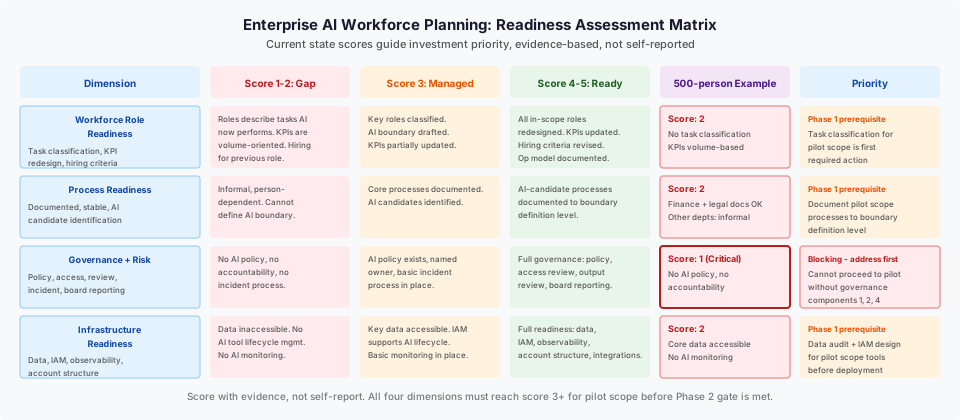
Assessment dimensions and scoring (1-5):
| Dimension | Score 1 | Score 3 | Score 5 |
|---|---|---|---|
| Workforce role readiness | Roles not classified; no task mapping | Key roles classified; boundary documented for pilot scope | All in-scope roles redesigned; KPIs updated; hiring criteria revised |
| Process readiness | Processes informal or undocumented | Core processes documented; AI candidate processes identified | AI-candidate processes documented to boundary-definition level; review gates designed |
| Governance readiness | No AI policy; no accountability structure | AI policy drafted; named governance owner; basic incident process | Full governance framework operational; board reporting active; regulatory monitoring in place |
| Infrastructure readiness | Significant data accessibility, IAM, and observability gaps | Key data accessible; IAM supports AI tool lifecycle; basic monitoring in place | Full infrastructure readiness: data, IAM, observability, account structure, integration capability |
Scores below 3 on any dimension represent a readiness gap that should be addressed before the corresponding deployment phase.
Assessment inputs
The assessment requires evidence, not self-reporting. For each dimension:
- Workforce: review existing role descriptions and confirm task classification has been completed.
- Process: review process documentation and confirm AI candidate processes are identified.
- Governance: review policy documents and confirm accountability structure is named.
- Infrastructure: audit data systems, IAM, and monitoring capability.
Planning timeline: three phases with governance gates
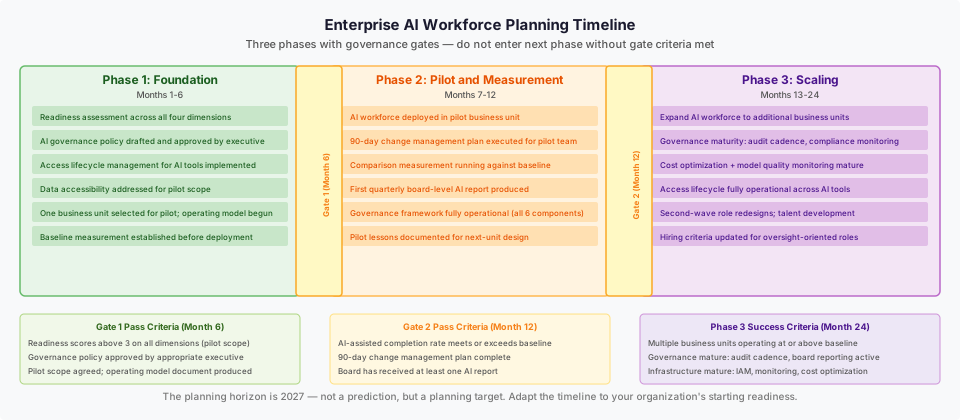
Phase 1: Foundation (months 1-6)
Objectives: Complete readiness assessment. Address blocking readiness gaps. Select pilot scope and begin operating model design.
Key activities:
- Readiness assessment across all four dimensions.
- Governance policy drafted and approved.
- Access lifecycle management for AI tools implemented.
- Data accessibility addressed for pilot scope data sources.
- One business unit selected for pilot; operating model design begun.
Governance gate for Phase 2: Written readiness assessment with scores above 3 on all dimensions for the pilot scope. Governance policy approved by appropriate executive. Pilot scope agreed by business unit lead.
Phase 2: Pilot and measurement (months 7-12)
Objectives: Deploy AI workforce in pilot scope. Measure performance against baseline. Establish board-level reporting. Learn and improve.
Key activities:
- AI workforce deployed in pilot business unit.
- Baseline measurement established before deployment; comparison measurement running.
- 90-day change management plan executed for pilot team.
- First quarterly board-level AI report produced.
- Lessons from pilot documented and applied to next-unit design.
Governance gate for Phase 3: Pilot business unit has completed the 90-day change management plan. AI-assisted completion rate meets or exceeds baseline. Governance framework is operational (policy, access review, output review, incident response). Board has received at least one AI report.
Phase 3: Scaling (months 13-24)
Objectives: Expand AI workforce to additional business units using learned patterns. Mature governance and monitoring. Plan for ongoing operations.
Key activities:
- Expansion to additional business units using the pilot's operating model as a template.
- Governance maturity development: audit cadence, compliance monitoring, quarterly board report cadence established.
- Infrastructure maturity: cost optimization, model quality monitoring, access lifecycle fully operational.
- Workforce planning: second-wave role redesigns, talent development for oversight roles, hiring criteria updated.
Diagram 1: Workforce planning timeline
See the accompanying diagram (enterprise-ai-workforce-planning-timeline-desktop.svg) showing the three planning phases with governance gates, key activities per phase, and go/no-go criteria between phases.
Diagram 2: Readiness assessment matrix
See the accompanying diagram (enterprise-ai-workforce-readiness-matrix-desktop.svg) showing the readiness assessment matrix mapping current state scores across role, process, risk, and infrastructure dimensions with investment priority indicators.
Worked example: 500-person enterprise planning AI workforce introduction
Organization: A 500-person professional services organization. Divisions: operations (120 people), technology (80 people), sales (60 people), finance (40 people), HR (20 people), legal (15 people), customer success (100 people), leadership and admin (65 people).
Planning trigger: The executive team has decided to include AI workforce capability in the 2027 business plan. A transformation lead is assigned to develop the planning framework.
Readiness assessment scores (pre-planning)
| Dimension | Score | Key gaps identified |
|---|---|---|
| Workforce role readiness | 2 | No task classification completed. KPIs are volume-based for all roles. |
| Process readiness | 2 | Processes documented for finance close and legal review. All other departments: informal or person-dependent. |
| Governance readiness | 1 | No AI policy. No named accountability. No incident process. |
| Infrastructure readiness | 2 | Data accessible in core systems (CRM, ERP, finance). No AI tool lifecycle management. No AI monitoring. |
Overall assessment: Pre-planning state. All four dimensions below the Phase 1 gate threshold.
Phase 1 planning checklist (months 1-6)
| Item | Owner | Target | Done when |
|---|---|---|---|
| AI governance policy drafted and approved | General Counsel + CISO | Month 2 | Policy signed by CEO |
| Task classification for top 5 roles in operations | Operations VP + HR | Month 3 | Classification table produced for 5 roles |
| Data accessibility audit | CTO | Month 2 | Audit report with identified gaps |
| AI tool access lifecycle design | IT Security | Month 4 | Lifecycle workflow documented |
| Pilot scope selected | Transformation Lead + Operations VP | Month 3 | Written pilot scope document |
| Operating model design for pilot | Operations VP | Month 5 | Operating model document produced |
| Phase 2 governance gate review | Transformation Lead | Month 6 | Gate criteria assessed; go/no-go decision |
Phase 2 expected milestones (months 7-12)
- Month 7: AI workforce deployed in operations pilot (invoice processing team).
- Month 8: 90-day change management plan at week 4 (pilot team onboarded).
- Month 9: 90-day change management plan at week 8 (rollout cohorts active).
- Month 10: 90-day change management plan complete (steady-state metrics running).
- Month 10: First quarterly board AI report produced.
- Month 12: Phase 3 gate review - pilot assessment, expansion scope decision.
Operational, security, cost, and migration consequences
Operational consequences
Deploying AI workforce changes who is accountable for operational errors. When AI makes a mistake that affects a customer or process, the accountability chain must trace to a human decision-maker: who authorized the AI to operate in this scope, who reviews its outputs, and who is responsible for quality. Organizations that do not design this accountability chain will find that AI errors produce accountability gaps rather than clear ownership.
Security consequences
AI tools expand the attack surface. Social engineering attacks can target users who interact with AI systems. Data accessible to AI is accessible to adversaries who compromise AI credentials. Prompt injection attacks can redirect AI agents to perform unauthorized actions. The governance framework must include AI-specific security design; the AI access privilege review resource addresses the access dimension.
Cost consequences
AI workforce costs have a different profile than human workforce costs: variable consumption costs that scale with usage, plus human oversight costs that are roughly fixed per AI deployment. Budget planning must model both components. See the CFO Guide to AI Workforce Cost Accounting for the cost model design.
Migration consequences
Existing processes that are manually operated must be transitioned to AI-assisted operation through a structured change management process. The transition period carries productivity risk (the team is learning while volumes continue). See the change management AI workflow introduction resource for the transition design.
Talent planning for AI oversight roles
The workforce role evolution described in Dimension 1 creates a talent planning obligation that is frequently underestimated. When AI handles structured, high-volume tasks, the residual human role requires higher-order judgment: quality review, exception handling, escalation assessment, and oversight of AI performance metrics. These are not entry-level skills.
The talent planning implication is that organizations deploying AI workforce components often need to upskill existing employees or hire for capabilities that did not exist in the role descriptions before AI deployment. The task classification exercise (see the HR Leader Guide to AI Workforce Roles) produces a view of which skills are needed in the redesigned roles. The talent planning step converts that view into a gap assessment and a plan.
Reskilling candidates. For each AI-assisted role, identify team members who demonstrate the judgment skills needed for the oversight function. These are typically the team's higher performers under the previous model, since high performers usually have both the domain knowledge and the judgment to review AI outputs critically. Create a reskilling plan that provides these employees with training in AI quality assessment, escalation judgment, and performance metric review.
New hiring criteria. For roles where the redesigned function requires skills not present in the current team, update the hiring criteria before the first open position is filled under the new model. Hiring for the old role description and deploying the new operating model creates a mismatch between what the new employee was hired to do and what their role actually requires.
Attrition planning. Some roles will become smaller after AI deployment handles a significant fraction of the volume. Plan for this reduction through attrition rather than elimination where possible: natural turnover creates the headcount adjustment without active restructuring. If the reduction timeline is faster than natural attrition allows, the planning should address this explicitly rather than discovering it after deployment.
Skill continuity risk. AI oversight quality depends on employees who understand the domain well enough to identify when the AI output is wrong. If the oversight role becomes too thin (too few experienced employees), quality review degrades and errors propagate. Maintain a minimum bench depth for each oversight role and include this in the talent planning model.
Governance cadence and board reporting
The governance framework described in Dimension 3 is not a one-time activity. It requires a recurring cadence of review and reporting that connects the operational state of AI workforce components to the executive and board level.
Monthly operational review. The AI governance lead reviews the previous month's AI task metrics, escalation rate, error rate, and incident log. Any metric outside the agreed threshold triggers a review before the next month's review. Monthly review is the minimum cadence for detecting quality degradation before it compounds.
Quarterly board report. The board-level AI report provides a summary of AI risk posture and business value. The report should not be a technical update: it should address three questions in business terms. First, is the AI workforce operating within its defined governance boundaries? Second, what business value has the AI workforce delivered against the baseline? Third, are there emerging risks or regulatory developments that the board should be aware of? The executive AI risk and value board reporting resource provides a reporting framework for this.
Annual governance framework review. Once per year, the full governance framework is reviewed: policy documents, access lifecycle procedures, output review sampling rates, and incident response runbooks. The review should assess whether the framework remains appropriate given changes in AI capability, organizational structure, and regulatory environment.
Triggers for out-of-cycle reviews. Three events should trigger an unscheduled governance review regardless of the regular cadence. A material AI incident (quality failure, security incident, or operational failure affecting a significant user population) always triggers an immediate review. A significant change in AI capability (a major model update that changes output quality or scope) triggers a review of the operating model for affected deployments. A regulatory development with direct application to the organization's AI use triggers a legal and compliance review before the next quarterly cycle.
Limitations and cases where this framework does not apply
Highly regulated environments with specific AI prohibitions. Some regulated environments (certain financial decision processes, clinical decision-making contexts) have specific regulatory constraints on AI use that this framework does not address. Obtain regulatory counsel before designing AI workforce components for heavily regulated decision types.
Organizations without adequate data infrastructure. The framework assumes data can be made accessible with reasonable preparation effort. Organizations where data is irrecoverably siloed, manually maintained, or in formats that cannot be programmatically accessed face a longer pre-work timeline than this framework covers.
Very small teams (fewer than 20 people). AI workforce economics typically require sufficient volume for the fixed costs of governance design and AI system setup to be justified by the operational gain. Very small teams may find that individual AI tool adoption (not full AI workforce deployment) is more appropriate.
Environments where task definitions cannot be stabilized. AI workforce deployment requires stable task definitions. In highly dynamic environments where the nature of work changes substantially quarter to quarter, the task boundary documentation becomes stale before it can be used. Address process stability before attempting AI workforce design.
Review checklist and practical next steps
Before starting the planning framework:
- [ ] Is executive sponsorship confirmed at CEO or COO level?
- [ ] Is a named transformation lead assigned with cross-functional access?
- [ ] Has the readiness assessment been scheduled across all four dimensions?
- [ ] Is the planning horizon (2027 or adjusted) agreed and communicated?
Before moving to Phase 2 (pilot):
- [ ] Readiness assessment scores above 3 on all dimensions for pilot scope.
- [ ] Governance policy approved.
- [ ] Access lifecycle management operational for AI tools in pilot scope.
- [ ] Pilot operating model document produced and reviewed.
- [ ] Baseline measurement established before pilot deployment begins.
Before moving to Phase 3 (scaling):
- [ ] Pilot completion rate at or above pre-AI baseline.
- [ ] 90-day change management plan completed.
- [ ] Board-level AI reporting active.
- [ ] Governance framework fully operational across all six components.
- [ ] Pilot operating model reviewed and lessons applied to expansion design.
Change management for AI-augmented roles
Role augmentation with AI tools changes the daily work pattern for human employees even when headcount is unchanged. Employees who previously spent time on a task now spend that time reviewing AI outputs, handling exceptions, and deciding escalations. This is a different cognitive load pattern and a different set of skills. Organizations that treat this as a simple tool rollout without change management support typically see adoption plateau below the designed utilization rate. A structured change management plan for each augmented role should include a skills assessment, a training sequence, a designated support contact during the first ninety days, and a feedback mechanism that surfaces problems the AI system is creating for human workers before those problems escalate. The governance framework is not complete when it is designed. It is complete when the first governance review meeting happens on schedule, produces findings, and those findings change something in the operational design. If the first three governance reviews produce no findings and no changes, the review process is not surfacing real problems. Build an expectation into the governance cadence that the first year of operation will produce active changes to task routing rules, escalation thresholds, and quality criteria, and that this represents a healthy, responsive framework rather than a sign that the initial design failed.
Primary references
- NIST AI Risk Management Framework (NIST AI 100-1), source checked 2026-11-05
- AWS Bedrock Responsible AI, source checked 2026-11-05
- AWS AI overview, source checked 2026-11-05
- AWS Bedrock Agents documentation, source checked 2026-11-05
- Amazon Bedrock monitoring documentation, source checked 2026-11-05
- AWS Organizations SCPs documentation, source checked 2026-11-05
Related resources
Prepare Your Company for an AI Workforce in 2027
Prepare your first AI workforce role for 2027: define its job, data access, accepted results, exception ownership, test evidence and operating costs.
Buy a Platform, Build an Agent, or Commission a Managed AI Workforce?
Compare buying, building and managing AI workforce roles with responsibility maps, a worked cost model, exit checks and a practical decision worksheet.
Measuring AI Adoption Maturity: Cross-Functional Readiness Framework
A maturity model with five dimensions, scoring rubric, and prioritization guidance for transformation leads and strategy directors assessing AI adoption readiness consistently across business functions.
AI Workforce Operating Model Design: Role Definitions and Human-AI Task Boundaries
A step-by-step playbook for operations directors and transformation leads to design an AI workforce operating model: covering role definitions, task routing rules, escalation paths, and boundary documentation as a governance artifact produced before deployment.