Prepare Your Company for an AI Workforce in 2027
Prepare your first AI workforce role for 2027: define its job, data access, accepted results, exception ownership, test evidence and operating costs.
Prepare one job you can delegate and measure
To prepare your company for an AI workforce in 2027, define a recurring job, the sources it may use, an accepted result, its permitted actions and the person who handles exceptions. Collect evidence of the current process before choosing how to build or buy the role. That preparation lets you compare proposals against work your team needs done.
Here, an AI employee means a software role configured to perform defined work in your business systems. It is not a claim that software can take unrestricted responsibility for an employee's full job. Routine independent work can be part of the role, while commercial commitments, sensitive decisions or other protected actions stay with named people under your policy.
Use 2027 as a planning horizon, not a prediction that every company must adopt AI by a deadline. The useful planning output is a first-role brief and an evidence backlog. Your company may be ready to test a bounded job now, need source-data improvements first, or decide that an existing deterministic workflow is sufficient.
The enterprise AI readiness checklist covers broader technical feasibility. This guide focuses on the operating preparation for delegating an actual recurring job: what to gather, who must participate, what to test and what would change the decision.
Define the first role around an accepted result
Write down the trigger, required inputs, task, destination and completion evidence. Avoid assigning a department-sized responsibility such as “manage sales” before defining which work the role may perform.
Consider an illustrative delivery-brief role. On the project owner's agreed schedule, it reads permitted project records and the approved commitment tracker, prepares a status brief with source references, and posts it to a designated internal channel. Missing ownership or conflicting deadlines become visible exceptions. The role cannot change project commitments or send a customer assurance without the required approval.
That scope supports two different operating states. During evaluation, a reviewer compares its output with the current process in an isolated destination. After acceptance, ordinary internal briefs may be posted independently within the approved authority. A proposed deadline change still follows its protected decision path. The initial review arrangement does not have to become a permanent approval click for every routine result.
Choose a job whose errors can be detected and contained at a cost the business can accept. If the current team cannot explain what makes a brief correct, first agree on the output standard. If a wrong action could expose sensitive records or create an irreversible commitment before anyone notices, narrow the role or keep that action outside its authority.
Map business ownership separately from technical access
A business owner decides why the role needs a source and whether its use is appropriate. A data owner approves the relevant records and handling conditions. A platform administrator or other authorized grantor may need to configure the application identity, consent or resource permissions. One person can hold several responsibilities, but the role pack should not assume that every data owner can grant OAuth access.
| Preparation record | Decision it supports |
|---|---|
| Named source and authoritative fields | Which records resolve factual disagreements |
| Business and data owners | Who approves the purpose and permitted data use |
| Authorized technical grantor | Who can implement and verify the specific access |
| Allowed records, fields and operations | What the role may read or change |
| Classification and handling rules | Which data may enter prompts, logs, summaries or caches |
| Freshness and outage policy | When to flag, defer or reject stale or unavailable inputs |
| Retention, deletion and exit owner | Who manages copies and removes access when the role ends |
For example, permission to read an account object may expose more fields than a briefing role needs. Record that gap and require filtering or a narrower integration. Do not treat an application permission label as proof that the runtime enforces your intended customer, channel or record boundary.
Microsoft's permissions and consent overview distinguishes delegated and application access. It is one example of why the identity model and consent path must be checked for the chosen platform. A business approval and a successful login are separate pieces of evidence.
Gather representative examples without exposing sensitive work
Use permitted historical examples where they help establish the actual output standard. Redact identifiers and confidential details before moving examples into a test environment, and confirm that redaction preserves the decision you want to test. A record with its entire meaning removed is not a useful fixture.
Add synthetic and adversarial cases for conditions history has not captured safely. An invented source record can test a conflicting owner, an expired entitlement, a duplicate trigger or an instruction hidden in retrieved content. Label its origin so a fabricated test scenario is never presented as an observed customer incident.
For each fixture, record the source category, expected result, permitted action, expected exception and reviewer. Explain why the case belongs in the coverage set. A few normal examples can start a discussion, but no fixed count establishes readiness. The required range follows the work's variation, consequences and known failure modes.
Keep development examples separate from held-out acceptance cases. The implementation team can use development examples to refine prompts, rules and output format. An acceptance owner controls a separate set that is not repeatedly used to tune those choices. If a held-out case becomes a tuning example after a failure, record that change and replace the missing independent coverage.
This adapts the evaluation separation explained in Google's dataset-splitting guidance to an application review. It does not mean that prompting a role is the same as training a model, or that a particular statistical split is appropriate for every workload. Keep sensitive fixtures in approved storage; do not paste the acceptance set into public issue trackers or send it to an unapproved provider.
Assign an exception owner with a workable escalation route
The exception owner needs enough context to judge what happened and enough authority to invoke the documented stop or escalation process. They do not necessarily need administrator access themselves. Name the administrator or on-call implementer who can disable a connector, restrict credentials or investigate uncertain writes.
Define what the owner receives: the affected job, safe record references, the attempted action, its known outcome, urgency and the next decision required. A notification that says “agent failed” leaves the recipient reconstructing the incident. Include a backup route for an unavailable owner and a way to notice when the notification channel itself fails.
Agree which events require an immediate pause. Unauthorized access, a wrong recipient or an ambiguous external write can justify stopping a role after a single occurrence. A harmless formatting correction may only need normal triage. Do not decide this by counting errors alone.
NIST's Generative AI Profile places governance, measurement and response within the AI lifecycle. The owner and escalation records proposed here are practical preparation artifacts, not a NIST certification checklist.
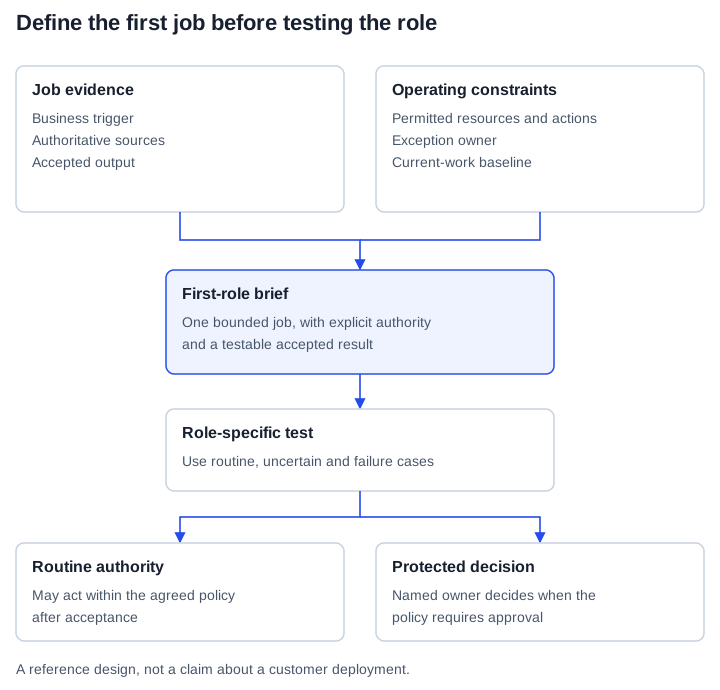
Reference pattern: prepare the job evidence and operating constraints together. Routine permitted actions and protected decisions follow different authority paths; they are not sequential stages.
Establish a baseline that measures useful work
Ask the current process owner to record preparation time, checking time, corrections, exceptions and the evidence used to accept a result. Include source lookup and downstream rework, not only the time spent writing the final brief. Distinguish missing measurements from a known zero.
Choose observations that reflect relevant variation. A quarter-end reporting job needs evidence about quarter-end behavior, but you do not have to expose production data or wait for the calendar to repeat before exploring the risk. Permitted historical replay and clearly labeled synthetic stress cases can supplement observation. Record what remains untested.
Use the same accepted-result definition when comparing a platform, an internal build and a managed service. Include provider and connector charges, setup allocation, customer review, corrections, operating support and exit effort within the chosen horizon. Do not compare one option's subscription price with another option's fully staffed operating cost.
The accepted-result cost calculator can structure this comparison. Its inputs remain assumptions until your team supplies evidence. A lower cost per attempted run may still be a poor result if more work is rejected, corrected or left unresolved.
Plan authority according to consequences
Read-first and shadow evaluation are useful starting approaches when you need to understand output behavior before enabling an action. They are not universal architectural requirements, nor proof that the role will behave correctly after writes are enabled. A role that eventually updates tickets needs tests for the update itself, including changed records and uncertain responses.
Classify candidate actions before granting them. A routine internal status post can run independently after its destination, inputs, quality and failure handling are accepted. A price commitment may require a named approver. Deleting a record may remain prohibited even if the platform offers a delete permission.
Enforce these distinctions in the tool or connected-system boundary, rather than relying on a model instruction to decide its own authority. OWASP's excessive-agency guidance explains the risks of granting unnecessary capabilities, permissions and autonomy. The practical preparation is an action-policy table that the implementer can enforce and the owner can test.
For every proposed expansion, record the newly allowed action, affected resources, approver, test evidence, exception route and stop control. Group related changes only when their combined effect can be evaluated and attributed. Avoid expanding authority merely because a calendar milestone has arrived.
Prepare the team and supplier handoff
Tell colleagues what the role will do, how to identify its messages, where to ask questions and what it must escalate. Do not let an illustrative name or conversational interface obscure that this is an automated system. If the role will join a meeting, agree participant notice, recording or transcript handling, permitted destinations and who checks action items before they become commitments.
A supplier should receive approved examples and a scoped problem statement, not unrestricted credentials or a dump of the company's shared drive. Ask who owns the production accounts, logs, configuration and exit materials. Confirm how model or connector changes are assessed, what support covers, and who responds outside normal working hours. Continuous availability is an operating requirement to agree and test, not a consequence of calling something an AI employee.
The sourcing decision whitepaper compares implementation and operating responsibilities. Use the onboarding playbook when your first-role brief is ready for an owned test and release process.
Create the first-role preparation record
Bring the business owner, data owner, implementer and prospective operator together around one job. Record which decisions are ready, which require evidence and who will close each gap.
| Decision | Evidence to bring | Hold condition |
|---|---|---|
| Job and accepted result | Agreed output with source references and completion evidence | Owners disagree on what counts as correct |
| Data access | Permitted resources and a verified grant path | Required access exposes unrelated data without an accepted control |
| Evaluation | Representative development fixtures and an independent holdout plan | Acceptance examples leak into tuning without replacement |
| Action authority | Routine, approval-required and prohibited actions | A protected action can bypass its enforced boundary |
| Operation | Named owner, escalation route and tested stop procedure | Nobody can account for in-flight or uncertain actions |
| Economics | Same workload, horizon and accepted-result denominator | A proposal excludes material review or operating work |
Treat this record as the start of a scoped implementation conversation. Keep unresolved coverage visible, including rare high-consequence cases. If the job is unsuitable for AI, retaining a deterministic workflow or improving the existing process is a valid planning outcome.
Primary references
Sources checked on 16 October 2026. The role brief, example and preparation worksheet are proposed guidance, not results from an Ampity customer deployment.
- NIST AI 600-1, Generative Artificial Intelligence Profile: lifecycle governance, measurement and response.
- Microsoft identity platform, permissions and consent overview: identity and consent distinctions.
- Google Machine Learning Crash Course, dividing datasets: separation of development and test evidence, adapted here without prescribing a model-training split.
- OWASP LLM06:2025, excessive agency: limiting capabilities and enforcing authorization at action boundaries.
Related resources
Enterprise AI Readiness Checklist: Evidence Before a Pilot
Test whether an enterprise AI use case has a decision owner, usable data, measurable quality gates, safe integration and an operating path before funding a pilot.
What Access Your AI Employee Needs in Slack, Teams and Zoho CRM
Plan least-privilege access for AI employees in Slack, Teams and Zoho CRM. Compare identities, permission boundaries, revocation and practical launch tests.
Onboard an AI Employee: Role Pack, Tests and Safe Operations
Onboard an AI employee with a reusable role pack, scoped access, isolated tests, acceptance evidence, routine authority and owned recovery procedures.
Related services
Custom AI Workforce Engineering and Management
Ampity engineers and manages AI employees with defined jobs, business-system access and proactive workflows. Onboard, validate and delegate authorised work.
AI Readiness Assessment Services
AI readiness assessment covering workflow needs, feasibility and operating constraints. Identify the evidence, team capability and controls needed for adoption.