Change Management: Introducing AI Workflows Without Productivity Regression
How change management leads and operations directors can introduce AI-assisted workflows without causing productivity regression during transition, covering...
Productivity regression during AI workflow introduction is common and predictable. The team is learning new tools, the AI system is calibrating to real production inputs, and the existing process is partly disrupted before the new one is stable. Teams that introduce AI without a structured transition plan often experience a dip that lasts longer than it should, sometimes long enough for stakeholders to lose confidence in the deployment.
The transition dip is not avoidable, but its depth and duration are manageable. This article describes a 90-day change management plan designed to minimize productivity regression and maintain stakeholder confidence during AI workflow introduction for an operations team.
Why AI workflow introduction fails at the change management layer
AI deployments fail for technical reasons (the model does not handle the actual task well, integration breaks) and for change management reasons (the team does not use the tool, adoption is inconsistent, measurement is unclear). Technical post-mortems typically surface the technical failures. Change management failures tend to be attributed to the tool or the technology rather than the transition design.
The specific change management risks for AI workflow introduction:
Metric confusion. If the team is still measured on volume metrics (documents per day, tickets per hour) during the transition period, and the AI is handling some of that volume while the humans are learning the new workflow, volume per person appears to drop. The team appears less productive. The metric is measuring the wrong thing during transition.
Inconsistent adoption. Without structured rollout, some team members use the AI extensively, others avoid it, and the variance in behavior makes performance measurement impossible. Comparisons between team members become unfair and demoralizing.
Escalation design absent. The AI encounters task variants it was not designed for. If the team has no clear escalation path, some team members improvise, others abandon the AI entirely for those case types, and the AI's scope boundary becomes ambiguous.
Stakeholder expectation misalignment. If stakeholders expect productivity improvement from day one of AI deployment, any transition period that shows flat or declining metrics will be interpreted as a failure, even if the trajectory is exactly on plan.
The 90-day plan structure
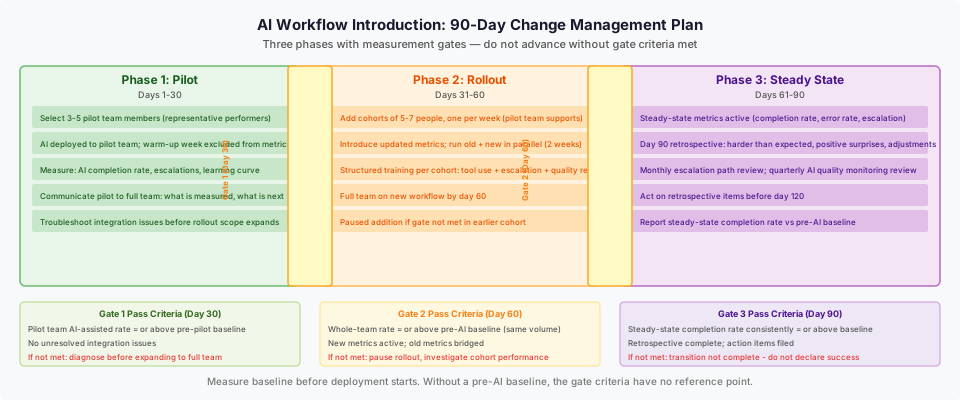
The plan has three phases of 30 days each: pilot, rollout, and steady-state. Each phase has a measurement gate with go/no-go criteria before the next phase begins.
| Phase | Days | Team scope | Gate criterion to advance |
|---|---|---|---|
| Pilot | 1-30 | 3-5 selected members | Pilot team AI-assisted productivity at or above pre-pilot baseline |
| Rollout | 31-60 | Full team (staged, groups of 5-7) | 80% of team meeting the updated productivity metric for two consecutive weeks |
| Steady-state | 61-90 | Full team | AI task completion rate stable and escalation rate below defined threshold |
Phase 1 (days 1-30): Pilot
Pilot team selection. Select three to five team members for the pilot. These should be competent, representative performers - not the highest performers (they are needed in the main queue) and not the lowest (they may struggle more with learning the new workflow). The pilot team should represent the range of task types in scope.
What the pilot establishes:
- AI task completion rate on real production inputs (not test data)
- The escalation rate to humans (which task types need human handling)
- The learning curve for the tool (how long before the pilot team reaches steady-state proficiency)
- Any integration or technical issues that need resolution before broader rollout
Measurement gate for phase 1: At day 30, the pilot team's AI-assisted productivity should be at or above their pre-pilot baseline. If it is not, do not proceed to phase 2 without diagnosing why. Proceeding to full rollout while the pilot team is still below baseline expands the regression to the whole team.
Stakeholder communication at phase 1 start: Inform all team members that a pilot is running. Describe what will be measured and when phase 2 will begin. This prevents rumor and uncertainty from affecting the non-pilot team's behavior.
Phase 2 (days 31-60): Rollout
Rollout sequence. Add team members in groups of five to seven people, one group per week. Do not add everyone at once. The staged rollout allows the pilot team members (now experienced) to support their peers, and allows the change management team to identify problems in one group before the next group is added.
Updated metrics introduction. At rollout start, introduce the updated productivity metrics that reflect the AI-assisted workflow. Run the old metrics in parallel for the first two weeks of rollout to establish a bridging dataset. After two weeks, retire the old metrics for the main reporting view (keep them in background monitoring for two additional weeks).
Training format. Provide structured training before each cohort goes live. The training should cover three things: how to use the AI tool for the specific tasks in scope, what to do when the AI encounters a task variant it cannot handle (escalation path), and how to recognize when the AI output is wrong and needs correction. Generic AI tool training is not sufficient; the training must be specific to the team's tasks.
Measurement gate for phase 2: At day 60, whole-team AI-assisted productivity should be at or above the pre-AI baseline for the equivalent task volume. If teams that completed rollout are still below baseline, pause additional rollout and investigate.
Phase 3 (days 61-90): Steady state
Steady state does not mean done. The first 90 days establishes the new workflow. Ongoing management requires the updated metrics to continue being tracked, the escalation path to be reviewed monthly, and the AI system's quality to be monitored against the ground truth sample.
Retrospective at day 90. Hold a structured retrospective with the team covering: what about the transition was harder than expected, what about the tool surprised them positively, what process adjustments would improve the workflow. Record the retrospective findings and act on the actionable items before 120 days.
Measurement gate for phase 3: At day 90, the steady-state metrics should show the AI-assisted workflow consistently at or above the original baseline. If the metrics have not recovered to baseline at 90 days, the transition is not complete and should not be declared successful.
Worked example: 50-person operations team over 90 days
Team: 50-person operations team processing vendor invoices and purchase orders. Pre-AI baseline: 96 percent completion rate on a weekly volume of 4,100 documents.
AI deployment scope: AI handles template-matched invoices (approximately 65 percent of volume). Humans handle exception queue, purchase orders, and AI-escalated items.
Phase 1 (days 1-30): Five-person pilot team. Week 1 AI completion rate: 87 percent (below baseline while team learns). Week 3: 93 percent. Week 4: 96 percent. Gate passed.
Phase 2 (days 31-60): Three rollout cohorts of 15 people each added in weeks 5, 7, and 9. Full team on the new workflow by day 60. Whole-team completion rate at day 60: 94.3 percent (slightly below baseline; individual cohort performance improves within two weeks of going live). Gate: passed with note that two cohorts are still in learning phase.
Phase 3 (days 61-90): Steady-state metrics. By day 75, whole-team completion rate reaches 97.1 percent - 1.1 percentage points above the pre-AI baseline at the same weekly volume. The improvement reflects that humans are spending more time on exception cases where they add judgment value, rather than routine template-matched processing.
Diagram: change timeline
See the accompanying diagram (change-management-ai-workflow-introduction-desktop.svg) showing the 90-day timeline with pilot, rollout, and steady-state phases, measurement gates, go/no-go criteria, and productivity trajectory.
Failure modes
Going straight to full-team rollout without a pilot. The pilot exists to find the problems before they affect the whole team. Organizations that skip the pilot and deploy to everyone simultaneously have no way to contain the blast radius when problems arise.
Not running updated metrics in parallel with old metrics during rollout. Teams that switch to new metrics cold turkey on rollout day have no way to bridge between the old performance picture and the new one. Stakeholders cannot track progress.
Measuring pilot team against full-team standards. A pilot team of five in a 50-person team is handling a small volume with learning overhead. Measuring them on throughput that assumes full capacity misreads their performance.
Declaring success at 90 days based on the plan rather than the metrics. If the day 90 measurement gate shows the team is still below baseline, the transition is not complete. Report the actual state, not the plan.
What to do next
The next useful step is confirming the measurement baseline (current completion rate, volume, error rate) before designing the 90-day plan, so the measurement gates have a reference point. Without a baseline, the gates have no threshold.
For the operating model design that determines what AI is authorized to handle, see the AI Workforce Operating Model Design playbook. For measurement of task completion rate methodology, see the operations task completion rate resource.
The Custom AI Workforce service page describes how Ampity manages AI workforce deployments including transition planning.
Primary references
- AWS Bedrock Responsible AI, source checked 2026-11-05
- Amazon Bedrock Agents documentation, source checked 2026-11-05
Related resources
Prepare Your Company for an AI Workforce in 2027
Prepare your first AI workforce role for 2027: define its job, data access, accepted results, exception ownership, test evidence and operating costs.
AI Project Readiness: Decide What Is Ready to Build
Decide whether an AI use case is ready to build with a business baseline, data rights, representative evaluation, risk boundaries, and an operating owner.
AI Workforce Operating Model Design: Role Definitions and Human-AI Task Boundaries
A step-by-step playbook for operations directors and transformation leads to design an AI workforce operating model: covering role definitions, task routing rules, escalation paths, and boundary documentation as a governance artifact produced before deployment.