CFO Guide to AI Workforce Cost Accounting: Subscription vs Consumption vs Outcome
How CFOs should account for AI workforce costs across three models: subscription, consumption, and outcome-linked, with budget planning, opex/capex treatment, and a...
AI workforce costs do not map cleanly onto existing finance categories. The procurement team asks whether it is software, services, or headcount. The accounting team asks whether it is capex or opex. The budget owner asks how to forecast it. These questions have different answers depending on the commercial structure of the AI workforce arrangement.
This article defines three AI workforce cost models: subscription, consumption, and outcome-linked. It describes the accounting treatment appropriate to each, and provides a budget planning comparison against a conventional 10-person operations team.
The accounting treatment described here is intended to inform internal budget design and cost framing discussions. Organizations should obtain guidance from their own finance and accounting advisors for binding accounting treatment decisions under applicable standards (GAAP, IFRS, or other applicable framework).
Three cost models
Subscription. A fixed monthly or annual fee for access to AI workforce capacity, regardless of usage volume. The vendor may express this as a seat count, an agent count, or a named-capability tier. Costs are predictable: you pay the same amount whether the AI handles 500 tasks or 50,000. Scaling beyond the tier incurs additional fixed fees at tier boundaries, not variable per-task costs.
Consumption. A variable fee based on measured usage: typically tokens processed, API calls made, tasks completed, or compute hours consumed. The underlying infrastructure model for most AI services (including Amazon Bedrock) is consumption-based. Costs scale with volume. A month with high workload costs more than a quiet month. Forecasting requires usage volume estimates, not just a contract figure.
Outcome-linked. A fee structured around verified business outcomes: completed tasks, accepted decisions, or processed documents that meet acceptance criteria. The vendor is paid for delivery rather than for access or activity. This model transfers some execution risk to the vendor and aligns payment timing with delivered value. It is less common for commodity AI services but is used in managed AI delivery arrangements where scope and acceptance criteria are agreed in advance.
Accounting treatment by model
| Cost model | Typical classification | Opex/Capex | Predictability | Budget planning unit |
|---|---|---|---|---|
| Subscription | Software license or SaaS service | Opex (SaaS); multi-year prepays may require assessment under ASC 350-40 (US GAAP) or IAS 38 (IFRS) depending on arrangement | High: fixed periodic cost | Annual contract value divided by period |
| Consumption | Cloud service usage / variable service cost | Opex | Low to medium: depends on volume forecast | Unit cost x volume estimate, with range |
| Outcome-linked | Professional services or managed delivery | Opex (services), or capitalized if output meets internal-use software criteria | Medium: bounded by agreed scope | Per-outcome fee x projected volume |
For subscription costs, the accounting treatment typically follows the organization's existing SaaS treatment. If the arrangement includes a prepayment covering multiple years, check whether the multi-year element requires capitalization and amortization under the applicable standard. A one-year annual subscription renewed each year is generally treated as a period cost.
For consumption costs, the monthly invoice is a variable operating expense. The challenge is forecasting. Without a volume model, finance teams tend to anchor on the first month's invoice and miss growth. Build the budget from a task-volume estimate multiplied by the per-task cost, and include a growth scenario and a cap scenario.
For outcome-linked costs, the payment is typically recognized when the outcome is accepted, which aligns the expense recognition with the value realization. If the arrangement delivers a software artifact (for example, a configured pipeline or integration), portions may meet the criteria for capitalization under internal-use software rules. Obtain accounting advice before capitalizing outcome-linked AI delivery.
Worked example: 10-person operations team vs AI workforce
This example uses illustrative figures to show the structure of the comparison. It is not a quote, benchmark, or guarantee. Actual costs depend on the specific AI system, vendor, task complexity, and organization context.
Human operations team (10 people):
| Cost component | Annual illustrative amount |
|---|---|
| Salaries + benefits (fully loaded) | $900,000 |
| Management overhead | $90,000 |
| Tools and licenses | $30,000 |
| Recruiting and onboarding (annualized) | $20,000 |
| Total | ~$1,040,000 |
Characteristics: fixed cost, predictable, scales in steps (hire one more person), capacity limited to working hours.
AI workforce handling equivalent tasks (consumption model example):
| Cost component | Annual illustrative amount |
|---|---|
| AI service usage (tokens, API calls) | $60,000–$180,000 depending on volume |
| Integration and orchestration infrastructure | $12,000–$24,000 |
| Human oversight roles (review, exception handling) | $120,000–$200,000 |
| Vendor platform fee | $24,000–$60,000 |
| Total | ~$216,000–$464,000 |
Characteristics: variable core cost, scales with task volume without headcount, requires human oversight investment to maintain quality and handle exceptions.
Key differences for budget planning:
- Human team cost is predominantly fixed and predictable. AI workforce cost contains a variable component that moves with volume.
- Human team capacity is capped by working hours. AI workforce can process during off-hours without overtime costs.
- AI workforce cost does not replace all human cost. Human oversight, exception handling, and escalation roles remain necessary.
- Task type mix matters. Not all operations tasks transfer to AI with equal effectiveness or cost. High-judgment tasks with low volume may be more economical with humans.
Budget predictability and scaling behavior
A CFO planning AI workforce budget should model three scenarios:
Low volume (cost floor): Minimum expected task volume in a trough period. For subscription models, the cost is fixed. For consumption models, the cost is proportional to tasks. The floor scenario tests whether the AI arrangement is cost-effective at minimum utilization.
Expected volume (base case): Forecast task volume based on historical operations data. This is the primary budget line.
High volume (cost ceiling): Peak or growth scenario. For subscription models, test whether the tier covers the peak or whether a tier-up cost applies. For consumption models, understand the linear growth in cost and whether volume discounts apply at scale.
The scaling behavior difference is significant. A human team scales in steps (one full-time equivalent at a time). An AI workforce scales smoothly with volume, up to platform limits. This means the AI option looks more cost-effective at high utilization and less cost-effective at low utilization (for consumption models) or constant (for subscription models).
Failure modes and cost risks
Unbounded consumption. A consumption model without spending caps can exceed budget if task volume spikes. Use AWS Cost Explorer budgets, service quotas, and application-level rate limits to prevent runaway spend. See AWS Cost Management documentation for budget alert configuration.
Underestimating human oversight cost. AI workforce deployments require human review for exceptions, edge cases, and quality assurance. If the budget accounts only for the AI service cost and omits the oversight role cost, actual total cost will exceed projection.
Scope expansion without budget revision. Outcome-linked or subscription arrangements may appear fixed, but adding task types or expanding scope mid-year generates additional charges. Treat scope changes as budget events.
Incorrect opex/capex classification. Miscategorizing AI workforce costs can affect financial reporting and tax treatment. This requires accounting judgment specific to the arrangement, not general guidance.
Diagram
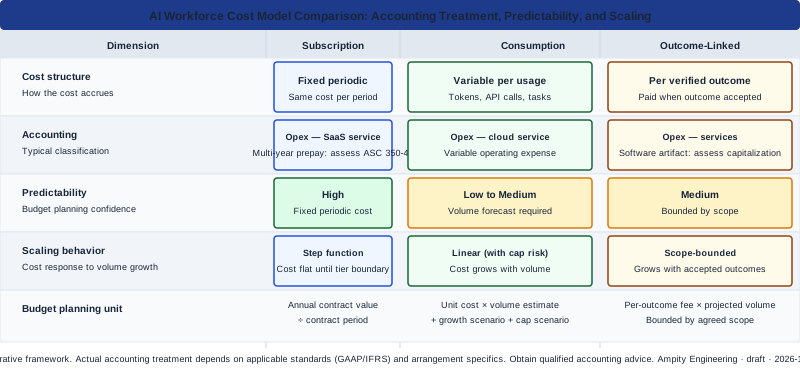
Three AI workforce cost structures compared by accounting treatment, predictability, and scaling behavior. Use this matrix to match cost structure to budget planning method before committing to a vendor arrangement.
What to do next
Before committing to an AI workforce budget line, map the specific cost model to your accounting treatment, model the three volume scenarios, and quantify the human oversight cost separately. Present the total AI workforce cost (AI service + infrastructure + oversight) against the equivalent human team cost.
For more on task-level cost measurement, see the AI cost-per-completed-task resource. For the architecture decisions that affect operating cost, see the Custom AI Workforce service page.
Primary references
- AWS Cost Management overview, source checked 2026-11-05
- AWS Cost Explorer user guide, source checked 2026-11-05
Related resources
Token Cost Is Not Cost per Completed AI Task
Measure AI workflow costs against verified completion, including retries, retrieval, human review and recovery. Compare changes without hiding failures.
Enterprise FinOps: Allocation, Forecasting, and Cost Decisions
Build a defensible FinOps operating model: reconcile cloud costs, allocate shared spend, evaluate commitments, and assign decisions without compromising service reliability.
AI Integration Architecture for Enterprise Systems: Teams, Slack, Salesforce, and Jira
A decision framework for enterprise architects and VP Engineering designing AI agent integration with Teams, Slack, Salesforce, and Jira: covering trust boundaries, data minimization, permission scope, event audit design, and failure isolation.