HR Leader Guide: Defining Roles and Performance Criteria When AI Handles Part of the Work
How CHROs and HR directors should redesign job roles, update performance criteria, and revise hiring standards when AI takes on a portion of team tasks: including a...
When AI takes over a portion of a team's tasks, the remaining human responsibilities change in ways that most job descriptions, performance frameworks, and hiring profiles do not capture. This guide gives HR leaders a structured approach to redesigning roles, updating KPIs, and hiring for teams where AI is a standing participant.
The article addresses operational design choices, not employment law compliance. Organizations should obtain qualified legal and HR counsel for binding determinations about employment classification, performance management obligations, and applicable labor regulations in their jurisdiction.
Why existing role definitions break
A role description written before AI introduction defines performance against a volume of work. A claims processor might be measured on tickets closed per day or calls handled per hour. When AI handles the high-volume, low-judgment portion of that queue, the ticket-per-day metric becomes a poor proxy for the human contribution.
The human is now accountable for the cases the AI cannot or should not handle: edge cases, emotionally complex interactions, escalations, quality review, and exception decisions. These are qualitatively different from the original volume metric. Measuring the human against the old metric undervalues judgment-intensive work and fails to identify when AI quality is degrading.
Three problems surface together:
- Job descriptions describe tasks AI now performs. The role appears deskilled when it has actually shifted to higher-judgment work.
- Performance criteria are volume-oriented. They measure what AI does, not what humans must do well.
- Hiring criteria select for the previous role, not the redesigned one. Candidates who would excel at oversight, escalation, and quality review may not look like the strongest candidates under the old scoring rubric.
A framework for role redesign
Role redesign for AI-assisted teams has four steps: task classification, boundary definition, performance criteria update, and hiring criteria revision.
Step 1: Classify tasks by AI suitability
For each role, list the tasks from the existing job description and classify each:
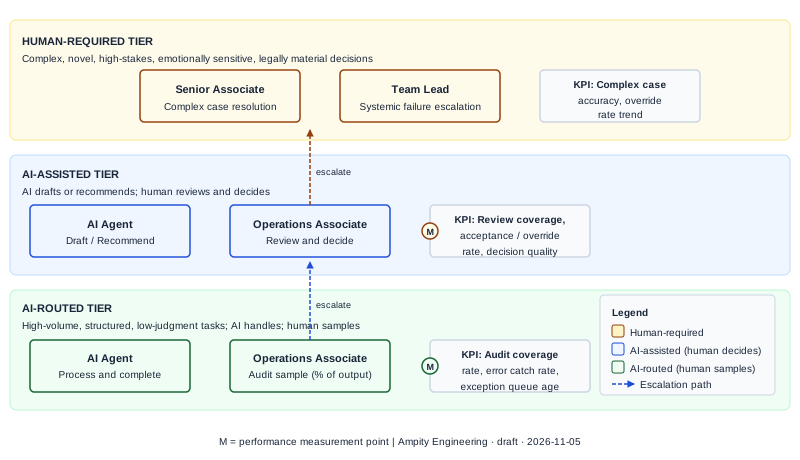
| Task class | Description | Routing |
|---|---|---|
| Routine-structured | High-volume, rule-based, low-judgment, well-documented inputs | AI handles; human reviews sample |
| Assisted-judgment | Moderate complexity; AI drafts or recommends; human decides | AI prepares; human reviews and decides |
| Human-required | Complex, novel, high-stakes, emotional, or legally sensitive | Human only |
This classification is the foundation. Without it, the role redesign is guesswork.
Step 2: Define the human-AI task boundary explicitly
Document which tasks are AI-routed, which are AI-assisted, and which are human-only. This boundary document:
- Tells employees what AI will and will not do in their role.
- Tells managers what oversight is expected of each person.
- Becomes the input for updated job descriptions.
The boundary should be reviewed when AI capabilities change, when new task types are added, or when quality monitoring shows systematic failures in AI handling.
Step 3: Update performance criteria
Replace volume metrics for AI-routed tasks with quality and oversight metrics. The updated criteria should measure what the human is actually responsible for.
| Old KPI (volume-oriented) | Redesigned KPI (oversight-oriented) |
|---|---|
| Tickets closed per day | Exception handling accuracy rate |
| Calls handled per hour | Escalation decision quality score |
| Documents processed per week | AI output review coverage rate |
| Average handle time | Edge case resolution time |
Do not remove the volume metric without adding a replacement that captures the judgment work. Teams without any output measure can lose accountability for throughput.
Step 4: Revise hiring criteria
Hiring for AI-assisted roles requires weighting judgment, escalation skill, and AI oversight ability more heavily. Consider:
- Scenario assessments that show how a candidate makes exception decisions under uncertainty.
- Evaluation of ability to review and critique AI-generated output, not just produce original work.
- Comfort with feedback loops: escalating a problem, communicating ambiguity, and updating a decision based on new information.
Candidates who excelled in high-volume production roles may not be the best fit for oversight-intensive positions. The evaluation should reflect the redesigned role, not the previous one.
Worked example: operations team before and after AI introduction
Before AI introduction: operations team (10 people):
| Role | Key tasks | Primary KPIs |
|---|---|---|
| Operations Associate | Process purchase orders, validate invoices, update records | Orders per day, error rate |
| Senior Associate | Handle escalations, review complex cases | Cases resolved, turnaround time |
| Team Lead | Queue management, coaching, reporting | Team throughput, SLA adherence |
After AI introduction: same team with AI handling routine order processing:
| Role | Revised key tasks | Updated KPIs |
|---|---|---|
| Operations Associate | Review AI-processed orders (sample audit), handle exception queue, resolve ambiguous cases | Exception resolution accuracy, audit coverage rate, escalation decision quality |
| Senior Associate | Handle AI-escalated complex cases, review AI recommendations for high-value orders, perform quality sampling | Complex case resolution accuracy, quality sample score, AI recommendation acceptance/override rate |
| Team Lead | Monitor AI output quality, manage exception queue health, review KPI dashboards, escalate systemic AI failures | AI quality trend (weekly), exception queue aging, human override rate trend |
The team lead role gains a new accountability: detecting when AI quality is degrading before it affects customers. This requires a different skill set than pure throughput management.
Diagram: role boundary map
See the accompanying diagram (hr-leader-ai-role-boundary-desktop.svg) showing task ownership split between human and AI, escalation paths, and performance measurement points by task tier.
Managing the transition
Communicate before changing metrics. Employees who have been high performers under old metrics need to understand that the change reflects a role redesign, not a performance problem. Document the rationale.
Run the new and old metrics in parallel during transition. Maintain the old volume metric for the first cycle to establish a baseline for the redesigned KPIs. This prevents a gap in performance history.
Train for oversight skills. Reviewing AI outputs for quality, detecting systematic errors, and deciding when to escalate are learnable skills. Provide structured training before holding employees accountable on oversight-oriented KPIs.
Review the boundary document on a fixed schedule. AI capabilities change. Set a quarterly review date for the task classification so the role design does not drift out of sync with what the AI actually handles.
Failure modes
Keeping old KPIs without adding new ones. The team is judged by metrics that no longer reflect human contribution. High performers on the previous volume metric may underperform on actual current responsibilities.
Redefining the role without telling employees. Informal expectation drift is worse than formal redesign. If expectations change without documentation, employees have no basis to understand what success looks like.
Skipping the oversight role in hiring. Hiring for the previous job profile fills the team with people skilled at the work AI does rather than the work humans must do.
Making the human boundary too narrow. If AI handles everything routine and humans only handle extreme exceptions, human skills for the intermediate cases can atrophy. Keep humans involved in enough routine review to maintain judgment.
What to do next
The next useful step is conducting a task classification for one role before redesigning job descriptions. The classification surfaces where the boundary actually sits and prevents over-engineering the redesign. For the broader operating model framework, see the AI Workforce Operating Model Design playbook. For the AI governance considerations that affect what AI is permitted to do, see the AI governance framework resource.
The Custom AI Workforce service page describes how Ampity delivers AI workforce deployments including operating model design and boundary documentation.
Primary references
- AWS Bedrock Responsible AI, source checked 2026-11-05
- NIST AI Risk Management Framework, source checked 2026-11-05
Related resources
Prepare Your Company for an AI Workforce in 2027
Prepare your first AI workforce role for 2027: define its job, data access, accepted results, exception ownership, test evidence and operating costs.
AI Governance Framework: Production Decisions, Controls and Evidence
Build proportionate AI governance with a decision inventory, a worked routing example, release evidence, calibrated monitoring and explicit stop conditions.
AI Workforce Operating Model Design: Role Definitions and Human-AI Task Boundaries
A step-by-step playbook for operations directors and transformation leads to design an AI workforce operating model: covering role definitions, task routing rules, escalation paths, and boundary documentation as a governance artifact produced before deployment.