Measuring AI Adoption Maturity: Cross-Functional Readiness Framework
A maturity model with five dimensions, scoring rubric, and prioritization guidance for transformation leads and strategy directors assessing AI adoption readiness...
A transformation lead who needs to assess AI adoption readiness across eight departments cannot rely on anecdote. Without a consistent scoring framework applied across all departments, comparisons are meaningless - each department presents its AI readiness through its own lens, and the resulting picture tells the executive team where things feel advanced, not where they actually are.
This article provides a five-dimension maturity model for consistent cross-functional AI readiness assessment, with a scoring rubric and prioritization guidance for investment decisions.
Why consistent scoring across functions matters
The same AI capability assessment question asked independently of each department produces incomparable answers. A technology department and a finance department use different vocabulary, different standards of evidence, and different benchmarks for what "good" looks like. The technology department may score itself high on data readiness because it has a data warehouse, while the finance department scores itself low because it lacks structured access to its own operational data. The gap may be just as large in both directions, but the vocabulary difference makes it invisible.
A maturity model provides a shared scoring vocabulary. Each dimension is defined in terms of specific observable criteria, not abstract aspirations. A score of 3 on data readiness means the same thing for the technology department as for the finance department.
The model is a planning tool, not a performance review. The purpose of scoring is to identify investment priorities, not to rank departments against each other.
Five dimensions of AI adoption maturity
Dimension 1: Data readiness
Data readiness measures whether a department has structured, accessible, and sufficiently complete data to support AI use cases.
| Score | Observable criteria |
|---|---|
| 1 | Data is unstructured, inconsistently stored, or not accessible without manual extraction. No data dictionary. |
| 2 | Key data exists in structured systems but requires significant cleaning or transformation before use. Some documentation. |
| 3 | Structured, documented data is accessible via API or data platform. Known data quality issues are tracked. |
| 4 | Data is accessible, well-documented, and has automated quality checks. Historical data is available for model evaluation. |
| 5 | Data is maintained with provenance, version control, and ongoing quality monitoring. Ready for use in AI training and evaluation. |
Dimension 2: Process clarity
Process clarity measures whether the department's processes are documented, understood, and stable enough to identify where AI can operate within defined boundaries.
| Score | Observable criteria |
|---|---|
| 1 | Processes are informal, person-dependent, and not documented. High variation between practitioners. |
| 2 | Key processes are documented but not consistently followed. Significant informal variation exists. |
| 3 | Core processes are documented and followed. Exception paths are known. AI task boundary can be reasonably estimated. |
| 4 | Processes are documented, measured, and reviewed regularly. AI task routing rules can be precisely defined. |
| 5 | Processes have formal decision logic, measurement, and continuous improvement. AI integration boundaries are precise and contractually defined with clear escalation paths. |
Dimension 3: Governance posture
Governance posture measures whether the department has the policies, accountability structures, and review processes required to deploy AI responsibly.
| Score | Observable criteria |
|---|---|
| 1 | No AI policy. No named accountability for AI outputs. No review process. |
| 2 | Informal guidelines exist. Some awareness of AI risks. No formal accountability. |
| 3 | An AI policy or framework exists and is applied. Named owner for AI governance. Basic output review process. |
| 4 | Governance policy is enforced with evidence records. Access controls are reviewed periodically. Incident reporting exists. |
| 5 | Mature governance with formal audit cadence, board-level visibility, and continuous improvement driven by incident learning. |
Dimension 4: Skill and capability
Skill and capability measures whether the department has the knowledge to work alongside AI tools and the capacity to manage the human-AI workflow.
| Score | Observable criteria |
|---|---|
| 1 | No AI awareness or training. No internal capability. |
| 2 | Some team members have personal experience with AI tools. No structured training. |
| 3 | Structured AI literacy training has been completed. Team can operate defined AI tools and escalate appropriately. |
| 4 | Team members can design AI use cases, write effective prompts, evaluate AI output quality, and train others. |
| 5 | Internal capability to design AI workflows, evaluate model selection, and manage AI quality monitoring. Can contribute to procurement and vendor evaluation. |
Dimension 5: Tooling and infrastructure
Tooling and infrastructure measures whether the department has the technical foundation to adopt and operate AI tools.
| Score | Observable criteria |
|---|---|
| 1 | No AI tools in use. No integration capability. |
| 2 | Individual use of consumer AI tools without IT governance. No enterprise integration. |
| 3 | At least one AI tool deployed through IT governance with defined scope and access controls. |
| 4 | Multiple AI tools integrated with enterprise systems. Monitoring and cost tracking in place. |
| 5 | AI tooling is managed as infrastructure: versioned, monitored for quality, integrated with identity management, and subject to change control. |
Scoring rubric and assessment process
Assign scores on a 1-5 scale for each of the five dimensions, for each department being assessed. The assessment requires evidence for each score, not self-report alone.
Evidence by dimension: Data readiness - inspect data sources, documentation, and access mechanisms. Process clarity - review process documentation and observe actual practice. Governance posture - review policy documents and evidence records. Skill - review training completion records and conduct a skills demonstration. Tooling - audit AI tools in use and their integration status.
Assessment method: Use a combination of department self-assessment (scored on the rubric) and assessor review (checking evidence for each score claim). Self-assessment scores that exceed evidence should be adjusted. The final score is the evidence-supported score, not the self-reported score.
Worked example: eight departments scored
An enterprise with eight departments scored on the five-dimension model:
| Department | Data | Process | Governance | Skill | Tooling | Average |
|---|---|---|---|---|---|---|
| Technology | 4 | 4 | 3 | 4 | 4 | 3.8 |
| Finance | 3 | 4 | 3 | 2 | 2 | 2.8 |
| Legal | 2 | 3 | 4 | 2 | 2 | 2.6 |
| HR | 2 | 3 | 3 | 2 | 2 | 2.4 |
| Operations | 3 | 3 | 2 | 3 | 3 | 2.8 |
| Sales | 3 | 2 | 2 | 3 | 3 | 2.6 |
| Marketing | 3 | 2 | 2 | 3 | 3 | 2.6 |
| Customer Success | 4 | 3 | 3 | 3 | 3 | 3.2 |
Observations from this profile:
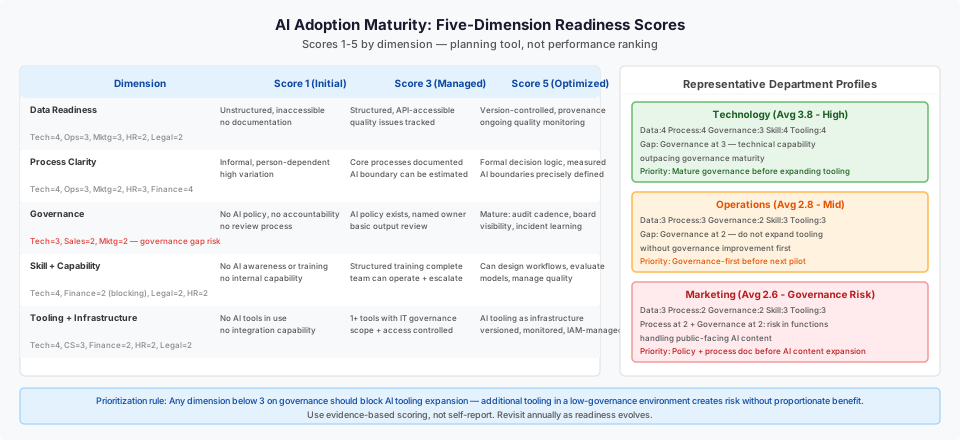
The Technology and Customer Success departments are most advanced overall. Technology is held back primarily by governance posture (score 3), suggesting that technical capability has outpaced governance maturity. Customer Success has reasonable balance across dimensions and is a viable candidate for a next pilot.
Finance has good process clarity (score 4 - close processes are well documented) but low skill and tooling scores, suggesting that the barrier to AI adoption is not process readiness but capability development and IT-governed tooling.
Legal has the highest governance score (score 4), reflecting legal's existing culture of structured review and evidence records. Its data readiness (score 2) reflects the unstructured nature of legal documents and the absence of a legal data platform.
HR, Sales, and Marketing all show low governance scores (score 2), which is a cross-functional risk: if AI tools are adopted in these departments without governance maturity, the organization will have a governance gap in functions that handle sensitive data (HR) or make public claims (Marketing) or operate with significant customer data (Sales).
Prioritization guidance
The maturity scores support two types of investment prioritization:
High-readiness departments: Departments scoring 3.0 or above on average with no dimension below 2 are candidates for expanded AI deployment. Prioritize investments that use their existing readiness rather than building new foundations.
Blocking dimension investments: For departments with one dimension significantly below others, a targeted investment in the blocking dimension provides the highest return before broader AI adoption. Finance's blocking dimension is skill (score 2); the investment is structured training, not additional tooling.
Governance-first requirement: Any department scoring below 3 on governance should not expand AI tooling beyond current deployment until governance posture improves. Additional tooling in a low-governance environment creates risk without proportionate benefit.
Diagram: maturity radar
See the accompanying diagram (ai-adoption-maturity-cross-functional-readiness-desktop.svg) showing the maturity radar with scores by dimension across three representative department profiles (high readiness, mid readiness, and governance-first).
Failure modes
Using self-report scores without evidence review. Departments consistently self-report higher than evidence supports, particularly on governance and skill dimensions. Without an evidence-based review, the scores are flattering rather than informative.
Averaging across dimensions to hide weakness. A department with an average of 2.8 that includes a governance score of 1 is a governance risk regardless of its average. Report dimension scores alongside averages.
Scoring once and treating it as a permanent baseline. The maturity model is a planning tool for the current state. Organizations move on these dimensions over time, both improving through investment and declining through inattention. Reassess annually.
Using the model as a ranking to shame low-scoring departments. If departments expect the scores to be used for internal competition, they will optimize for the score rather than for genuine capability development. Keep the scoring purpose focused on investment planning.
What to do next
The next useful step is piloting the scoring rubric on two departments before running the full eight-department assessment - one you expect to score high and one you expect to score low. Check whether the evidence-based scores match the expected pattern and whether the rubric produces consistent scores between assessors. Revise any criteria that produce inconsistent results before scaling.
For detailed data readiness criteria, see the data readiness for generative AI resource. For the broader preparation narrative, see the prepare company for AI workforce 2027 resource.
The Custom AI Workforce service page and AWS Consulting service page describe how Ampity supports enterprise AI readiness assessment and deployment planning.
Primary references
- AWS Bedrock Responsible AI, source checked 2026-11-05
- AWS AI overview whitepaper, source checked 2026-11-05
Related resources
Prepare Your Company for an AI Workforce in 2027
Prepare your first AI workforce role for 2027: define its job, data access, accepted results, exception ownership, test evidence and operating costs.
AI Project Readiness: Decide What Is Ready to Build
Decide whether an AI use case is ready to build with a business baseline, data rights, representative evaluation, risk boundaries, and an operating owner.
Data Readiness for Generative AI: An Evidence Checklist
Assess whether an information corpus is safe and useful enough for a generative AI system across rights, access, quality, retrieval, freshness, deletion and evaluation.
Related services
Custom AI Workforce Engineering and Management
Ampity engineers and manages AI employees with defined jobs, business-system access and proactive workflows. Onboard, validate and delegate authorised work.
AWS Consulting & Migration Services
AWS consulting for architecture and Well-Architected reviews, cost optimisation, FinOps and migration. Plan changes around workload evidence and recovery needs.