AWS Modernization and AI Readiness as an Integrated Investment Decision
Decision framework for treating cloud modernization and AI readiness as a unified investment. Covers how account structure, networking, data platform, and workload...
Abstract
Many enterprises treat cloud modernization and AI readiness as separate investment decisions. The modernization team plans account restructuring, network upgrades, and workload migration. The AI team plans data pipelines, model infrastructure, and inference endpoints. These plans are often developed by different teams, approved in different budget cycles, and executed on different timelines. The result is that modernization investments either accidentally enable or accidentally block AI deployment, and the organization discovers the dependency only when the AI team attempts to access data or deploy models in an environment that was modernized without AI requirements in mind.
This whitepaper presents a decision framework for evaluating cloud modernization investments through the lens of AI readiness. The framework identifies four investment layers (account structure, networking, data platform, and workload architecture) and maps the specific modernization decisions within each layer that create or remove prerequisites for AI deployment. The worked example follows an enterprise with on-premises ERP, fragmented AWS accounts, and legacy networking through a sequenced modernization plan that produces both operational improvement and AI readiness.
This framework does not prescribe a single modernization path. It provides evaluation criteria so that each modernization decision can be assessed for its AI readiness impact before the investment is committed. The framework applies to organizations using AWS as their primary cloud platform. Multi-cloud considerations are noted but not covered in depth.
Source: AWS Well-Architected Framework, AWS MAP, checked 2026-11-05.
2. Definitions and Scope
Cloud modernization means any investment that changes how existing workloads run on AWS: account restructuring, network architecture changes, database migration, application refactoring, container adoption, or operational model changes. Modernization does not require AI and has its own justification (cost, reliability, security, agility).
AI readiness means the organization's technical and operational ability to deploy AI systems into production. This includes data accessibility, compute provisioning, model deployment infrastructure, security controls for AI workloads, and organizational processes for AI governance.
Integrated investment means evaluating modernization and AI readiness together so that modernization spending intentionally creates AI prerequisites, and AI requirements are reflected in modernization planning before the investment is committed.
Scope exclusions. This whitepaper does not cover: AI model selection or training methodology, non-AWS cloud platforms in depth, organizational change management for AI adoption (covered in the companion planning framework), or specific AWS service configuration details (covered in service-specific blogs and playbooks in this collection).
3. The Problem: Disconnected Investment Planning
How disconnected planning creates waste
When modernization and AI readiness are planned separately, three failure patterns emerge.
Pattern 1: Modernization blocks AI. The modernization team restructures AWS accounts for cost allocation and security, but places data lake accounts in a separate organization unit with restrictive SCPs. When the AI team later needs cross-account access to training data, the SCP structure requires rework. The modernization investment did not consider AI access patterns.
Pattern 2: AI deployment reveals modernization gaps. The AI team attempts to deploy a Bedrock-powered RAG system. The data they need is in an on-premises database that was not included in the modernization scope because it was classified as a "stable system." Now the AI project requires an unplanned data migration that delays AI deployment by 6 months.
Pattern 3: Duplicate infrastructure investment. The modernization team builds a data lake for analytics. The AI team builds a separate vector store for RAG. Both need the same source data, but neither team designed their infrastructure to share it. The organization pays twice for data ingestion, storage, and quality management.
Why this happens
Modernization and AI initiatives typically have different sponsors, budgets, teams, and timelines. The modernization sponsor (VP Infrastructure, CIO) is measured on operational metrics: cost reduction, reliability improvement, security posture. The AI sponsor (Chief Data Officer, VP Product) is measured on AI-specific outcomes: model accuracy, inference latency, business impact. Neither sponsor has visibility into the other's requirements during the planning phase.
The AWS Well-Architected Framework provides six pillars (operational excellence, security, reliability, performance efficiency, cost optimization, sustainability) that are commonly applied to modernization planning. AI readiness cuts across all six pillars but is not called out as a distinct planning dimension, which means it is easy to omit from modernization reviews.
4. The Four Investment Layers
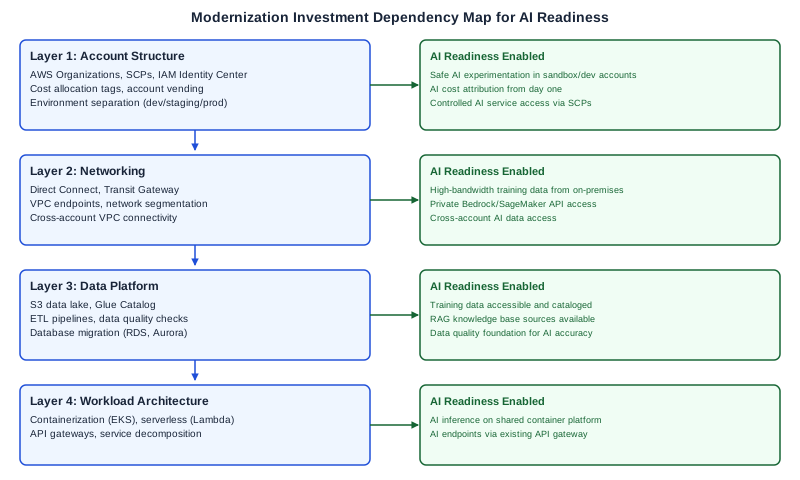
This framework evaluates modernization decisions across four layers. Each layer contains specific decisions that either enable or block AI readiness. See the accompanying diagram (aws-modernization-ai-readiness-dependency-map-desktop.svg) showing the dependency map across all four layers with AI readiness outcomes.
Layer 1: Account structure
Account structure determines who can access what, how costs are attributed, and where workloads are permitted to run. Modernization investments in account structure (AWS Organizations, SCPs, IAM Identity Center, account vending) directly affect whether AI workloads can be deployed and who can access AI services.
Key modernization decisions and their AI readiness impact:
| Decision | Modernization benefit | AI readiness impact |
|---|---|---|
| Separate accounts by environment (dev/staging/prod) | Security isolation, cost clarity | Enables safe AI experimentation in dev without production risk |
| Restrict Bedrock/SageMaker via SCPs | Cost control, prevent shadow AI | May block legitimate AI development if SCPs are too restrictive |
| Centralize data lake in a dedicated account | Data governance, access control | Enables cross-team AI access to training data if permissions are designed for it |
| Implement cost allocation tags | FinOps visibility | Enables AI cost attribution from day one if AI tag taxonomy is included |
| Deploy IAM Identity Center | Unified access management | Simplifies AI tool access provisioning if AI roles are defined |
AI readiness questions for account structure decisions:
- Do the proposed SCPs allow AI service access in development accounts?
- Does the account structure support cross-account data access for AI training and inference?
- Is the cost allocation tag taxonomy extensible to AI workloads?
- Does the IAM strategy include roles for AI service access?
Layer 2: Networking
Network architecture determines whether data can flow between on-premises systems and AWS services, between AWS accounts, and between Regions. AI workloads often have different network requirements than traditional applications: higher bandwidth for training data transfer, lower latency for real-time inference, and private connectivity for sensitive data processing.
Key modernization decisions and their AI readiness impact:
| Decision | Modernization benefit | AI readiness impact |
|---|---|---|
| Deploy Direct Connect for on-premises connectivity | Reliable hybrid access, lower data transfer cost | Enables high-bandwidth training data transfer from on-premises sources |
| Implement Transit Gateway for inter-account networking | Simplified network architecture | Enables AI services in one account to access data in another |
| Deploy VPC endpoints for AWS services | Private connectivity, reduced data transfer cost | Keeps AI API traffic (Bedrock, SageMaker) off the public internet |
| Implement network segmentation by workload type | Security isolation | May block AI services if segmentation does not account for AI traffic patterns |
AI readiness questions for networking decisions:
- Does the network architecture support the bandwidth required for training data transfer?
- Can AI services access data stores in other accounts or VPCs without internet routing?
- Are VPC endpoints planned for AI services (Bedrock, SageMaker, S3)?
- Does the network segmentation allow AI inference traffic to reach application layers?
Layer 3: Data platform
The data platform layer is where modernization and AI readiness intersect most directly. AI systems require accessible, governed, timely data. Modernization investments in data lakes, data warehouses, ETL pipelines, and data quality directly determine whether AI systems can access the data they need in the format and freshness they require.
Key modernization decisions and their AI readiness impact:
| Decision | Modernization benefit | AI readiness impact |
|---|---|---|
| Migrate on-premises databases to RDS or Aurora | Reduced operational overhead, improved availability | Makes data accessible for AI training and RAG knowledge bases |
| Build a data lake on S3 | Centralized analytics, reduced data silos | Provides a foundation for AI training data if schema and access are designed for AI |
| Implement data catalog (Glue Catalog) | Data discovery, governance | Enables AI teams to find and understand available training data |
| Deploy ETL pipelines (Glue, Step Functions) | Data integration, quality | Provides data freshness that AI systems depend on for accurate outputs |
| Implement data quality checks | Analytics reliability | Directly improves AI training data quality and RAG source reliability |
AI readiness questions for data platform decisions:
- Are the data formats in the lake/warehouse compatible with AI ingestion (Bedrock, SageMaker)?
- Is the data catalog extensible to include AI-relevant metadata (embedding status, quality scores)?
- Do ETL pipelines produce data at the freshness AI systems require?
- Are data quality checks in place for the specific fields AI systems will use?
Layer 4: Workload architecture
Workload architecture decisions (containerization, serverless adoption, microservices decomposition) affect how AI components are deployed, scaled, and integrated with existing applications.
Key modernization decisions and their AI readiness impact:
| Decision | Modernization benefit | AI readiness impact |
|---|---|---|
| Containerize applications on EKS | Operational consistency, scaling | Enables AI inference containers to run on the same platform |
| Adopt serverless (Lambda, Step Functions) | Reduced operational overhead | Enables event-driven AI pipelines (document processing, enrichment) |
| Decompose monoliths into services | Independent deployment, scaling | Creates integration points where AI services can be inserted |
| Implement API gateways | Traffic management, security | Provides a routing layer for AI inference APIs |
AI readiness questions for workload architecture decisions:
- Does the container platform have GPU node support for AI inference?
- Can serverless functions invoke AI services within timeout and concurrency limits?
- Do service boundaries create natural integration points for AI augmentation?
- Does the API gateway support the latency budget for real-time AI inference?
5. Investment Priority Matrix
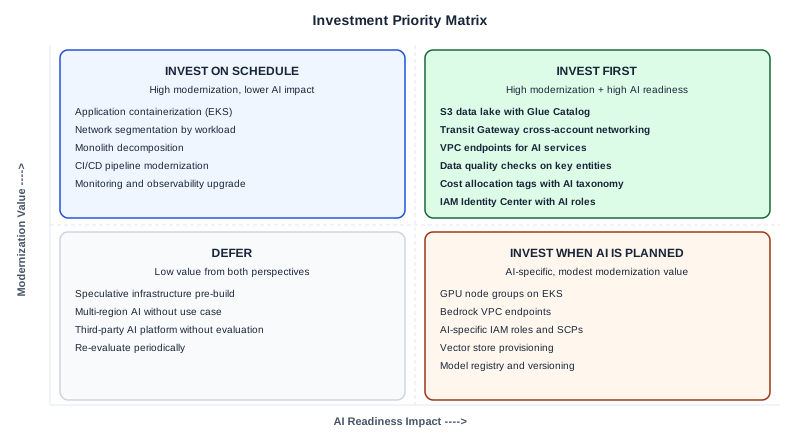
Not all modernization investments have equal AI readiness impact. The following matrix helps prioritize modernization investments based on both operational value and AI enablement.
Priority categories:
High modernization value, high AI readiness impact (invest first). These investments are justified on operational grounds and also create AI prerequisites. Examples: data lake on S3, VPC endpoints for AI services, cross-account networking via Transit Gateway.
High modernization value, low AI readiness impact (invest on schedule). These investments are justified operationally but do not significantly affect AI readiness. Examples: application containerization (unless AI containers are planned), network segmentation (if AI traffic is accounted for).
Low modernization value, high AI readiness impact (invest when AI is planned). These investments are primarily justified by AI requirements. Examples: GPU-capable node groups on EKS, Bedrock VPC endpoints, AI-specific IAM roles. These should be planned alongside specific AI projects rather than speculatively.
Low modernization value, low AI readiness impact (defer). These investments have limited justification from either perspective. Re-evaluate periodically.
See the accompanying diagram (aws-modernization-ai-investment-priority-matrix-desktop.svg) illustrating the four-quadrant investment priority matrix with example investments in each category.
6. Worked Example: Enterprise Modernization for AI Readiness
Current state
A mid-size manufacturing enterprise (500 employees, $150M revenue) has:
- On-premises ERP (SAP) running in a co-located data center
- 15 fragmented AWS accounts, no Organizations hierarchy, inconsistent tagging
- Site-to-Site VPN for hybrid connectivity (100 Mbps, variable latency)
- No data lake; reporting runs on direct database queries
- Applications are monolithic, running on EC2 with manual deployments
- No AI deployment; executive team has approved an AI strategy for 2027
Target state
The executive team wants to:
- Modernize the AWS environment for operational efficiency and cost control
- Prepare the infrastructure for AI deployment starting Q3 2027
- Avoid separate modernization and AI infrastructure investments
Sequenced investment plan
Quarter 1: Account structure and governance (Layer 1)
- Deploy AWS Organizations with OU structure: Core, Workloads (Dev, Staging, Prod), Data, Security, Sandbox
- Implement SCPs that control AI service access: allow Bedrock in Dev and Data accounts, restrict in Prod until governance is established
- Deploy IAM Identity Center with role definitions including AI Developer and AI Admin roles
- Implement cost allocation tags including AI workload taxonomy
- *AI readiness outcome:* AI teams can begin experimenting in Dev and Sandbox accounts from day one
Quarter 2: Networking and connectivity (Layer 2)
- Deploy AWS Direct Connect (1 Gbps) replacing VPN for primary connectivity
- Implement Transit Gateway connecting all account VPCs
- Deploy VPC endpoints for S3, Bedrock, and SageMaker in Data and Workload accounts
- *AI readiness outcome:* High-bandwidth path for ERP data extraction; private AI service access
Quarter 3: Data platform foundation (Layer 3)
- Build data lake on S3 in the Data account with Glue Catalog
- Implement ETL pipelines extracting ERP data to the lake daily
- Deploy data quality checks on key entities (customers, orders, inventory)
- *AI readiness outcome:* Training data accessible, cataloged, and quality-checked for AI consumption
Quarter 4: Workload modernization begins (Layer 4)
- Containerize first application group on EKS
- Implement API gateway for service traffic
- Begin database migration from on-premises to Aurora for non-ERP databases
- *AI readiness outcome:* Container platform available for AI inference; API gateway ready for AI endpoints
Quarter 5-6: AI enablement builds on modernization
- Deploy Bedrock Knowledge Base using data lake content
- Implement AI inference endpoints on EKS for custom models
- Connect AI outputs to existing application workflows via API gateway
- *AI readiness outcome:* AI deployment uses modernization infrastructure rather than building separate systems
Investment analysis
| Layer | Modernization investment | AI-specific incremental cost | AI readiness enabled |
|---|---|---|---|
| Account structure | $30,000 (consulting + implementation) | $5,000 (AI role definitions, SCP tuning) | AI experimentation accounts, governance |
| Networking | $120,000 (Direct Connect + Transit Gateway) | $8,000 (VPC endpoints for AI services) | High-bandwidth data access, private AI traffic |
| Data platform | $180,000 (lake build + ETL + quality) | $15,000 (AI metadata schema, embedding-ready formats) | Training data accessible and cataloged |
| Workload architecture | $250,000 (EKS, API gateway, DB migration) | $20,000 (GPU node group, AI endpoint config) | AI deployment platform ready |
| Total | $580,000 | $48,000 | Full AI readiness |
The AI-specific incremental cost ($48,000) is 8.3% of the total modernization investment. This small increment converts a modernization-only investment into a modernization-plus-AI-readiness investment. The alternative (building AI infrastructure separately after modernization) would require re-creating networking, data access, and deployment infrastructure at significantly higher cost.
7. Data Catalog as the AI Readiness Bridge
The data catalog is the investment that most directly connects the modernization data platform (Layer 3) to AI readiness. Without a catalog, AI teams cannot discover which data exists, what schema it uses, what quality checks have been applied, or which organizational systems it comes from. This discovery work must happen manually for each AI project, consuming engineering time that the catalog investment would eliminate.
A modernization data catalog (AWS Glue Catalog is the common choice for AWS-native environments) built to serve analytics use cases can serve AI readiness with modest additional investment in two areas.
AI-relevant metadata attributes. A standard analytics catalog records schema, table location, partition keys, and update frequency. For AI readiness, add: whether the dataset has been quality-checked for AI consumption (and what quality checks passed), whether the dataset is approved for AI training or RAG use, and the data owner who must approve AI access. These attributes do not require a separate AI catalog: they are additional fields in the existing catalog schema.
Embedding-ready format tracking. Bedrock Knowledge Bases and SageMaker processing jobs consume documents in specific formats (PDF, TXT, HTML, structured JSON for certain connectors). If the modernization data lake stores documents in proprietary formats that require conversion before AI ingestion, the catalog should record the conversion status. AI teams can then query the catalog for datasets that are already in AI-ready formats rather than discovering format incompatibility at project start.
The incremental investment for AI-relevant catalog attributes is typically 5-10% of the catalog implementation cost: primarily the work of defining the attribute schema and training data stewards to populate it. This investment reduces the per-project discovery cost for every subsequent AI project.
8. When the Recommendation Does Not Apply
Multi-cloud organizations
Organizations running significant workloads across AWS, Azure, and GCP face a different calculation. AI readiness investments tied to AWS-specific services (Bedrock, SageMaker) may not benefit workloads on other platforms. Multi-cloud organizations should evaluate whether AI readiness investments should be platform-neutral (e.g., Kubernetes-based inference) or platform-specific.
Organizations without near-term AI plans
If the organization has no AI plans for the next 18-24 months, the incremental AI readiness investments described here may be premature. However, the account structure and data platform decisions should still be evaluated for AI extensibility, because restructuring these layers later is expensive.
Highly regulated industries
Organizations in healthcare, financial services, or government may have regulatory constraints that affect which AI services can be used, where data can be processed, and what governance structures are required. These constraints may override the sequencing recommended in this framework.
Small AWS environments
Organizations with fewer than 5 AWS accounts and modest workloads may not need the full four-layer framework. A simpler evaluation of data accessibility and network connectivity for AI services may be sufficient.
8. Operational, Security, and Cost Consequences
Operational consequences
Integrated planning requires cross-team coordination that most organizations do not have by default. The modernization team and the AI team need a shared planning cadence, shared decision criteria, and shared visibility into each other's requirements. Without this coordination mechanism, the framework reverts to disconnected planning.
Security consequences
AI services introduce new trust boundaries: model access, data access patterns for training and inference, and output handling. These trust boundaries must be integrated into the security design during modernization, not added afterward. SCPs, IAM policies, and network controls designed without AI traffic patterns may block legitimate AI operations.
Cost consequences
The incremental cost of AI readiness during modernization is small relative to the modernization investment itself. However, it requires budget authorization that spans both modernization and AI budgets, which may require sponsor-level coordination if the budgets are owned by different executives.
9. Cross-Team Coordination Model
The integrated investment framework requires deliberate coordination between the modernization team and the AI team. Without a formal coordination mechanism, the investment planning reverts to disconnected silos regardless of the framework's intent.
Shared planning cadence. The modernization team and AI team should meet at a fixed cadence (at minimum quarterly) to review upcoming modernization decisions against AI readiness requirements. This meeting is not a status update: its output is a decision on whether each planned modernization investment should include AI readiness increments, and who is responsible for designing those increments.
Shared decision log. Maintain a written record of each modernization investment decision and its assessed AI readiness impact. This log becomes the audit trail if the organization later needs to understand why a specific AI deployment was delayed by an infrastructure gap.
Escalation path for conflicts. When a modernization decision accelerates cost reduction at the expense of AI readiness (for example, choosing a cheaper networking option that reduces bandwidth below AI training requirements), the conflict must be escalated to a named decision authority who can weigh both objectives. Without an escalation path, the conflict is resolved by default in favor of the lower-cost option, and the AI readiness cost is deferred without being acknowledged.
Investment authorization that spans both budgets. The small AI readiness incremental cost identified in the worked example (8.3% of total modernization investment) requires budget authorization from both the modernization sponsor and the AI sponsor. Organizations where these budgets are siloed will need a cross-team authorization mechanism before the integrated investment approach can be executed.
10. Security Architecture for AI Workloads
Modernization investments that do not account for AI security requirements create remediation work later. AI workloads have specific security characteristics that differ from traditional applications.
Data in transit for AI workloads. Training data and RAG corpus documents transferred from on-premises or other AWS accounts to AI services should use private connectivity (VPC endpoints, Transit Gateway, Direct Connect) rather than internet routing. The networking layer decisions in Layer 2 determine whether this is possible without additional investment.
Model access credentials. IAM roles that invoke Bedrock or SageMaker require managed credential lifecycle. During modernization, IAM Identity Center deployment (Layer 1) creates the foundation for managed AI tool access. Organizations that delay IAM Identity Center deployment find that AI tool access is provisioned through long-lived access keys that are harder to audit and revoke.
Data boundary enforcement. AI systems that process sensitive data require explicit data boundary enforcement at the IAM and VPC layer. SCPs that restrict Bedrock access to specific accounts (Layer 1) and VPC endpoint policies that limit which services can be accessed from which networks (Layer 2) are the primary technical controls. These should be designed during the modernization phase, not added as a remediation after AI deployment reveals a gap.
Output handling security. AI-generated outputs that are written back to business systems (CRM enrichment, document annotation, automated communications) require the same access control review as human-generated content. The API gateway layer (Layer 4) is the natural enforcement point for output access control.
12. Review Checklist
Before approving a modernization investment, the approval authority should verify:
- [ ] Has the modernization plan been evaluated against AI readiness requirements for each layer?
- [ ] Are AI access patterns (data, network, compute) reflected in account structure and networking decisions?
- [ ] Does the data platform design include AI metadata and ingestion compatibility?
- [ ] Is the incremental AI readiness cost identified and authorized?
- [ ] Is there a cross-team coordination mechanism between modernization and AI teams?
- [ ] Have security controls been designed to accommodate AI traffic patterns?
- [ ] Are AI cost allocation tags included in the tagging taxonomy?
- [ ] Has the sequencing been reviewed so that AI-enabling layers are completed before AI deployment is planned?
13. Limitations
This framework assumes AWS as the primary cloud platform. Organizations with significant multi-cloud commitments need a platform-neutral or multi-platform evaluation approach.
The investment figures in the worked example are illustrative and based on typical consulting rates and AWS service costs. Actual costs vary by organization size, complexity, and geographic location.
The framework does not cover AI model selection, training, or performance optimization. These are separate technical decisions that depend on the specific AI use case, not on the modernization infrastructure.
The framework assumes that the organization has or will develop the skills needed to operate both modernized infrastructure and AI systems. Skills gaps may require investment in training or external expertise not included in the worked example. Organizations with limited internal cloud engineering capacity should account for this in the modernization investment plan rather than discovering the skills gap after migration work has begun. Governance structures built during modernization, particularly those covering account structure, IAM boundaries, and cost allocation, directly reduce the governance setup work required when AI workloads are added. Organizations that defer governance design until AI deployment typically discover that the account and IAM structure created during modernization does not cleanly support the multi-tenant or permission-scoped patterns required for production AI agents, requiring retroactive account restructuring that is substantially more expensive than forward design would have been at the start of modernization. Organizations with limited internal cloud engineering capacity should account for this in the modernization investment plan rather than discovering the skills gap after migration work has begun. Governance structures built during modernization, particularly those covering account structure, IAM boundaries, and cost allocation, directly reduce the governance setup work required when AI workloads are added. Organizations that defer governance design until AI deployment typically discover that the account and IAM structure created during modernization does not cleanly support the multi-tenant or permission-scoped patterns required for production AI agents, requiring retroactive restructuring that is more expensive than forward design.
The framework assumes that the organization has or will develop the skills needed to operate both modernized infrastructure and AI systems. Skills gaps may require additional investment in training or external expertise that is not included in the worked example.
14. Next Steps
- For organizations beginning modernization planning: Apply the AI readiness questions from each layer to your current modernization plan before finalizing the investment.
- For organizations mid-modernization: Audit the decisions already made against the AI readiness impact tables. Identify any decisions that have inadvertently blocked AI readiness and determine the remediation cost.
- For organizations planning AI deployment on existing AWS infrastructure: Assess your current environment against the four layers to identify which AI prerequisites are already in place and which require investment.
Ampity delivers AWS modernization and AI readiness as an integrated engineering engagement. To discuss how modernization and AI readiness fit together for your organization, visit our AWS Consulting and Custom AI Workforce service pages.
Primary references
- AWS Well-Architected Framework, source checked 2026-11-05
- AWS Migration Acceleration Program (MAP), source checked 2026-11-05
- AWS Organizations documentation, source checked 2026-11-05
- Amazon VPC and Transit Gateway documentation, source checked 2026-11-05
- AWS Glue Data Catalog documentation, source checked 2026-11-05
- Amazon Bedrock security and IAM documentation, source checked 2026-11-05
Related resources
AWS Lifecycle Debt: Decide What to Upgrade, Defer or Retire
Compare EKS version support, node-image retirement, RDS paid continuation and Bedrock model removal using an explicit lifecycle register, bounded exceptions, funding alternatives and evidence required before implementation.
AWS Multi-Account Control Assurance: Define What a Green Result Covers
Separate Control Tower configuration, analyzer coverage and observed enforcement using version-specific scope records, counterexamples and a reusable AWS multi-account assurance worksheet.
2027 Enterprise AI Workforce Planning Framework
A planning framework for CEOs, COOs, and Chief People Officers preparing enterprise AI workforce transformation, covering workforce role evolution, process redesign priorities, risk and governance posture, and infrastructure readiness assessment, framed as planning guidance not predictions.
Building an Honest AWS Migration Business Case: TCO Components and Common Omissions
Build a complete total cost of ownership comparison for an AWS cloud migration. Covers direct and indirect cost components, commonly understated items, and a worked example mapping 20 on-premises servers to AWS.
Related services
AWS Consulting & Migration Services
AWS consulting for architecture and Well-Architected reviews, cost optimisation, FinOps and migration. Plan changes around workload evidence and recovery needs.
Custom AI Workforce Engineering and Management
Ampity engineers and manages AI employees with defined jobs, business-system access and proactive workflows. Onboard, validate and delegate authorised work.