AWS Lifecycle Debt: Decide What to Upgrade, Defer or Retire
Compare EKS version support, node-image retirement, RDS paid continuation and Bedrock model removal using an explicit lifecycle register, bounded exceptions, funding...
Abstract
An AWS lifecycle review should distinguish buying eligible support from avoiding a required change. Paying to extend a Kubernetes control-plane version does not extend the life of a retired node image. A database support charge does not establish application compatibility with its eventual replacement. A model nearing removal cannot be treated as an ordinary database version whose migration is automatically handled by the service. These boundaries create different funding decisions, even when the affected resources support one customer journey.
This paper is for platform leaders, application owners and their finance and security partners choosing among upgrade, bounded deferral, replacement and retirement. Its position is that an exception must name the exact boundary it preserves, the authority accepting the residual risk and the evidence required to exit. A lifecycle dashboard is an input to that decision, not the decision itself. Use a resource-specific register to join provider evidence, installed configuration, business dependence and approved funding without pretending that these sources say the same thing.
The framework and worked portfolio are educational reference material. No customer inventory, implementation result, price quote, migration duration or tested AWS behavior is represented. Primary-source checks are dated October 7, 2026. The paper compares EKS, RDS and Bedrock lifecycle mechanisms, not every AWS service, every database engine or every model. It provides a decision record and proposed evaluation methods. Actual changes require authorized resource-specific validation and acceptance by the responsible workload owners.
1. Start with the decision that the deadline changes
A review becomes useful when it changes a funded action. “We have old versions” can describe many conditions, from a supported patch awaiting a normal maintenance window to a model endpoint that will no longer accept requests. Begin with one required business function and the component that could stop supporting it. Then ask which decision must occur before that constraint becomes binding.
For a processing service, that function could be accepting a request, persisting its status and producing a reviewed classification. Those functions may depend on different components and have different acceptable degradation. A missing classification can remain visibly pending while durable request status continues. Losing database access can prevent even that reduced service. Do not give every lifecycle item the same consequence just because it appears in one application diagram.
Write the planning question narrowly: can the team fund a compatible transition within the remaining verified operating window, or does it need an eligible exception, a replacement mechanism or an approved reduction of service? Keep the required outcome separate from the preferred remedy. An upgrade is not automatically the right answer if the function is about to be retired; paid continuation is not automatically wrong if it preserves a critical migration window that the team can actually use.
The existing technical-debt strategy covers general funding and risk acceptance. This paper adds the AWS-specific continuation and removal boundaries that a generic debt label conceals. It does not recommend a universal percentage of engineering capacity for lifecycle work.
2. Define lifecycle debt without treating it as a liability total
Lifecycle debt here means the future work and exposure created by depending on a component whose applicable operating or support envelope is changing. It is an engineering planning concept, not a balance-sheet measure. An unsupported image, an eligible paid engine version and a retiring model do not become comparable simply by assigning them the same severity number.
Keep four facts distinct. The installed identity is what the workload uses. The lifecycle boundary is the provider-defined change in support or access. The business dependence is the function affected if that component stops meeting its contract. The chosen treatment is the organization's funded action. A resource can have a verified lifecycle date but an unknown application dependence. That is an investigation item, not a completed risk assessment.
Likewise, an application may already have a compatibility defect even while its platform version is supported. Standard support does not establish that every extension, agent, library, prompt or retrieval path is fit for the application. Lifecycle evidence helps bound the decision; it cannot replace the evidence of useful behavior.
Use terms consistently: a paid deferral is a bounded continuation mechanism offered for the exact component; an accepted exception is the organization's decision to use it under stated conditions. An upgrade changes an installed version, while replacement changes a broader dependency. Retirement removes the required function or component under business authority. None of these words establishes an executed result.
3. Separate clocks within the workload
The system context is a proposed dependency register, not an architecture Ampity has deployed. A workload may depend on EKS for execution, RDS for state and Bedrock for a particular AI task. Each service has its own lifecycle evidence. EKS nodes and add-ons introduce additional component clocks within the apparent cluster boundary. A green control-plane row can coexist with an unsupported worker image.
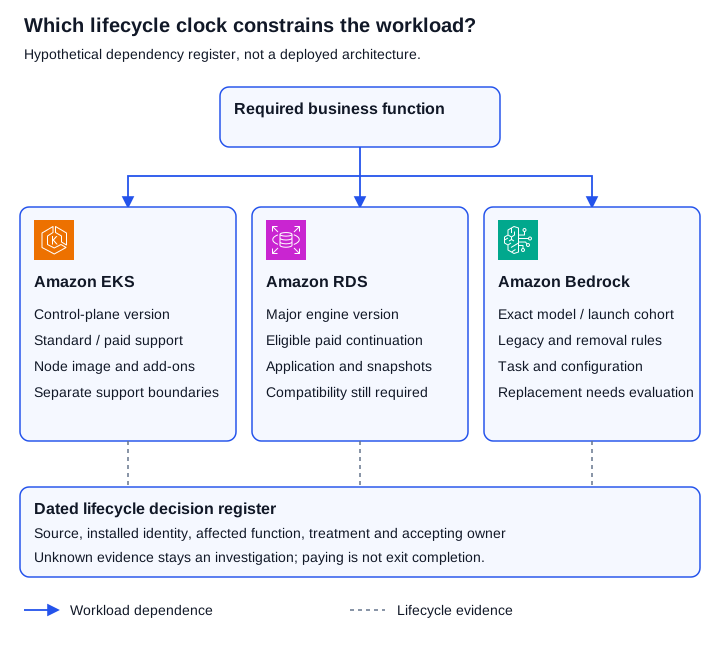
*Reference dependency view. Blue lines mean declared workload dependence, not runtime protocols or proven deployment. Dashed lines mean lifecycle evidence entering the register. Separate service and component clocks must not be collapsed into one deadline.*
Record edges as well as resources. If the database is used only for an optional report, its interruption may have a different consequence from losing the authoritative transaction store. If a model is used only to draft text that people can produce manually, the available hold or manual path may be sufficient. That judgment belongs to the actual service owner, not to the model's lifecycle label.
The diagram deliberately omits networking, Regions, account placement, IAM policies, instance sizes, inference destinations and deployment topology. Those details become required inputs when choosing or implementing a transition. They cannot be inferred from this reference view. The register below preserves where their absence would leave a decision unready.
4. EKS version continuation does not mean indefinite operation
AWS's EKS version lifecycle distinguishes standard support from a paid extended period and describes terminal automatic control-plane upgrades. Its default extended-support policy and the actual cluster policy must both be checked. AWS also documents a bounded prior-version rollback path for eligible in-place upgrades, rather than a universal prohibition or guarantee. Preserve the applicable lifecycle and recovery evidence with the decision.
Treat support policy as an operational configuration, not merely a finance label. The disable-extended-support guidance says that disabling extended support while eligible changes subsequent upgrade behavior; a cluster already in extended support cannot use that disablement path. A recommendation to “turn off the extra charge” may therefore imply a provider-triggered version change or be inapplicable to the installed state.
Inventory the control plane separately from customer-managed nodes and add-ons. Do not assume that an automatic control-plane update validates manifests, adjusts every node group or resolves application dependencies. Assign the platform owner the compatible intermediate-state analysis and assign the application owner the useful-service acceptance. A provider lifecycle transition is not evidence that those owners completed their work.
Use the Kubernetes operating evidence paper for detailed change and recovery planning. The portfolio decision here should commission that work with a bounded target, not reproduce its node-drain and policy procedures. The lifecycle record needs a supported destination, a funded owner and a feasible verification window before paid deferral can be defended.
5. A node-image retirement can invalidate the proposed deferral
The EKS AL2 transition FAQ separates the EKS-optimized AL2 image boundary from Kubernetes version support. EKS AL2 image support/publishing ended November 26, 2025; the broader AL2 end-of-support date was June 30, 2026. Both are past at this paper's October 7, 2026 source check. EKS extended support is not an AL2 image extension.
Consequently, an illustrative team proposing to keep an AL2 node image because it paid for the control-plane version has not justified that image's continued support. The finance approval addresses the wrong boundary. The next decision is not “how many more months of cluster support shall we buy?” It is how to replace or retire the affected image-dependent function, and which residual exposure the authorized owner may accept during that transition.
The AL2023 upgrade guidance shows why an image change is more than replacing a name: initialization, metadata behavior, packages and runtime assumptions need workload checks. Existing launch-template choices can also affect the available migration approach. This paper does not select AL2023 versus Bottlerocket or supply a universal migration command.
Do not describe the historical custom-AL2 build windows in the FAQ as an available future bridge. A past option is not a current treatment simply because it remains in documentation. If the team proposes a custom image today, require its maintained dependencies, ownership and support evidence independently. Calling an image custom transfers work to an owner; it does not restore the retired provider support envelope.
6. RDS paid continuation has an exit obligation
The RDS Extended Support guidance describes paid continuation for eligible major engine versions and an eventual terminal upgrade. Inspect the exact engine, version, topology, support dates and EngineLifecycleSupport setting. An engine-level support offering must not be generalized to every RDS engine, extension or customer dependency.
The paid option can preserve time to evaluate an application-compatible transition. That is its potential planning value, not proof that deferral is optimal. A defensible exception states why the immediate transition is not ready, which work the extra window funds, and when the team will cease using the old version. Continuing to pay without progressing the exit is recurring acceptance of exposure, not evidence of risk reduction.
Changing enrollment after standard support may initiate an automatic major-version transition. AWS's overview also documents restoration behavior around old engine snapshots. Do not treat disabling enrollment or restoring an old snapshot as a harmless accounting operation. Review the actual API/resource path and the resulting engine behavior before authorizing it.
An exception must account for future recovery, not only the running instance. Identify the engine required to restore retained snapshots, the application versions that can read that restored state and the access needed to validate it. A successful current query does not establish that next month's restore will preserve the same compatible environment. The worksheet records those questions without claiming that this paper tested them.
7. Bedrock retirement requires the correct launch cohort
AWS now publishes separate Bedrock lifecycle policies. The newer-launch policy applies to models launched on or after September 7, 2026; the earlier-launch policy governs prior launches. Identify the Bedrock launch cohort before reasoning about the notice period or a public extended-access phase. Model-provider API dates are not substitutes for Bedrock-specific evidence.
For the newer cohort, use the exact model card's no-sooner-than and notice information. Do not promise every model a six-month migration window. Legacy state can restrict new adoption or provisioning, and existing access can be affected by inactivity. For earlier models, public extended access may involve a pricing change before removal. Neither policy implies an indefinite, ordinary-account equivalent of database extended support.
The important application distinction is semantic replacement. When the old model is removed, changing an identifier does not prove that the new model meets the task's output, evidence, authorization or operating contract. A private continuation arrangement cannot be assumed. Treat the replacement evaluation, held-work policy and eventual removal of obsolete configuration as separately owned work.
Use GetFoundationModel and the relevant documentation/card to preserve dated identity and lifecycle evidence. The response schema can inform the register, but an API field is not a universal substitute for the applicable policy. This paper has not called a customer's account or demonstrated a particular model's present availability.
8. Build an evidence register, not a copied deadline list
Join provider evidence to an observed resource identity. A notice for a major engine is not enough if the team cannot establish which databases use it. A repository default is not enough if running nodes came from a different image. A human-readable model family is not enough if the application selects a version through an inference profile or deployment-specific configuration.
Retain the checked date and evidence location, not just a mutable dashboard link. Keep precise dates distinct from approximate dates and dates that remain unavailable. Record which field or statement establishes the boundary, its scope and any exception. Missing evidence remains an owned investigation. A blank date must not become “no deadline.”
Source discrepancies need visible handling. The broad EKS lifecycle page includes an illustrative AL2 statement less precise than the dedicated image-transition FAQ. For exact image dates, this paper uses the dedicated component guidance. If a disagreement affects a customer's action, preserve both statements and seek applicable clarification rather than quietly choosing the more convenient one.
The register's owner must also notice changes. A source-check date establishes what was inspected then, not an evergreen contract. Recheck before approving a transition and when a provider notice, inventory change, model state or support policy changes. Keep superseded evidence so a later reviewer can reconstruct why an earlier bounded decision was reasonable.
9. Notifications complement the register rather than certify it
AWS Health organizational view can help identify affected accounts and resources. Its enablement, organizational membership, loading state and history limits matter. At the source check, that viewing guide says pre-enablement events are not recorded, while the enablement guide says historical events may take up to 24 hours to appear. Treat historical coverage as unresolved until applicable guidance and actual loading/query evidence establish it. Neither an empty view nor an enabled-state readback proves that every material lifecycle obligation has been captured.
Assign an owner to turn a relevant notification into an inventory check and decision. The first output is the affected resource set and any missing ownership, not a bulk ticket with a generic due date. Retain a sanitized notice reference and source-check result. Keep sensitive account details and credentials out of public decision documents.
Use approved source exports and inventory reads where practical. This paper does not require enabling a new service, granting organization-wide access or wiring an EventBridge integration. If the team needs notification automation, commission it with an explicit account boundary, access model, retention and operational owner. A hypothetical monitoring capability must not be counted as existing evidence coverage.
10. Compare four treatments against the same function
| Treatment | Defensible condition | Added obligation | Reason to reject |
|---|---|---|---|
| Upgrade within the service | A supported target can meet the required function | Compatibility, bounded change and acceptance evidence | Target or recovery boundary is unverified |
| Eligible paid deferral | Exact continuation covers the actual component and a feasible funded exit | Enrollment, cost basis, expiry and accepted residual risk | Payment covers a different boundary or exit is unfunded |
| Replace or replatform | Existing mechanism cannot preserve the required envelope | New operating model, state migration and behavior evaluation | Additional dependence or complexity defeats the intended function |
| Retire or hold | Business can accept the resulting service limitation | Communication, data disposition and remaining deterministic path | Required obligation would be silently abandoned |
These are alternatives, not a maturity ladder. Replatforming is not automatically superior to a tested in-service upgrade. Paid deferral is not automatically waste. A narrow held function can be more defensible than an unevaluated replacement that gives users a confident but changed result.
Compare them on accepted function, security boundary, reversibility, operating effort, timeline confidence and financial basis. Some factors are constraints rather than weighted preferences. A prohibited data destination cannot be offset by a better price. An unsupported image is not made supported by a low assessed outage probability. Expose the authority required to accept each remaining exception.
11. Price the window without inventing a migration return
The model should separate continuation charges, implementation effort, overlapping operation, retained copies and steady-state changes. A provider support surcharge is not the whole cost of waiting. A migration estimate is not the whole cost of moving. Compare options over an explicitly defined observation/planning window and record exclusions.
For an eligible resource, a symbolic continuation expression is sum(applicable quantity × dated rate × billed duration). The quantity might differ by service and topology. RDS charge guidance includes standby instances and documented historical timing exceptions. Obtain actual engine/Region rates and reconcile the applicable charge start rather than turning a simplified date rule into a universal invoice calculation.
Keep engineer-days and currency separate until the organization supplies an authorized cost model. Do not invent an hourly rate or multiply a rough estimate into a promised saving. Present uncertainty as an interval or named unknown. If a workload is to be retired soon, include that planned retirement as an alternative to paying for an upgrade that will never support useful traffic.
The financial question is which funded option preserves the accepted function within the constraint, not how to force every item into a positive ROI. Security or support obligations may justify work without a speculative velocity benefit. Conversely, a large budget cannot make a nonexistent continuation mechanism available.
12. Use a fictional portfolio to expose the wrong-boundary exception
Consider a hypothetical processing service with three planning rows. All installed resources, owners and relative deadlines below are stipulated examples, not a real inventory. T is the fictional review day, not a named service's published EOL. Before using the method, replace every relative boundary with checked evidence for the actual component.
| Row | Stipulated condition | Proposed decision | Evidence preventing a false conclusion |
|---|---|---|---|
| EKS execution | Control plane still in standard support until T+60; workers use retired EKS AL2 images | Reject the claim that a cluster support payment extends the image. Fund a bounded node replacement investigation and compatibility path | Dedicated image support notice and actual worker image identity; control-plane policy remains a separate record |
| RDS state | Eligible old major version, actual enrollment assumed verified for this fictional example; supported upgrade target identified but not yet tested | Consider a short accepted paid exception only if the evaluation and exit work are funded | Actual enrollment and dates would be required in a real estate; retained snapshot/app restore compatibility stays unresolved until tested |
| Bedrock task | Fictional newer-cohort model card has an announced EOL at T+45; candidate behavior evaluation has not passed | Do not assume automatic migration or six months of notice. Commission a bounded evaluation and held-task alternative | Exact model/card and cohort would be required; a model name change is not task acceptance |
This comparison does not authorize continuing the unsupported image. It demonstrates why the proposed finance treatment is insufficient. Security and service owners must decide the permitted containment and transition scope. Nor does the RDS row claim a particular database qualifies; qualification is stipulated only to show how an eligible option differs from the rejected one.
Suppose the team has a planning capacity of 18 engineer-days after ordinary obligations, and the three investigations are provisionally estimated at 6, 5 and 7 days. The sum is 18, but those estimates are not interchangeable labor or proof of feasibility. The plan assigns bounded discovery/evaluation outputs, not completion of all migrations. Missing specialist capacity or a failed fixture can change the allocation. The review must disclose that change rather than treating the illustrative total as an execution promise.
13. Make the acceptance decision reversible where possible
Before accepting paid deferral, verify the exact continuation mechanism and whether it covers the actual boundary. If the evidence is missing, investigate or hold. If it covers the wrong component, compare upgrade, replacement or retirement. If it covers the component but the required exit has no feasible funding or owner, the exception is not ready merely because the service can keep billing it.
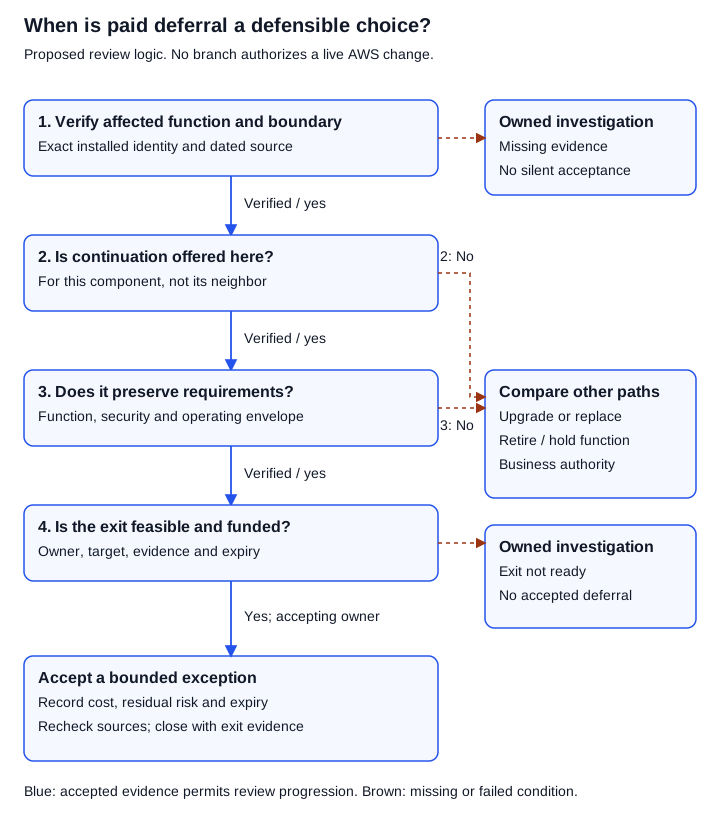
*Proposed decision tree, not AWS API behavior. No branch means automatic operational approval. An accepted exception includes an owner, expiry, funding and source-change trigger. A failed or unknown evidence check does not silently continue to acceptance.*
Reversibility is a property of the planned transition, not the word rollback. Identify where old state can still be read, where new writes or external effects change the recovery question, and whether returning to the old dependency remains supported. A model replacement may need to hold unresolved tasks; a database transition may need state reconciliation. Do not promise that one configuration toggle restores every business consequence.
14. Preserve a reusable lifecycle decision record
Decision ID and checked date:
Required function and service owner:
Resource identity, account/Region and configuration revision:
Component version/model ID and dependency identities:
Observed inventory reference (or explicitly unknown):
Boundary type: standard support / paid continuation / image retirement / model removal
Authoritative policy/card and applicable launch cohort:
Date certainty: exact / approximate / unknown
Boundary dates and provider behavior at each boundary:
Actual enrollment/upgrade policy/deployment type:
Chosen treatment and alternatives rejected:
Current function/evidence/security requirements:
Continuation coverage and exclusions:
Cost basis, dated rate/quantity inputs and uncertainties:
Bounded evaluation output and proposed fixtures:
Compatible target and state/recovery constraints:
Funding authority, implementer, accepting service owner:
Residual-risk authority and accepted scope:
Exception expiry and funded exit milestone:
Stop/review triggers, including source or inventory changes:
Observed results (blank until executed):
Retirement/retained-copy disposition evidence:
A populated template is not proof that a resource was upgraded. Separate observed fields from plans. Keep links to approved internal evidence rather than copying credentials, customer payloads or unrestricted diagnostic data. The public article's example record deliberately contains no real account identity or claim of access.
Version the decision when scope changes. An accepted engine exception does not automatically cover a new replica, another Region or a different model task. Keep the original reasoning and the replacement decision rather than editing the historical record into an apparently successful plan. This allows finance and engineering to distinguish paid time purchased from useful exit work actually completed.
15. Define proposed evaluation outputs before allocating the work
For the node-image row, the bounded output is an actual-image inventory, supported candidate choice, dependency checks and representative workload fixtures. Check startup, storage, networking, workload credentials and application runtime behavior in an authorized environment. A node joining is a partial observation, not acceptance of the processing function. This paper has not run those tests.
For the database row, the output is a version/extension/app compatibility record and isolated state/recovery evaluation. Include representative query and data invariants, retained snapshot behavior, permitted target and a recovery method whose state assumptions are explicit. Do not test an enrollment change against production simply to learn whether it triggers an upgrade. Documentation review and an authorized representative environment should precede consequential action.
For the model row, the output is a task-family evaluation against required evidence and adverse fixtures. Preserve authorization checks independently of the generator. Examine refusals, incomplete outputs, unsupported claims, latency/capacity limits and the safe held-task experience. The provider continuity and exit paper owns detailed task-switching and portable-state mechanics. This lifecycle paper commissions those outputs rather than relabeling that existing framework.
Each investigation needs a stopping condition and the decision its result can change. A failed candidate may justify another candidate, a narrower function or retirement. It should not silently authorize a larger program. An unexecuted test plan remains proposed; no template checkbox or AI peer review substitutes for observed workload adoption evidence.
16. Separate funding, execution and residual-risk authority
Finance can approve the applicable support expense and implementation budget. It cannot establish that a retired image is supported. The platform owner can assess a compatible target and change approach. It cannot accept every customer obligation or data-processing constraint. The application owner decides whether the required function remains useful; security and relevant risk owners determine which exposure can be accepted within their authority.
Record when one person holds more than one role. The purpose is not organizational complexity for its own sake, but a reconstructable decision. The approver of an exception should know whether the underlying evidence is current and which claims remain unknown. The executor should know the approved boundary and how to stop without expanding it.
Avoid an emergency policy that authorizes any available replacement because a deadline was missed. Model availability, supported infrastructure and a low price do not establish permitted data handling or command authority. Likewise, a support continuation fee does not justify broad administrator access, uncontrolled test restores or indefinite retained copies. Lifecycle urgency changes prioritization; it does not remove security boundaries.
17. Review exceptions through their exit evidence
At each review, ask what new evidence changes the decision. A support bill proves a charge was incurred, not that migration work progressed. A pull request proves a source change, not that the installed estate adopted it. A candidate model answering sample questions proves limited behavior, not acceptance for every task. Close the gap with the output appropriate to the originally funded boundary.
Trigger review when the source policy changes, a component/model enters a new state, inventory grows, expected migration effort changes or the agreed fixture fails. Recheck exact deadlines before a change window. A monthly meeting alone can be too coarse for a short model notice or a changed deployment restriction. Set the cadence from the remaining evidence window and the consequence of missing it, not a universal scheduling rule.
At closure, retain the resulting component identities, acceptance evidence, removed obsolete configuration and disposition of retained data/copies. Confirm which support charges should cease and reconcile actual bills separately. A theoretical avoided surcharge is not achieved savings until the relevant charge no longer occurs on a comparable basis. Report remaining exclusions instead of calling the whole portfolio modernized.
18. Limits and next action
Review checklist: accept a treatment, not a support label
- Match the recorded installed identity to the exact provider component and lifecycle policy. A control-plane policy cannot clear a node-image exception; a model family cannot establish a launch cohort.
- Identify the required customer function and what degradation the service owner permits. Keep unknown dependence as an investigation rather than silently ranking its consequence low.
- Compare upgrade, eligible continuation, replacement and retirement against that same function. Record the disqualifying requirement for every rejected option.
- For paid continuation, verify component coverage, applicable enrollment and dates, a funded exit output, an accountable implementer and an expiry or earlier invalidating event.
- Separate proposed evaluation from observed results. The responsible owner must accept compatibility, retained-state recovery and eventual installed adoption before the transition is called complete.
- Retain the decision revision, accepted limits and next evidence action. Reopen changed inputs and reconcile resulting charges separately from hypothetical avoided cost.
This framework cannot determine eligibility, legal obligations, pricing, migration safety or model task quality without the actual estate. It does not cover every AWS service, every customized model lifecycle or every support arrangement. Private contractual exceptions and special deployment paths require their own evidence. Documentation may change; source checks are not a promise of future behavior. The figures are reference views and have not been validated against a deployed workload.
Do not turn a weak deadline inventory into a program that upgrades everything indiscriminately. Also do not use uncertainty as a reason to carry every exception indefinitely. Choose one required function, identify its exact installed dependencies, preserve current authoritative lifecycle evidence and compare the four treatments. Unknown ownership or enrollment may make the next useful output a bounded inventory check, not an architecture build.
The conclusion is a narrow one: purchase only the continuation that covers the actual constraint, fund the work needed to leave it, and keep replacement/retirement available when continuation cannot preserve the required function. The useful first review packet is one complete lifecycle decision record with a rejected wrong-boundary treatment, a named owner and a verified next evidence requirement.
Ampity's AWS consulting services can be relevant when the organization needs a scoped inventory, decision or transition assessment. Agree the evidence outputs, access, exclusions and acceptance criteria for the actual system separately. This paper makes no competency, delivery-time, ranking, deployment or outcome guarantee.