Business Continuity Planning: Mapping AI Tool Dependencies for Critical Processes
How business continuity managers and CROs can identify and manage AI tool dependencies in business continuity plans, covering AI dependency inventory, manual fallback...
Business continuity plans are written against a world where the critical path runs through people, systems, and suppliers. When AI tools become part of the operational critical path, the BCP must account for them explicitly. Organizations that add AI tools to critical processes without updating their BCPs create an invisible dependency that is not reflected in their recovery plans.
This article describes how to identify AI tool dependencies in critical processes, document manual fallback procedures, and estimate recovery time objectives for each dependency.
Why AI dependencies in critical processes need explicit BCP treatment
A well-managed organization maps its critical process dependencies: which suppliers, systems, and people are on the critical path, and what happens if each fails. AI tools that become operationally embedded in critical processes are dependencies in the same sense as any other supplier or system, with specific characteristics that require distinct treatment.
Availability characteristics differ from conventional software. AI tool availability depends on the cloud service provider, the AI model provider, and the integration layer. An outage at any of these layers can make the AI tool unavailable without the organization's own systems being affected. The recovery path is outside the organization's control.
Manual fallback capability can atrophy. When AI handles a task routinely, the team's proficiency at the manual equivalent can decline. A BCP that assumes the team can revert to manual procedures needs to verify that the team still has the skills and tools to do so. Skills and documentation that were current when the AI was introduced may be stale two years later.
AI tool failure may not be obvious. A conventional system failure typically produces an error message. An AI tool that is producing degraded output may appear to be functioning while generating wrong results. The manual fallback trigger must include quality degradation, not only tool unavailability.
Step 1: AI dependency inventory for critical processes
For each critical process in the BCP, add an AI dependency section. This section identifies each AI tool involved in the process and the nature of its involvement.
AI dependency fields:
| Field | Description |
|---|---|
| Process name | The critical process this dependency belongs to |
| AI tool name | Specific tool or service |
| Dependency type | Decision support (AI advises, human decides) / Process automation (AI acts without human per-step review) / Data processing (AI produces structured output for downstream use) |
| Criticality to process | Can the process run without this tool? At reduced capacity? Not at all? |
| Provider | Who operates the AI service (vendor, internal team, cloud provider)? |
| Last confirmed availability SLA | The availability commitment from the provider, if any |
| Fallback procedure reference | Link to the documented manual procedure |
| RTO estimate | Time to restore AI-assisted operation or complete a manual equivalent |
Step 2: Manual fallback procedure per dependency
For each AI dependency with criticality "reduced capacity" or "not at all," document a manual fallback procedure. The procedure must be specific enough for someone who has not used the manual method recently to follow without additional help.
The fallback procedure should include:
- Who initiates the fallback (role, not name)
- What signals trigger the fallback (tool unavailability, quality threshold breach, provider incident notification)
- What tools and access the team needs to execute the fallback manually
- The step-by-step procedure in enough detail to follow without reference to the AI tool
- The expected throughput at manual capacity (this is usually lower, and the BCP should reflect it)
- The re-entry procedure when AI tool availability is restored
The fallback procedure must be tested annually. A procedure that has never been executed is a document, not a plan. Test results should be recorded with date, participants, and any procedure updates resulting from the test.
Worked example: finance close process with three AI dependencies
A finance team runs a monthly close process with the following AI tools embedded:
AI dependency 1: AI-assisted account reconciliation. The AI tool matches transaction records against bank statements and flags discrepancies for human review. Without the tool, the reconciliation team performs manual three-way matching using spreadsheets.
| Field | Value |
|---|---|
| Dependency type | Process automation |
| Criticality | Reduced capacity (can run manually but at 40% throughput) |
| Provider | SaaS vendor |
| Fallback | Manual reconciliation spreadsheet procedure (documented in BCP appendix A) |
| RTO estimate | 2 hours to switch to manual; full close timeline extends by 1.5 days at manual throughput |
AI dependency 2: AI-assisted variance commentary generation. The AI tool drafts initial commentary on budget vs. actual variances for the finance narrative report. Without the tool, analysts write commentary manually.
| Field | Value |
|---|---|
| Dependency type | Decision support |
| Criticality | Reduced capacity (manual drafting adds time but process continues) |
| Provider | Cloud LLM service |
| Fallback | Manual commentary using analyst templates (documented in BCP appendix B) |
| RTO estimate | No switch time needed; process continues at manual pace; timeline extends by 4 hours |
AI dependency 3: AI document classification for expense coding. The AI tool classifies expense reports into cost categories and suggests GL coding for human approval. Without the tool, expense coders review and code manually.
| Field | Value |
|---|---|
| Dependency type | Decision support |
| Criticality | Reduced capacity (manual coding at 30% throughput) |
| Provider | Internal AI system on cloud infrastructure |
| Fallback | Manual coding procedure using GL reference sheet (documented in BCP appendix C) |
| RTO estimate | 1 hour to shift queue to manual team; timeline extends by 2 days for full expense volume |
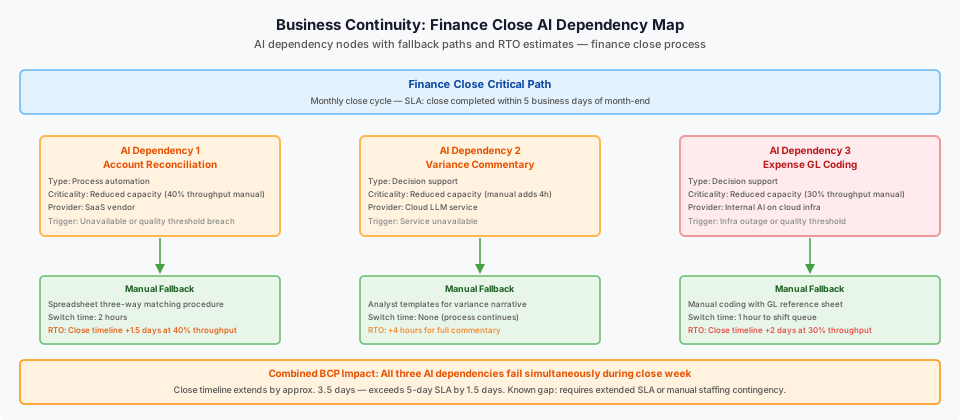
Combined BCP impact: If all three AI dependencies fail simultaneously during close week, the close timeline extends by approximately 3.5 days at manual throughput. This exceeds the organization's current close SLA by 1.5 days. The BCP should record this as a known gap requiring either an extended SLA under fallback conditions or a staffing contingency to increase manual throughput.
Diagram: critical process dependency map
See the accompanying diagram (business-continuity-ai-tool-dependencies-desktop.svg) showing the finance close critical path with AI dependency nodes, fallback paths, and RTO estimates per dependency.
RTO estimation methodology
The RTO for an AI-dependent step is the time to restore AI-assisted operation at its pre-outage performance level. This may be much longer than the time to restore the AI tool itself, because:
- Manual teams may need to clear a backlog accumulated during the outage before steady-state throughput resumes.
- Some AI dependencies have no equivalent manual process and require process redesign to work around.
- Internal AI systems on cloud infrastructure have a recovery path that depends on infrastructure recovery, not just tool reactivation.
Estimate RTOs from the last manual operation or test, not from an assumption that the team can immediately revert to full manual throughput.
BCP update cadence for AI dependencies
Review the AI dependency section of the BCP whenever:
- A new AI tool is added to a critical process
- An existing AI tool changes scope or is updated significantly
- A provider changes their availability commitments
- The process changes in a way that changes the AI tool's role
- An annual BCP review is conducted
Annual BCP reviews must include a test of at least one AI tool fallback procedure per critical process. Document the test date, participants, and results.
Failure modes
BCP that lists AI tools without manual fallbacks. A dependency map without a fallback procedure is an inventory, not a plan. Every identified dependency needs a documented alternative or a written acceptance that no alternative exists.
Manual fallback procedure that has not been tested. An untested procedure may fail on the first real execution due to tool access changes, procedural gaps, or skill atrophy. Test results are as important as the procedure document.
RTO estimates based on optimistic assumptions. An RTO of "two hours" that assumes full manual staffing, current familiarity with manual procedures, and no backlog from the outage period is not an honest RTO. Build estimates from test results, not from plans.
Missing the quality degradation trigger. If the fallback only triggers on tool unavailability, a scenario where the AI tool is available but producing degraded output goes unaddressed. Define quality thresholds as fallback triggers alongside availability triggers.
What to do next
Start with the most time-sensitive critical process in your organization and map its AI dependencies first. For each dependency, confirm whether a manual fallback procedure exists and when it was last tested. The gap between the AI dependency map and the tested fallback procedures is the BCP risk picture.
For provider outage planning from the AI system design perspective, see the AI provider outage degraded mode resource. For AWS disaster recovery design, see the AWS disaster recovery workloads whitepaper.
The Custom AI Workforce service page describes how Ampity designs AI workforce deployments with operational resilience and fallback design built in.
Primary references
- AWS Disaster Recovery workloads on AWS whitepaper, source checked 2026-11-05
- AWS Bedrock Responsible AI, source checked 2026-11-05
Related resources
What Should an AI Workflow Do During a Provider Outage?
Choose safe delay, tested fallback or a bounded manual path during an AI outage. Preserve task state, reconcile uncertain writes and control backlog recovery.
Prepare Your Company for an AI Workforce in 2027
Prepare your first AI workforce role for 2027: define its job, data access, accepted results, exception ownership, test evidence and operating costs.
Executive Reporting: Board-Level AI Risk Posture and Business Value Framework
How CTOs, CIOs, and Chief AI Officers should design a quarterly board report on AI risk posture and business value, covering value metrics, risk indicators, incident summary, and forward investment view.