AWS EDP: Publicly Available Signals, Commitment Risk, and What to Raise With AWS
Understand the AWS Enterprise Discount Program as a commitment-based program from publicly available information. Covers commitment risk considerations, qualification...
The AWS Enterprise Discount Program (EDP) is a commitment-based arrangement where an organization agrees to a minimum level of AWS spend over a defined period in exchange for a discount on that spend. EDP terms, discount rates, and eligibility criteria are negotiated privately with AWS and are not publicly disclosed in detail. This article covers what is publicly understood about EDP, the commitment risks a buyer should evaluate, and the questions to raise directly with AWS or a qualified AWS partner.
This article does not assert specific discount percentages, guaranteed qualification criteria, or negotiation outcomes. All EDP terms are privately negotiated. Source: AWS Pricing, checked 2026-11-05.
What is publicly understood about EDP
EDP is not a self-service program. You do not sign up through the AWS console. It is an enterprise commercial arrangement that AWS offers to organizations with substantial and growing AWS spend. The following characteristics are commonly understood from public AWS partner and customer discussions, though specific terms vary.
Commitment-based structure. The organization commits to a minimum annual or multi-year AWS spend threshold. In return, AWS provides a discount applied to eligible services. The discount applies retroactively to qualifying spend, not as an upfront credit.
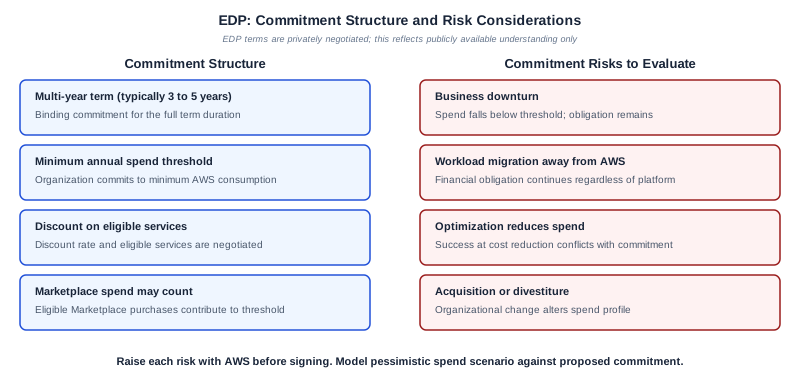
Multi-year terms. EDP agreements typically span multiple years (commonly 3 to 5 years). The commitment is binding for the term duration, which means the organization is obligated to meet the spend threshold regardless of changes in business conditions.
Eligible services. Not all AWS spending may count toward the EDP commitment. The specific list of eligible services and spend types is defined in the agreement. AWS Marketplace purchases from eligible vendors may count toward the commitment, which is one reason organizations route software procurement through Marketplace.
Private negotiation. Each EDP agreement is negotiated individually between the organization and AWS. Discount rates, spend thresholds, eligible services, and flexibility provisions are all negotiated terms. There is no published rate card.
Signals that AWS may initiate an EDP conversation
While qualification criteria are not publicly standardized, several signals commonly precede an EDP conversation.
Substantial current AWS spend. Organizations with significant monthly AWS consumption are the primary audience for EDP. The specific threshold varies, but EDP is designed for enterprise-scale spend, not startup or departmental budgets.
Predictable growth trajectory. AWS is more likely to offer favorable EDP terms when the organization demonstrates consistent spend growth. A growing trajectory reduces AWS's risk that the organization will struggle to meet the commitment.
Strategic AWS commitment. Organizations that have chosen AWS as their primary cloud platform and are planning workload consolidation onto AWS present a stronger case for EDP than organizations with multi-cloud strategies that divide spend across providers.
Upcoming contract renewals. If the organization has existing AWS commit arrangements (Savings Plans, Reserved Instances) approaching renewal, this creates a natural negotiation window.
Commitment risk considerations
EDP commitment risk is the primary evaluation area for a CFO or VP of Infrastructure. The discount is valuable only if the organization can meet the commitment without overprovisioning or maintaining unnecessary spend.
Risk 1: Business downturn reduces AWS usage
If the organization's business contracts, AWS spend may fall below the EDP commitment threshold. The organization is still obligated to meet the minimum spend, which means paying for AWS capacity it does not need. This is the most significant EDP risk.
Mitigation question to raise with AWS: What happens if our actual spend falls below the commitment threshold? Are there provisions for renegotiation, commitment reduction, or payment of the shortfall difference?
Risk 2: Workload migration away from AWS
If the organization decides to move workloads to another cloud provider or back to on-premises infrastructure, the EDP commitment constrains that decision. The financial obligation to AWS continues regardless of where the workloads run.
Mitigation question to raise with AWS: Does the EDP include any provisions for commitment adjustment if we migrate workloads to a different platform?
Risk 3: Technology shift reduces compute demand
Efficiency improvements, serverless migration, or AI-driven optimization may reduce AWS spend below what was projected when the EDP was negotiated. Ironically, successful optimization can make it harder to meet the commitment.
Mitigation question to raise with AWS: If we significantly reduce spend through optimization, does the EDP commitment adjust, or are we committed to the original threshold?
Risk 4: Acquisition or divestiture changes scope
Mergers, acquisitions, or divestitures can change the organization's AWS spend profile significantly. An EDP negotiated for a combined entity may not fit after a divestiture.
Mitigation question to raise with AWS: How does the EDP handle organizational changes such as acquisitions, divestitures, or spin-offs?
Worked example: evaluating EDP qualification
A manufacturing company with annual AWS spend of approximately $3M, growing 25% year over year, is evaluating whether to pursue an EDP conversation with AWS.
Assessment of qualification signals:
| Signal | Status | Implication |
|---|---|---|
| Current spend level | $3M annually, $250K monthly | Likely in the range for EDP conversation |
| Growth trajectory | 25% year-over-year | Positive signal for AWS |
| Platform commitment | 90% of cloud spend on AWS | Strong single-platform signal |
| Contract renewals | Savings Plans renewing in 6 months | Natural negotiation window |
Commitment risk assessment:
| Risk factor | Likelihood | Impact | Mitigation |
|---|---|---|---|
| Business downturn reducing spend below commitment | Moderate | High | Negotiate commitment at 80% of projected spend |
| Workload migration to another provider | Low (strategic AWS commitment) | Very high | Ensure EDP does not prevent evaluation of alternatives |
| Optimization reducing spend | Moderate (active FinOps) | Medium | Model aggressive optimization scenario against commitment |
| Organizational change | Low | High | Include M&A provisions in EDP negotiation |
Negotiation checklist:
- Model three spend scenarios (base, optimistic, pessimistic) against the proposed commitment level
- Ensure the commitment is set at or below the pessimistic scenario to avoid shortfall risk
- Understand which services and spend types count toward the commitment
- Clarify whether Marketplace purchases count and under what conditions
- Request provisions for commitment adjustment in case of organizational change
- Understand the discount structure and how it compares to existing Savings Plans and Reserved Instance discounts
- Determine whether the EDP replaces or supplements existing commitment mechanisms
When EDP may not be the right choice
Unpredictable spend. Organizations with highly variable AWS consumption face higher commitment risk. If spend could reasonably drop below the commitment in a downside scenario, the EDP may create more risk than value.
Multi-cloud strategy. Organizations that deliberately distribute workloads across AWS, Azure, and GCP may not want to lock a large commitment to a single provider, even at a discount.
Early-stage cloud adoption. Organizations in the early stages of cloud migration may not have enough spend history to accurately predict future consumption, making a multi-year commitment risky.
Active cost optimization. If the organization is in the middle of a major cost optimization initiative, projected spend based on current consumption may be too high. Negotiate after the optimization stabilizes and you have at least two months of post-optimization spend data to use as a baseline.
Next step
If the qualification signals suggest EDP may be appropriate, prepare the three-scenario spend model and the negotiation checklist before contacting your AWS account team. Involve your CFO and legal counsel in the review, as EDP is a binding financial commitment.
Ampity helps organizations evaluate and optimize AWS commercial arrangements. To discuss your spend strategy, visit our AWS Consulting service page.
Primary references
- AWS Pricing, source checked 2026-11-05
- AWS Reserved Instances documentation, source checked 2026-11-05
Related resources
AWS Cloud Credits: Runway and the Bill After Expiry
Separate eligible credit offsets from the gross operating bill using an exact monthly ledger, expiry loss, excluded charges and post-credit scenarios.
Is This Savings Plans Recommendation Still Valid After the Migration?
Check migration cutover, historical lookback, current commitment inventory and excluded queued purchases before treating a Savings Plans recommendation as a usable decision input.
AWS Native FinOps vs Third-Party Platforms: When Cost Explorer Is Enough
Compare AWS native cost management tools with third-party FinOps platforms across allocation, anomaly detection, forecasting, and showback. Includes decision criteria by organization size and complexity.