Marketing: AI Content Governance and Approval Chain Design
How VP Marketing and brand directors should design an approval chain for AI-assisted marketing content, covering content types, required reviews by type, approval...
AI-assisted content generation changes the speed at which marketing teams can produce drafts. It does not change the fact that published content carries brand, legal, and regulatory risk. An approval chain designed for human authorship at human speed does not translate well when the volume of AI drafts exceeds the capacity of reviewers who assumed slower throughput.
This article describes how to design an approval chain that fits the actual risk profile of different AI-assisted content types, rather than applying a uniform review gate to everything and creating a bottleneck, or applying no gate and publishing unchecked AI output.
Why AI content governance needs its own design
The problems that arise from AI-generated marketing content are different from the problems that arise from human-authored content.
Volume exceeds review capacity. AI tools can generate dozens of blog drafts or social posts in an hour. A one-reviewer-per-post rule that worked at human authorship speed becomes a queue bottleneck at AI scale.
Hallucination risk is different from error risk. A human author who writes an inaccurate statistic usually does so from memory or a misread source. An AI system produces plausible-sounding text that may have no basis in any source. The fact-check review required for AI content must actively verify claims, not assume good-faith accuracy.
Brand voice drift. AI systems trained on broad text corpora can produce text that is grammatically correct but tonally inconsistent with the brand. A single AI draft does not represent the brand. Thousands of AI-drafted posts do, in aggregate, if they are published without brand voice review.
Regulatory exposure. In regulated industries (financial services, healthcare, pharmaceuticals), content that makes capability or outcome claims can trigger compliance obligations. AI content that generates a confident-sounding regulatory claim requires legal sign-off regardless of whether a human or AI wrote it.
Content type classification
The first step in approval chain design is classifying AI-assisted content types by their risk profile. Risk varies by audience, channel, claim type, and regulatory exposure.
| Content type | Audience | Claim sensitivity | Regulatory exposure | Suggested review tier |
|---|---|---|---|---|
| Internal AI-drafted blog (B2B, factual) | Practitioners | Medium | Low | Fact-check + brand voice |
| Product capability page | Buyers | High | Medium | Fact-check + brand voice + legal |
| Social post (organic) | Public | Low | Low | Brand voice spot-check |
| Paid ad copy | Public | High | Medium | Fact-check + legal + brand voice |
| Whitepaper or long-form research | Decision-makers | High | Low to medium | Full editorial + fact-check + legal |
| Email campaign | Existing customers | Medium | Medium | Fact-check + brand voice + compliance |
| Regulated industry content | Regulated audience | High | High | Full review + compliance + legal |
This table is a starting classification. Organizations should adjust it based on their specific industry, regulatory context, and brand risk tolerance.
Defining review gates by content type
Once content types are classified, assign a review gate to each gate type. A review gate is a named checkpoint with a named reviewer role, a defined scope of review, and an evidence format.
Fact-check gate. Verifies that factual claims in the draft are supported by a cited source. The reviewer should not assume a claim is accurate because it sounds plausible. For AI-generated content, treat every specific statistic, product capability claim, and attributed quote as unverified until a source is found and recorded.
Evidence format: a note next to each factual claim recording the source URL, the supporting text in the source, and the reviewer's initials. Claims that cannot be sourced are either removed or marked as the company's own stated position (not an external fact).
Brand voice gate. Checks whether the draft matches the brand's voice guidelines. This covers tone (formal vs. conversational), vocabulary (approved vs. avoided terms), and structural choices (sentence length, heading style).
Evidence format: a checklist of voice criteria with pass/fail notation and any specific edits made.
Legal gate. Reviews for claims that could create legal exposure: comparative claims about competitors, regulatory or compliance guarantees, capability claims that could constitute an offer or warranty, and content in regulated categories.
Evidence format: legal reviewer sign-off with date and any required modifications noted. Required only for content types with medium or high regulatory exposure.
Compliance gate. For regulated industries, a compliance reviewer confirms that the content meets applicable regulatory requirements for marketing communications. This is distinct from legal review: legal reviews for general liability, compliance reviews for industry-specific obligations.
Worked example: B2B marketing team with AI-assisted blog drafts
A B2B marketing team uses AI tools to draft blog articles at two to three times the previous authoring rate. The articles target engineering practitioners and are published on the company website. They occasionally reference competitor comparisons and product capability claims.
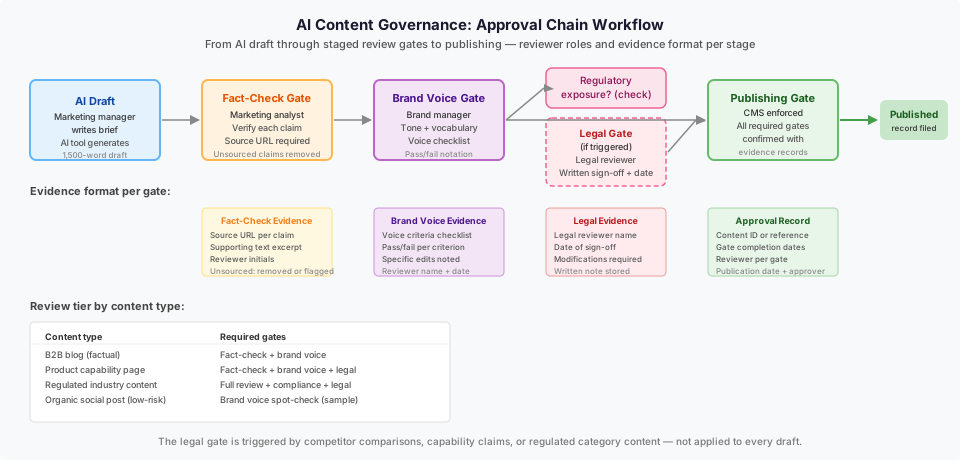
Step 1: AI drafts an article. The AI tool produces a 1,500-word draft based on a brief written by a marketing manager. The draft contains three factual statistics, two product capability claims, and one comparison to a competitor's approach.
Step 2: Fact-check gate. A marketing analyst reviews each factual claim and records a source URL and supporting text for each. Two of the three statistics are found and confirmed. The third cannot be sourced and is removed from the draft. The two capability claims are verified against the product team's current documentation. The competitor comparison is flagged for legal review because it names a specific competitor and makes an implicit superiority claim.
Step 3: Brand voice gate. A brand manager reviews the draft against the voice guidelines. The AI has used two terms the brand style guide flags as overused marketing language. The reviewer replaces them with more specific alternatives. Sentence length in the opening section is inconsistent with the brand's preferred direct style; the reviewer condenses three introductory sentences into one.
Step 4: Legal gate (triggered by competitor comparison flag). The legal reviewer assesses the competitor comparison. The specific phrasing is modified to remove the implicit superiority claim while preserving the technical distinction the article was making. Legal provides a written sign-off note with date.
Step 5: Publishing gate. Only after all required gates are completed and evidence is recorded does the content management system permit the article to be scheduled for publication. The gate requires confirmation that fact-check, brand voice, and (where triggered) legal review are complete with recorded evidence.
Approval record format
Every piece of published AI-assisted content should have an approval record that includes:
- Content ID or file reference
- Content type and assigned review tier
- Date of each gate completion
- Reviewer name or role for each gate
- Evidence reference (linked document, inline annotation, or ticket ID)
- Publication approval date and approver
This record is not bureaucracy for its own sake. It is the basis for a post-publication quality review (did content that skipped a gate produce more problems than content that followed the chain?) and for auditing compliance in regulated industries.
Diagram: AI content governance workflow
See the accompanying diagram (marketing-ai-content-governance-approval-chain-desktop.svg) showing the content workflow from AI draft through review stages to publishing gate, with reviewer roles and evidence format for each stage.
Scaling the approval chain without bottlenecks
The practical risk in a strict approval chain is that it becomes the throughput bottleneck and teams route around it informally.
Tier content volume to review depth. Not every piece of content requires every gate. A social media post with no factual claims and no regulatory exposure does not need a legal gate. The classification table should actively prevent over-review as well as under-review.
Use spot-check sampling for lower-risk content. For high-volume, low-risk content types (organic social posts, internal newsletters), apply a gate to a random sample rather than every piece. Record the sampling rate and results. If the error rate in the sample rises, increase the sampling rate.
Record gate results in the authoring workflow, not a separate system. If reviewers must switch to a separate tracking tool to record their completion, they will skip it under time pressure. Build the gate record into the authoring tool or CMS workflow.
Failure modes
Applying a single uniform gate to all content. Results in legal review being required for internal blog drafts and fact-check being skipped for ad copy because the reviewer assumes it was already done in the uniform chain. Classification by risk profile prevents this.
Treating AI output as a first draft that needs light editing. AI-generated content needs active verification, not proofreading. The review mindset is different. Reviewers who approach AI drafts as they approach junior writer output will miss hallucinated claims.
No publishing gate enforcement. Approval chains without technical enforcement are voluntary. Teams under deadline pressure will skip gates without a system-level block. The CMS or publishing workflow must require gate confirmation before the publish action is available.
Not updating the chain when AI tools change. Different AI tools produce content with different risk profiles. When a team adopts a new AI tool or changes its usage pattern, review whether the approval chain needs adjustment.
What to do next
The next useful step is classifying your current AI-assisted content types against the risk dimensions above. For each type, assign a review tier and define the evidence format for each gate. Then enforce the chain at the publishing layer, not only as a process guideline.
For the broader governance framework that covers AI tools across the organization, see the AI governance framework resource. For governance audit procedures, see the Enterprise AI Governance Audit playbook.
The Custom AI Workforce service page covers how Ampity designs governance frameworks for AI workforce deployments including content operations.
Primary references
- AWS Bedrock Responsible AI, source checked 2026-11-05
- Amazon Bedrock Guardrails documentation, source checked 2026-11-05
Related resources
AI Governance Framework: Production Decisions, Controls and Evidence
Build proportionate AI governance with a decision inventory, a worked routing example, release evidence, calibrated monitoring and explicit stop conditions.
AI Workforce Operating Model Design: Role Definitions and Human-AI Task Boundaries
A step-by-step playbook for operations directors and transformation leads to design an AI workforce operating model: covering role definitions, task routing rules, escalation paths, and boundary documentation as a governance artifact produced before deployment.
Enterprise AI Governance Audit: Policy Inventory, Access Review, Output Sampling
An execution guide for compliance officers and internal audit teams conducting an enterprise AI governance audit: covering policy inventory, access review, output sampling, risk rating, and findings documentation.