India AWS Partner Selection: Reading APN Competency Evidence Before Signing
Evaluate India-based AWS partners beyond tier and competency badge. Covers evaluation criteria, competency depth testing, team composition checks, and reference...
India has a dense concentration of AWS Partner Network (APN) members. When you search for AWS consulting partners based in India, you will find dozens of firms holding competency badges, specialization designations, and service delivery recognitions. The challenge is not finding partners with credentials; it is determining which partner will deliver well on your specific engagement.
This article focuses on what to evaluate after you have a shortlist. It assumes you have already identified 3-5 India-based partners that hold relevant AWS competencies and are now deciding which one to engage. Source: AWS Partner Network, AWS Competencies, checked 2026-11-05.
Why competency badges need deeper examination in India
India's AWS partner ecosystem is large and growing. Many partners invest heavily in acquiring AWS competencies and certifications because these credentials influence buyer shortlists. This investment is legitimate, but it creates a situation where the badge alone provides insufficient differentiation.
Several factors make deeper evaluation necessary.
Certification density does not equal delivery depth. A firm with 200 AWS-certified engineers may assign any combination of those engineers to your project. The certification count on the firm's website does not describe the team that will work on your engagement.
Competency validation has a time lag. AWS validates competencies periodically, not continuously. A partner may have earned a competency based on a team or capability that has since changed due to attrition, reorganization, or strategic pivot.
Sub-contracting is common. Some partners sub-contract portions of delivery to other firms or individual contractors. The competency holder may not be the team doing the work. Ask explicitly whether any work will be sub-contracted and, if so, what the partner's quality control process is.
Growth rate creates experience distribution. Fast-growing firms may have senior engineers who earned the competency and a larger number of junior engineers who joined after the competency was awarded. The average experience level of the delivery team may be lower than the competency suggests.
Evaluation scorecard
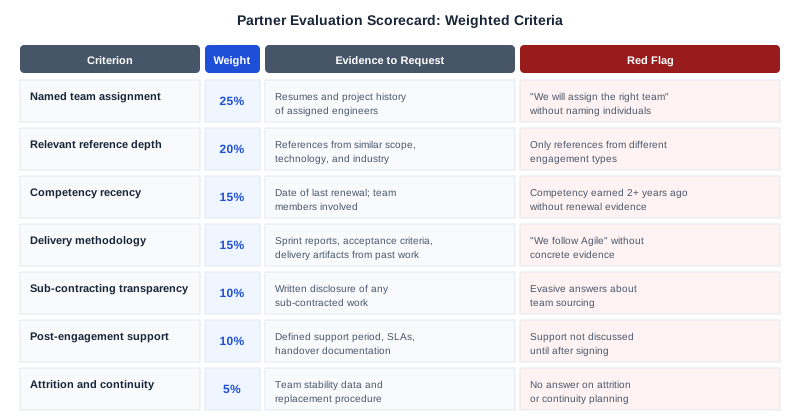
Use the following weighted criteria to differentiate shortlisted partners. Adjust weights based on your engagement's specific risk profile.
| Criterion | Weight | Evidence to request | Red flag |
|---|---|---|---|
| Named team assignment | 25% | Resumes and project history of assigned engineers | "We will assign the right team" without names |
| Relevant reference depth | 20% | References from similar scope, technology, and industry | Only references from different engagement types |
| Competency recency | 15% | Date of last competency renewal; team members involved | Competency earned more than 2 years ago without renewal evidence |
| Sub-contracting transparency | 10% | Written disclosure of any sub-contracted work | Evasive answers about team sourcing |
| Delivery methodology evidence | 15% | Sprint reports, acceptance criteria samples, or delivery artifacts from past engagements | "We follow Agile" without concrete evidence |
| Post-engagement support model | 10% | Defined support period, SLAs, and handover documentation | Support not discussed until after signing |
| Attrition and continuity plan | 5% | Team stability data and replacement procedure | No answer on attrition or continuity |
Worked example: evaluating three India-based Advanced-tier partners
An engineering director at a mid-size enterprise is evaluating three India-based partners for a 6-month AWS migration engagement covering 40 workloads.
Partner A: Large systems integrator (2,000+ employees)
Competency evidence review:
- Holds Migration, DevOps, and Machine Learning competencies
- 450 AWS-certified engineers listed on website
- Ask: Of the 450 certified engineers, how many have completed at least 2 migrations of similar scope?
- Ask: Which specific individuals will be assigned to this engagement, and what is their migration project history?
Reference check:
- Provided 3 references from large enterprise migrations
- Ask references: Was the proposed team the team that delivered? Were there significant team changes during the engagement?
Risk assessment: Large firms provide scale and breadth, but named team composition and sub-contracting practices need verification.
Partner B: Mid-size specialist firm (200 employees)
Competency evidence review:
- Holds Migration competency only
- 80 AWS-certified engineers
- Ask: What percentage of your revenue comes from migration engagements? This reveals whether migration is a core practice or a side activity.
- Ask: Can you walk through a specific migration engagement where things went wrong and how you handled it?
Reference check:
- Provided 2 references from mid-size migrations
- Ask references: What was the acceptance criteria, and how was delivery measured?
Risk assessment: Specialist firms may deliver deeper expertise for the specific engagement type but may lack breadth if the scope expands.
Partner C: Boutique firm (50 employees)
Competency evidence review:
- Holds Service Delivery designation for specific AWS services
- 30 AWS-certified engineers
- Ask: With 50 employees, what happens if 2-3 key team members leave during the engagement?
- Ask: Do you sub-contract any portion of delivery, and if so, how do you maintain quality?
Reference check:
- Provided 2 references from smaller engagements
- Ask references: What was the firm's communication cadence, and how were issues escalated?
Risk assessment: Boutique firms can provide senior attention and consistency but carry concentration risk if key personnel leave.
The competency depth interview
Beyond the scorecard, conduct a competency depth interview with the proposed delivery lead. This is not a certification exam; it is a conversation designed to reveal practical experience.
For a migration engagement, ask:
- Describe the last migration where you changed the migration strategy mid-engagement. What triggered the change, and what was the impact?
- What is your process for workloads that cannot be migrated using automated tools?
- How do you handle a workload that passes pre-migration testing but fails in production after cutover?
- What is your cutover rollback procedure, and when was the last time you executed it?
What good answers look like: Specific examples with named technologies, specific challenges, and specific resolutions. References to actual AWS service behaviors rather than generic descriptions.
What bad answers look like: Generic methodology descriptions, references to best practices without specific examples, or inability to describe a failure scenario from experience.
Failure modes in India partner selection
Selecting by badge count. The partner with the most badges is not necessarily the best fit. A focused partner with one relevant competency may outperform a generalist with many.
Accepting team composition at face value. Proposals often describe the ideal team. Verify that named individuals are available and committed for the engagement duration.
Skipping attrition inquiry. India's technology industry has significant employee mobility. Ask about attrition rates and the partner's continuity plan.
Ignoring timezone and communication practices. For engagements with international stakeholders, verify the partner's communication cadence, timezone overlap, and escalation procedures.
Not verifying competency recency. AWS competencies and partner tiers are reviewed periodically, but the status badge at the moment of evaluation may not reflect recent performance or audit results. Ask for the date of the most recent AWS competency audit and whether any conditions were attached.
Overlooking subcontractor use in cost-competitive bids. Some India-based partners win bids at competitive rates by planning to subcontract portions of the work to lower-cost providers with less direct accountability. Ask explicitly: will any work be performed by individuals not employed by your firm, and if so, in which workstreams? This is not a disqualification criterion, but undisclosed subcontracting creates accountability gaps that surface during delivery disputes.
Accepting certification count without asking about team continuity. A partner with 200 AWS certifications may assign 2 of those certified engineers to your engagement. Ask which certified individuals are assigned to your engagement, not how many the firm holds in total.
Next step
Apply the evaluation scorecard to your shortlisted partners before signing. The investment of 2-3 hours per partner in structured evaluation prevents months of delivery risk.
Ampity delivers AWS engagements as an accountable engineering partner, with senior-led teams and acceptance-criteria-based delivery. To discuss your AWS engagement, visit our AWS Consulting service page.
Related resources
Choosing an AWS Consulting Partner in India: An Evidence Checklist Before You Sign
Compare AWS consulting proposals using verifiable credentials, accountable scope, India billing arrangements, recovery evidence and a reusable scorecard.
AWS Partner Tiers Explained for Buyers: What the APN Requires and What It Does Not Guarantee
Understand what AWS Partner Network tier designations publicly require, what they do not guarantee about delivery quality, and what additional evidence buyers should request beyond the tier badge.
AWS Partner SOW Red Flags: 10 Risk Patterns to Raise With Legal Before Signing
Identify 10 observable risk patterns in AWS consulting partner statements of work. Each pattern explains the delivery risk it creates and suggests questions to raise with legal counsel before signing.