AWS Partner SOW Red Flags: 10 Risk Patterns to Raise With Legal Before Signing
Identify 10 observable risk patterns in AWS consulting partner statements of work. Each pattern explains the delivery risk it creates and suggests questions to raise...
A statement of work (SOW) is where the promises made during partner evaluation become contractual obligations. Many AWS consulting engagements fail not because the partner lacks technical skill, but because the SOW left critical terms ambiguous. Vague acceptance criteria, unlimited scope, missing rollback definitions, and one-sided IP clauses create delivery risk that surfaces only when something goes wrong.
This article identifies 10 observable SOW risk patterns that an engineering director or procurement team can spot before engaging legal. It does not provide legal advice or guaranteed-compliant alternative language. Final contract review must involve qualified legal counsel. Source: AWS Partner Network, checked 2026-11-05.
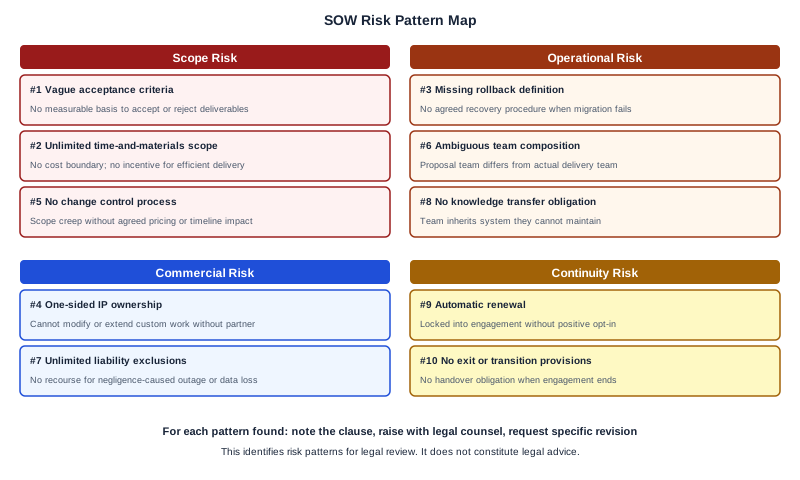
How to use this list
Read the SOW with these patterns in mind. For each pattern you identify, note the specific clause and raise it with your legal counsel using the suggested question. The goal is to identify delivery risk before signing, not to negotiate the contract yourself.
Pattern 1: Vague acceptance criteria
What it looks like: "Work will be deemed accepted when delivered to the client's reasonable satisfaction" or "Acceptance will be based on industry best practices."
The delivery risk: Without measurable acceptance criteria, you have no contractual basis to reject work that does not meet your needs. "Reasonable satisfaction" is subjective and difficult to enforce. "Industry best practices" is undefined and varies by interpretation.
Question for legal: Can we replace subjective acceptance language with specific, measurable criteria tied to the deliverables listed in the SOW?
Pattern 2: Unlimited time-and-materials scope
What it looks like: The SOW describes a broad outcome (e.g., "migrate the customer's workloads to AWS") but bills on a time-and-materials basis with no cap, milestone structure, or scope boundary.
The delivery risk: The partner has no financial incentive to deliver efficiently. If the migration encounters complications, costs escalate without a contractual boundary. You cannot budget accurately for the engagement.
Question for legal: Can we add a not-to-exceed cap, milestone-based payments, or a scope change approval process that requires written authorization before additional billing?
Pattern 3: Missing rollback definition
What it looks like: The SOW describes migration or deployment steps but does not define what happens if a step fails. There is no rollback procedure, recovery time objective, or decision criteria for aborting a cutover.
The delivery risk: If a migration cutover fails at 2 AM on a Saturday, there is no agreed procedure for reverting to the previous state. The partner and your team may disagree on whether to push forward or roll back, with production systems at risk.
Question for legal: Can the SOW include a rollback procedure for each migration phase, with defined decision criteria and recovery time expectations?
Pattern 4: One-sided IP ownership
What it looks like: "All intellectual property created during the engagement shall be the exclusive property of [the partner]" or conversely, no IP clause at all, leaving ownership ambiguous.
The delivery risk: If the partner retains ownership of custom code, infrastructure-as-code templates, or automation scripts built specifically for your environment, you may need the partner's permission (or a license) to modify, extend, or replace those components after the engagement ends.
Question for legal: Does the IP clause give us ownership or a perpetual, irrevocable license for all custom work products created specifically for our engagement? Are pre-existing partner tools and frameworks clearly distinguished from custom deliverables?
Pattern 5: No change control process
What it looks like: The SOW does not describe how scope changes are requested, evaluated, approved, and priced. Or it includes language like "scope changes will be handled as they arise."
The delivery risk: Without a change control process, any request from either party can expand scope without agreed pricing or timeline adjustment. This leads to disputes about what was "in scope" versus additional work.
Question for legal: Can we add a formal change request process that requires written scope change documentation, impact assessment (cost and timeline), and written approval from both parties before additional work begins?
Pattern 6: Ambiguous team composition commitment
What it looks like: "Partner will provide a qualified team of AWS-certified engineers" without naming specific individuals or defining minimum qualifications for each role.
The delivery risk: The proposal presentation featured senior architects and the partner's best engineers. The SOW does not require those specific people to work on your engagement. After signing, the team assigned may have different experience levels.
Question for legal: Can the SOW name the key team members (at minimum, the delivery lead and senior architect) and require written notice and approval before substituting named personnel?
Pattern 7: Unlimited liability exclusions
What it looks like: "Partner shall not be liable for any indirect, consequential, incidental, or special damages, including but not limited to loss of profits, data, or business interruption."
The delivery risk: While some liability limitations are standard, overly broad exclusions may leave you without recourse if the partner's negligence causes a production outage, data loss, or security breach during the engagement.
Question for legal: Are the liability exclusions proportionate to the engagement risk? Should we negotiate a liability cap tied to the engagement value, with carve-outs for data breaches, IP infringement, or willful misconduct?
Pattern 8: No knowledge transfer obligation
What it looks like: The SOW describes the technical deliverables but does not include a knowledge transfer phase, documentation requirements, or handover procedure.
The delivery risk: When the engagement ends, the partner's team leaves with institutional knowledge about your architecture, configuration decisions, and operational procedures. Your team inherits a system they did not build and cannot maintain without the partner's help.
Question for legal: Can the SOW include a defined knowledge transfer phase with specific deliverables (documentation, training sessions, recorded walkthroughs) and acceptance criteria before the engagement is considered complete?
Pattern 9: Automatic renewal or extension clauses
What it looks like: "This SOW shall automatically renew for successive 12-month periods unless either party provides 90 days' written notice of non-renewal."
The delivery risk: Automatic renewal clauses can lock you into continued engagement with a partner even if delivery quality has declined. The notice period may create an administrative trap if internal teams forget to send the non-renewal notice.
Question for legal: Can we replace automatic renewal with a positive opt-in renewal that requires written agreement from both parties?
Pattern 10: No exit or transition provisions
What it looks like: The SOW has no clause describing what happens when the engagement ends, whether by completion, termination for cause, or termination for convenience.
The delivery risk: Without exit provisions, the transition to your internal team or a different partner may be contentious. The outgoing partner has no obligation to assist with handover, provide documentation, or grant access to systems they configured.
Question for legal: Can the SOW include transition assistance obligations that apply regardless of how the engagement ends, including documentation delivery, credential handover, and a defined cooperation period?
SOW review checklist
Apply this checklist to any AWS partner SOW before signing.
| # | Pattern | Found? | Clause reference | Action |
|---|---|---|---|---|
| 1 | Vague acceptance criteria | |||
| 2 | Unlimited T&M scope | |||
| 3 | Missing rollback definition | |||
| 4 | One-sided IP ownership | |||
| 5 | No change control process | |||
| 6 | Ambiguous team composition | |||
| 7 | Unlimited liability exclusions | |||
| 8 | No knowledge transfer obligation | |||
| 9 | Automatic renewal | |||
| 10 | No exit/transition provisions |
Worked example: applying the checklist
A platform engineering director receives a SOW from an AWS Migration Competency partner for a 6-month, 40-workload migration. Applying the checklist:
Pattern 2 found: The SOW bills T&M at $250/hour with no cap. For a 6-month engagement with a 4-person team, this could reach $800K with no upper bound. Action: Request milestone-based pricing with a not-to-exceed cap, or at minimum a monthly spend limit requiring written approval to exceed.
Pattern 3 found: The migration section describes cutover steps but no rollback procedure. Action: Request a rollback procedure for each migration wave with defined decision criteria and maximum rollback time.
Pattern 6 found: The SOW references "senior AWS engineers" but does not name the delivery lead. Action: Request named personnel for the delivery lead and technical architect, with substitution requiring 2-week notice and client approval.
Pattern 8 found: No knowledge transfer section. Action: Request a 2-week knowledge transfer phase before engagement close, with specific deliverables (architecture documentation, runbook, recorded walkthrough).
Pattern 10 found: No transition clause. Action: Request a transition assistance clause that survives engagement termination.
Next step
Print the checklist and apply it to your next SOW before sending it to legal. The patterns are observable without legal training; the questions help your legal counsel focus on the highest-risk clauses. The time invested in SOW review prevents months of delivery disputes.
Ampity structures every AWS engagement with defined acceptance criteria, named delivery leads, and scope-controlled pricing. To discuss how we approach SOW design, visit our AWS Consulting service page.
Primary references
- AWS Partner Network, source checked 2026-11-05
- AWS Professional Services overview, source checked 2026-11-05
Related resources
AWS Partner Tiers Explained for Buyers: What the APN Requires and What It Does Not Guarantee
Understand what AWS Partner Network tier designations publicly require, what they do not guarantee about delivery quality, and what additional evidence buyers should request beyond the tier badge.
India AWS Partner Selection: Reading APN Competency Evidence Before Signing
Evaluate India-based AWS partners beyond tier and competency badge. Covers evaluation criteria, competency depth testing, team composition checks, and reference structure for shortlisted partners.
Building an Honest AWS Migration Business Case: TCO Components and Common Omissions
Build a complete total cost of ownership comparison for an AWS cloud migration. Covers direct and indirect cost components, commonly understated items, and a worked example mapping 20 on-premises servers to AWS.