Bedrock Fine-Tuning vs RAG: When Model Customization Adds Value Over Retrieval
Decision criteria for choosing between Bedrock fine-tuning and RAG: data requirements, latency, cost, maintenance burden, and accuracy targets with a customer support...
The Question Behind the Question
Teams often frame the fine-tuning vs RAG decision as "which approach produces better answers." The more useful frame is: "what problem am I actually trying to solve, and which approach addresses that problem directly?"
Fine-tuning changes the model's weights to encode new behavior, style, or implicit knowledge. RAG leaves the model weights unchanged and instead supplies relevant context at inference time. These are not interchangeable approaches -- they address different types of adaptation gaps.
If the gap is knowledge coverage -- the model does not know about your products, internal policies, or recent events -- RAG is usually the right starting point. It can be deployed faster, updated without retraining, and the retrieval step makes the information source explicit and auditable.
If the gap is behavioral consistency -- the model uses wrong terminology, produces inconsistently formatted output, fails to maintain a required tone, or makes systematic errors in domain-specific reasoning -- fine-tuning may add value that RAG cannot provide. RAG changes what the model knows but not how it reasons or speaks.
The direct answer: use RAG first. Fine-tune when RAG has been deployed and you have specific, measurable evidence that the remaining gap is behavioral rather than knowledge-based.
What Bedrock Fine-Tuning Does
Bedrock model customization allows you to fine-tune certain foundation models (the specific models available for customization vary; check the Bedrock console and documentation for your region) on your own labeled training data. The fine-tuning job runs on Bedrock-managed infrastructure and produces a customized model that you can then deploy using Provisioned Throughput.
Bedrock supports two customization approaches:
Fine-tuning (supervised fine-tuning). You provide prompt-completion pairs in JSONL format. The model is trained to produce the expected completion given each prompt. This is the standard approach for adapting tone, format, and domain-specific response patterns.
Continued pre-training. You provide unlabeled domain text. The model is trained on that text using its standard pre-training objective. This embeds domain vocabulary and factual knowledge into the model weights without requiring labeled examples. Use this when you have a large corpus of domain text (technical documentation, legal documents, scientific papers) and want the model to reason more fluently in that domain.
For either approach, the minimum dataset size guidance from AWS is in the documentation primary source. As of mid-2025, supervised fine-tuning typically requires at minimum several hundred to a few thousand high-quality labeled examples to produce measurable improvement. With fewer examples, the risk of overfitting or negligible improvement is high.
What RAG Does
Retrieval-Augmented Generation supplies the model with relevant text chunks from an external knowledge source at inference time. The model uses the retrieved chunks as context for generating its response. The model weights are unchanged; the retrieved context extends what the model can reference in its answer.
Bedrock Knowledge Bases provides a fully managed RAG infrastructure: document ingestion, chunking, embedding, vector storage (using multiple supported vector database backends), and retrieval via the Retrieve and RetrieveAndGenerate APIs. You can also build a custom RAG pipeline using Bedrock's embedding models with an external vector database (Pinecone, Weaviate, OpenSearch, etc.).
RAG's key advantages: knowledge can be updated by adding or removing documents from the index without any model retraining. The retrieved chunks are auditable -- you can inspect what source text influenced the response. For compliance and regulated domains where answer provenance matters, this auditability is often non-negotiable.
RAG's key limitations: the quality of the response is bounded by the quality of the retrieval step. If the retrieval does not surface the right chunks (poor embedding quality, insufficient chunk granularity, or missing documents), the model cannot compensate. And RAG does not change the model's response style, format, or tone -- those remain tied to the base model's behavior plus your system prompt.
Decision Criteria Across Five Dimensions
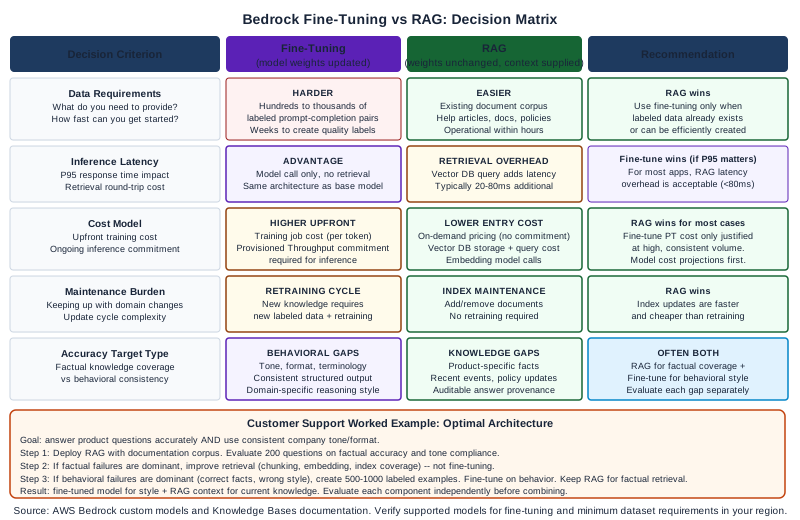
Data requirements. Fine-tuning requires labeled training examples. For supervised fine-tuning, you need prompt-completion pairs that represent the behavior you want the model to learn. Creating high-quality labeled examples is the most time-consuming and expensive part of fine-tuning. RAG requires a document corpus. If you have product documentation, support articles, or policy documents, RAG can be operational within hours. If you need to label thousands of training examples, fine-tuning timelines extend to weeks.
Latency. Fine-tuned models have similar inference latency to the base model (the architecture is unchanged). RAG adds a retrieval round trip before each model call, which adds latency. For latency-sensitive applications, a fine-tuned model that encodes domain behavior in its weights may be faster than a RAG system that must query a vector database before each inference call. However, retrieval latency for well-optimized vector databases is typically under 50ms and may not be significant at the system level.
Cost. Fine-tuning has an upfront training cost (Bedrock charges for the fine-tuning job by training token count) plus ongoing inference cost. Because fine-tuned models on Bedrock require Provisioned Throughput, the ongoing inference cost involves a commitment rather than pay-per-token pricing. RAG has ongoing inference cost (embedding model calls, vector database storage and query, and the foundation model call) but no upfront training cost and uses on-demand pricing unless you separately purchase Provisioned Throughput. For low-volume use cases, RAG's on-demand cost model is typically lower cost than fine-tuning's training cost plus Provisioned Throughput commitment.
Maintenance burden. A fine-tuned model requires retraining whenever your domain knowledge, terminology, or required behavior changes significantly. RAG requires maintaining the document index: adding new documents, removing outdated ones, and monitoring retrieval quality. For most teams, index maintenance is simpler and faster than retraining a fine-tuned model.
Accuracy targets. For knowledge-based accuracy (factual correctness about your domain), RAG with a well-curated index often outperforms fine-tuning. Fine-tuning on limited examples tends to recall domain facts inconsistently, and hallucination rates for specific factual queries may not decrease. For behavioral accuracy (consistent format, tone, terminology), fine-tuning on representative examples is effective where RAG and system prompting alone are insufficient.
Worked Example: Customer Support Domain
A customer support team wants to deploy an AI assistant that answers questions about their software product. The assistant needs to:
- Answer questions accurately based on current product documentation (feature descriptions, troubleshooting steps, pricing)
- Use the company's specific terminology and tone (not generic AI phrasing)
- Format responses consistently (numbered steps for procedures, specific section structure)
RAG for FAQ coverage:
Deploy Bedrock Knowledge Bases with the product documentation (help articles, release notes, API documentation). Configure chunk size and overlap for the document type. Deploy a RetrieveAndGenerate endpoint with a system prompt that describes the required tone and format.
Evaluation: measure answer accuracy against 100 representative support questions with known correct answers. Measure tone and format compliance manually or with a secondary scoring model. Track which questions are answered correctly and which fail (citing wrong documentation sections or missing information).
The expected outcome for a well-curated documentation corpus: high accuracy on questions where the documentation is complete and clear. Lower accuracy on edge cases, questions about undocumented behavior, or questions requiring multi-step reasoning across multiple documents.
Fine-tuning for tone and format consistency:
If the RAG evaluation reveals that tone and format compliance is consistently low -- the model uses generic phrasing, structures responses differently each time, or fails to use required terminology -- this is evidence that fine-tuning may add value. Create 500 to 1,000 labeled examples of ideal support responses: each example pairs a customer question with a hand-written example response in the required tone and format.
Fine-tune the Bedrock model on these examples. Evaluate the fine-tuned model on a held-out set of 100 questions (not used in training) and measure tone, format, and terminology compliance. Compare against the RAG-only baseline.
Important: fine-tuning on 500 tone examples does not reliably improve factual accuracy for domain knowledge not in the training examples. The fine-tuned model still needs the RAG retrieval step to answer factual questions about products and features. The optimal architecture for most customer support use cases combines both: fine-tuned model for consistent behavioral style, RAG context for current factual knowledge.
Comparison method:
Run both approaches against the same held-out evaluation set of 150 questions (100 factual, 50 tone-and-format focused). For factual questions, measure exact answer accuracy and citation quality. For tone questions, use a rubric-based scoring checklist applied by a human reviewer or a secondary scoring model. Record which approach wins on each criterion and by how much. Use the comparison results to decide whether the fine-tuning cost and maintenance burden are justified by the measured improvement in tone compliance.
Failure Modes
Fine-tuning on too few examples. A common mistake is running a fine-tuning job with 50 to 100 examples expecting significant improvement. The model may appear to change behavior in the first few inference calls, but performance on a diverse evaluation set often regresses or shows minimal consistent improvement. The minimum viable labeled dataset for supervised fine-tuning is typically measured in the hundreds of high-quality examples, and several thousand for reliable generalization. Verify AWS guidance on minimum dataset sizes in the customization documentation.
Using fine-tuning to compensate for missing RAG. If your RAG index is missing critical documents or has poor retrieval quality, fine-tuning will not fix that gap. The fine-tuned model still cannot answer questions about information that is not in its training data. Fix retrieval quality first; consider fine-tuning only after the knowledge access layer is working well.
Stale fine-tuned model after product updates. A fine-tuned model that was trained on documentation from six months ago has outdated factual knowledge baked into its weights. Without a RAG layer for current documentation, the fine-tuned model may confidently answer factual questions using outdated information. Use fine-tuning for behavior and RAG for current knowledge, not fine-tuning alone for factual coverage.
Provisioned Throughput cost for low-volume fine-tuned model. Fine-tuned models on Bedrock require Provisioned Throughput, which involves a commitment. If your request volume does not justify the commitment, the per-request cost of a fine-tuned model deployment may exceed the cost of a RAG system using on-demand pricing on the base model. Model the cost before committing.
Diagnostic Signals for Choosing
Before fine-tuning, run a structured evaluation:
- Deploy RAG with current documentation corpus
- Run 100 to 200 representative questions through the RAG system
- Score responses on: factual accuracy, tone compliance, format compliance, citation quality
- Categorize failures: factual gaps (missing or wrong information) vs behavioral gaps (correct facts, wrong style)
If more than 20% of failures are behavioral (correct facts, wrong presentation), and system prompt improvements do not resolve them, fine-tuning is a reasonable next step. If most failures are factual, improve retrieval quality and document coverage first.
Next Steps
For teams building domain-adapted AI systems on AWS Bedrock, the Ampity LLM and RAG Systems service [/ai/llm-rag-systems] covers the full stack from RAG architecture to fine-tuning evaluation methodology and production deployment. Verify current Bedrock model customization availability, supported model list, and fine-tuning dataset format requirements against the primary source documentation before initiating a fine-tuning project.
Primary Sources
- Bedrock Custom Models, source checked 2026-11-05
- Bedrock Knowledge Bases, source checked 2026-11-05
Related resources
Bedrock Embedding Migration: What Must Be Rebuilt?
Decide when a Bedrock embedding change needs new document vectors, a rebuilt index or a matched query route, with a worked compatibility example.
Bedrock Knowledge Bases: Retrieval Configuration Trade-offs
Choose chunking strategy, embedding model, and retrieval settings for Amazon Bedrock Knowledge Bases with known trade-offs documented. Covers fixed-size, hierarchical, and semantic chunking with a worked HR policy corpus example.