AWS MAP Program: Publicly Documented Structure, Coverage, and What to Verify With AWS
Understand the AWS Migration Acceleration Program phases, publicly documented coverage types, known exclusions, and the questions to raise with AWS or a qualified...
The AWS Migration Acceleration Program (MAP) is a structured engagement program that combines tools, training, partner expertise, and financial support to help organizations move workloads to AWS. If you are evaluating MAP as a funding mechanism for your migration, the first thing to understand is that eligibility and specific funding amounts are determined by AWS on a per-engagement basis. This article covers the publicly documented program structure so you can assess whether MAP is worth pursuing and know which questions to bring to your AWS account team or an AWS Migration Competency Partner.
This article does not reproduce private commercial terms, guarantee eligibility, or assert specific funding amounts. Readers must engage AWS or a qualified AWS partner to determine actual applicability. Source: AWS MAP overview, checked 2026-11-05.
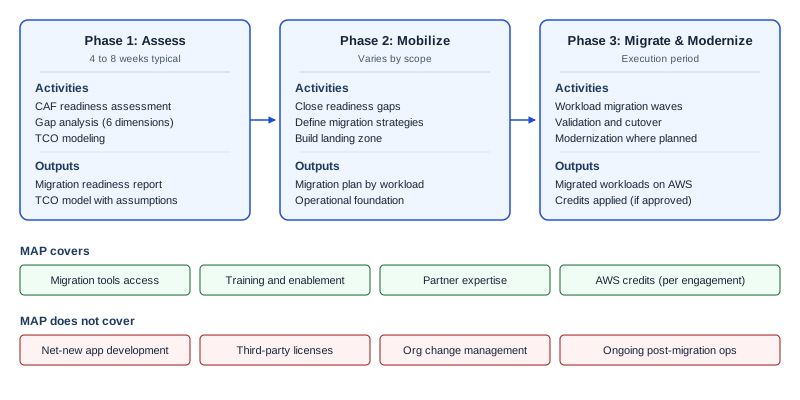
What MAP is and what it is not
MAP is a program, not a discount or a credit entitlement. It has defined phases, each with distinct activities and outputs. AWS positions MAP as a way to accelerate cloud adoption by addressing the organizational, technical, and financial dimensions of migration together.
MAP is not a blanket migration subsidy. It does not apply automatically to any organization that uses AWS. It is not a replacement for sound migration planning, and participation in MAP does not guarantee that the migration itself will succeed. The financial component is one element of a broader engagement structure.
The three MAP phases
AWS publicly documents MAP as a three-phase program aligned with the AWS Cloud Adoption Framework.
Phase 1: Assess
The Assess phase identifies capability gaps across six dimensions defined by the AWS Cloud Adoption Framework: business, process, people, platform, operations, and security. The output of the Assess phase is a migration readiness assessment and a realistic total cost of ownership model.
This phase helps the organization understand whether it is prepared to migrate, what organizational changes are required, and what the migration will cost. It is not a commitment to migrate. Organizations that complete the Assess phase may decide not to proceed based on the findings.
Phase 2: Mobilize
The Mobilize phase closes the gaps identified during assessment. Activities include establishing the operational foundation for migration, defining migration strategies for each workload (rehost, replatform, refactor, retire, retain, repurchase), and building the team and governance structures needed for execution.
This phase produces the migration plan and the organizational readiness to execute it. It is during the Mobilize phase that the specific migration approach for each workload is determined, including which workloads are in scope for MAP support and which are not.
Phase 3: Migrate and Modernize
The Migrate and Modernize phase executes the migration plan using AWS migration services, supported by AWS Professional Services and AWS Migration Competency Partners. This phase includes the actual workload migration, validation testing, and cutover activities.
The financial support component of MAP is most directly associated with this phase, where credits may offset migration-related AWS usage during and after the migration period. The specific structure and amount of financial support is determined during the earlier phases and is subject to AWS approval.
What MAP publicly covers
Based on publicly available AWS documentation, MAP provides support in several categories.
Tools and automation. Access to AWS migration tools including AWS Migration Hub, AWS Application Migration Service, and AWS Database Migration Service. These tools are available to any AWS customer, but MAP participants may receive guided implementation support.
Training and enablement. Training for the organization's technical team on AWS services, migration patterns, and operational practices. This training is structured around the gaps identified in the Assess phase.
Partner expertise. Engagement with AWS Migration Competency Partners who have demonstrated migration delivery capability. The partner's role, scope, and commercial terms are agreed separately between the customer and the partner.
Financial support. AWS credits that offset migration-related usage. The specific credit structure, amount, duration, and conditions are determined by AWS based on the migration scope and are not publicly standardized. Credits are not cash and cannot be applied to all AWS services or usage types.
What MAP does not cover
Several categories are consistently outside the publicly documented MAP scope.
Application development. MAP addresses migration of existing workloads, not building new applications on AWS. A workload that requires substantial re-architecture may qualify for modernization support, but net-new development is a different engagement.
Third-party licensing. Software license costs for third-party products running on AWS are the customer's responsibility. MAP credits do not cover Oracle, Microsoft, or other vendor license fees.
Organizational change management. While MAP addresses people-dimension readiness, it does not replace the organization's own change management program. The training component covers AWS technical skills, not broader organizational transformation.
Ongoing operations. MAP is a migration program, not an ongoing operational support program. Post-migration operational costs are the customer's responsibility. Credits associated with MAP have defined durations and usage conditions.
Worked example: 30-workload SaaS company evaluating MAP
Consider a mid-size SaaS company running 30 workloads across two on-premises data centers. The CTO wants to know whether MAP applies and what the company should expect from the process.
Step 1: Initial qualification conversation. The company contacts its AWS account team or an AWS Migration Competency Partner. The conversation covers current infrastructure, migration timeline, strategic intent, and whether the company meets the minimum workload or spend thresholds that AWS uses to determine MAP participation. These thresholds are not publicly standardized.
Step 2: Assess phase engagement. If AWS confirms initial interest, the company enters the Assess phase. The output is a migration readiness assessment covering all six CAF dimensions and a TCO model for the 30 workloads. Duration: typically 4 to 8 weeks, depending on environment complexity.
Step 3: Mobilize phase. Based on assessment findings, the company builds its migration plan. Of the 30 workloads, the plan identifies 22 as candidates for rehosting, 5 for replatforming, and 3 for retirement. The Mobilize phase establishes the landing zone, networking, security baseline, and operational processes needed before migration begins.
Step 4: Migrate and Modernize. The company executes the migration in waves, using AWS migration tools and partner support. Financial support, if approved, offsets AWS usage during the migration period.
Questions the company should ask before entering MAP:
| Question | Why it matters |
|---|---|
| What is the minimum workload or spend threshold for MAP participation? | Ensures the migration scope qualifies |
| Which credit types apply to our migration, and what are the usage restrictions? | Prevents assumptions about credit applicability |
| What are the reporting and milestone requirements during each phase? | Defines the operational overhead of MAP participation |
| Does MAP cover workloads we plan to modernize, or only rehost and replatform? | Clarifies scope boundaries for refactoring workloads |
| What happens if our migration timeline extends beyond the original estimate? | Determines whether credits and support have hard expiration dates |
| Can we use MAP credits for post-migration optimization and right-sizing? | Clarifies whether credits apply only to migration-period usage |
When MAP may not be the right fit
MAP is structured for organizations with a meaningful number of workloads to migrate. If your migration involves fewer than a handful of workloads, the overhead of the three-phase program may exceed the benefit. Small migrations may be better served by direct engagement with an AWS partner without the MAP program structure.
MAP also assumes the organization is committed to migrating. If the decision to migrate has not been made, the Assess phase can help inform that decision, but the program is designed for organizations that have strategic intent to move to AWS, not for organizations conducting a neutral cloud-versus-on-premises comparison.
Organizations with highly regulated workloads should verify that MAP's partner and financial components are compatible with their procurement and compliance requirements. The financial support component involves AWS credits, which have specific accounting treatment that may need CFO and legal review.
Diagnostic signals
You are ready for a MAP conversation when: you have a defined migration scope of multiple workloads, a strategic commitment to AWS, executive sponsorship for the migration, and a timeline within the next 12 to 18 months.
You should pause before engaging MAP when: the migration decision has not been made, the workload count is very small, the organization lacks executive sponsorship, or procurement cannot accommodate the MAP engagement structure.
Next step
If your migration scope and timeline suggest MAP may apply, contact your AWS account team or an AWS Migration Competency Partner to discuss eligibility. Prepare the workload inventory, current infrastructure costs, and strategic timeline before the conversation. These inputs accelerate the qualification process and produce a more useful assessment.
Ampity delivers AWS migrations as an accountable engineering partner. To discuss how MAP fits into your migration plan, visit our AWS Consulting service page.
Primary references
- AWS MAP overview, source checked 2026-11-05
- AWS Migration Hub documentation, source checked 2026-11-05
Related resources
AWS Cloud Credits: Runway and the Bill After Expiry
Separate eligible credit offsets from the gross operating bill using an exact monthly ledger, expiry loss, excluded charges and post-credit scenarios.
Unused Cloud Commitments Are Not AWS Migration Savings
Separate past payments, unavoidable future obligations and genuinely reusable discounts before counting source-cloud commitments as AWS migration savings.
Building an Honest AWS Migration Business Case: TCO Components and Common Omissions
Build a complete total cost of ownership comparison for an AWS cloud migration. Covers direct and indirect cost components, commonly understated items, and a worked example mapping 20 on-premises servers to AWS.