AWS Enterprise Support vs Third-Party Managed Services: Cost and Coverage Comparison
Compare AWS Enterprise Support with third-party managed services across cost, coverage, response time, and human judgment availability. Includes a decision framework...
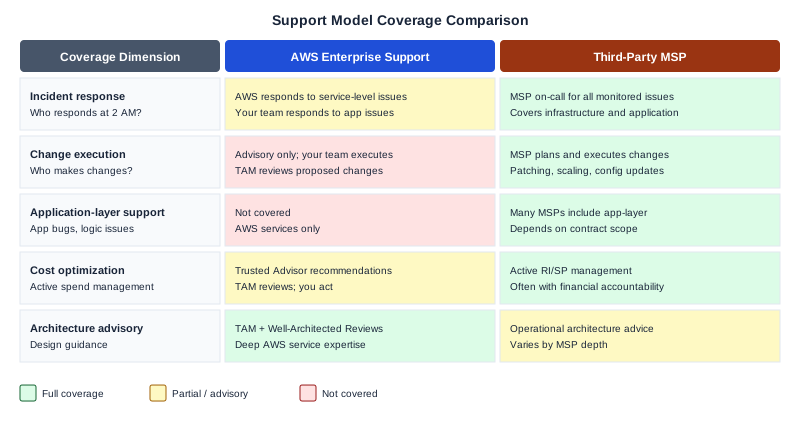
AWS Enterprise Support and third-party managed services solve overlapping but different problems. Enterprise Support gives you access to AWS expertise and faster response times when something goes wrong with AWS services. A managed service provider (MSP) operates your workloads, makes proactive changes, and takes responsibility for outcomes you define. Choosing between them, or combining them, depends on what your team can handle and where you need human judgment applied to your specific environment.
This article provides a comparison framework. Pricing information reflects publicly documented AWS support plan structures as of the source-checked date. Third-party MSP pricing varies by provider and scope. Source: AWS Premium Support, AWS Premium Support Pricing, checked 2026-11-05.
What Enterprise Support includes
AWS Enterprise Support is the highest tier in the standard AWS support plans. Based on publicly documented pricing as of the source-checked date, the cost is a percentage of monthly AWS spend using a tiered structure: 10% of the first $150K, 7% from $150K to $500K, 5% from $500K to $1M, and 3% above $1M, subject to a monthly minimum. The specific current minimum should be verified directly at AWS Premium Support Pricing before budgeting, as minimums are subject to change.
Key features of Enterprise Support:
Designated Technical Account Manager (TAM). A named AWS employee who provides architectural guidance, Well-Architected Reviews, and proactive engagement with your team. The TAM knows your environment and acts as your advocate inside AWS.
Response time commitments. Enterprise Support provides response times as fast as minutes for business-critical system-down situations. The specific SLA tiers depend on the severity level assigned to each case.
Proactive services. Well-Architected Reviews, infrastructure event management for planned launches, and security optimization guidance.
24/7 access to AWS engineers. Including access to security specialists for threat detection and incident response.
AWS Trusted Advisor. Full access to Trusted Advisor checks across cost optimization, security, fault tolerance, performance, and service limits.
What Enterprise Support does not include
Enterprise Support is reactive support with proactive advisory. It does not include:
Workload operations. AWS will advise you on how to configure, optimize, and troubleshoot your workloads, but your team or a third party performs the work. AWS support does not log into your account and make changes for you.
Application-layer support. AWS supports the infrastructure services. If your application has a bug, a memory leak, or a logic error that causes performance degradation, that is outside the scope of Enterprise Support.
Change management. Enterprise Support does not plan, execute, or validate changes to your environment. It can review proposed changes and provide recommendations.
Coverage of non-AWS components. If your architecture includes on-premises systems, third-party SaaS integrations, or non-AWS cloud services, Enterprise Support covers only the AWS portion.
Guaranteed resolution. Enterprise Support commits to response times, not resolution times. Complex issues may require extended troubleshooting.
What a managed service provider covers
A third-party MSP operating your AWS environment typically covers a broader operational scope. The exact coverage depends on the contract, but common elements include:
Proactive monitoring and response. The MSP monitors your workloads, responds to alerts, and takes corrective action without waiting for you to open a ticket.
Change execution. The MSP plans and executes changes such as patching, scaling, configuration updates, and infrastructure modifications based on agreed procedures.
Application-aware operations. Many MSPs understand the application layer and can troubleshoot issues that span infrastructure and application boundaries.
Cost optimization. Active management of reserved instances, savings plans, right-sizing, and resource cleanup, often with financial accountability for optimization targets.
Compliance and security operations. Continuous compliance monitoring, security event response, and audit preparation.
Defined outcomes. MSP contracts typically define SLAs for availability, response, and resolution, not just response time.
Cost comparison framework
Direct cost comparison requires normalizing for scope. Enterprise Support and an MSP are not substitutes; they cover different areas.
| Cost component | AWS Enterprise Support | Third-party MSP |
|---|---|---|
| Base cost structure | Percentage of AWS spend (minimum applies; verify current amount at aws.amazon.com/premiumsupport/pricing/) | Fixed monthly fee, percentage of spend, or per-resource pricing |
| Scales with spend | Yes, cost increases with AWS consumption | Varies by contract; some decouple from spend |
| Scope of coverage | AWS service-level support and advisory | Full workload operations including application layer |
| Team required internally | Operations team to execute changes and manage workloads | Smaller internal team focused on business requirements |
| Hidden costs | Internal team salaries, tooling, on-call coverage | Potential lock-in costs, transition costs at contract end |
Worked example: 50-workload production environment
A VP of Engineering manages 50 production workloads on AWS with $200,000 monthly AWS spend. The team has 4 operations engineers.
Enterprise Support cost estimate. Using the confirmed tiered percentage structure: 10% of $150K ($15,000) + 7% of $50K ($3,500) = $18,500/month. Verify whether the current monthly minimum affects this figure at AWS Premium Support Pricing. This provides TAM access, fast response times, and advisory services. The 4-person operations team continues to handle day-to-day operations.
Managed service cost estimate. MSP fees vary significantly by provider, scope, and geography. For this illustrative example, assume a planning estimate of 20% of monthly AWS spend ($40,000/month); request itemized quotes from shortlisted MSPs before budgeting, as actual rates depend on the agreed scope. At that illustrative rate, the internal operations team could potentially be reduced to 1-2 people focused on business requirements and MSP governance, offsetting part of the cost difference.
Combined approach. Some organizations maintain Enterprise Support for direct AWS service expertise and TAM access while also engaging an MSP for operational execution. The combined cost is higher, but the coverage is more complete.
Decision factors for this example:
| Factor | Enterprise Support alone | MSP alone | Combined |
|---|---|---|---|
| Total monthly cost | ~$18.5K (percentage calc) + internal team; verify current minimum | ~$40K illustrative (get actual quote) + reduced team | Combined total + minimal team |
| Who handles 2 AM incidents | Internal on-call | MSP on-call | MSP on-call |
| Who makes architecture decisions | Internal team + TAM advisory | Internal team + MSP advisory | Internal team + TAM + MSP |
| Risk of single-provider dependency | Low (AWS is the platform) | Moderate (MSP knowledge concentration) | Low (redundant expertise) |
Decision criteria by workload criticality
Low-criticality workloads (development, staging, internal tools). AWS Business Support (lower tier) is usually sufficient. MSP coverage for these workloads is rarely cost-justified unless they are part of a larger managed contract.
Medium-criticality workloads (business applications, customer-facing non-revenue). Enterprise Support provides adequate coverage if your team can handle operational execution. Consider an MSP if your team lacks capacity or specialized expertise.
High-criticality workloads (revenue-generating, regulated, customer-facing). The combination of Enterprise Support and an MSP provides the deepest coverage. Enterprise Support gives direct access to AWS service teams for infrastructure issues, while the MSP handles operational execution and application-layer monitoring.
When Enterprise Support is enough
Enterprise Support alone works well when your internal team has: sufficient operational capacity to handle day-to-day operations, enough AWS expertise to implement TAM recommendations, on-call coverage for off-hours incidents, and the ability to manage cost optimization independently.
When an MSP adds value
An MSP adds value when: your internal team is too small for 24/7 coverage, you lack specialized AWS expertise for your workload types, you need someone accountable for operational outcomes rather than advisory, or your compliance requirements demand documented operational procedures and audit evidence that your team cannot produce alone.
Failure modes
Under-investing in support for critical workloads. Using Developer or Business Support for production workloads saves money until an outage reveals that response times and expertise are insufficient.
Hiring an MSP without clear scope. An MSP contract without defined deliverables, SLAs, and acceptance criteria becomes an expensive advisory relationship rather than an operational partnership.
Assuming Enterprise Support replaces internal expertise. Enterprise Support advises; it does not operate. Without an internal team that can act on recommendations, Enterprise Support value is diminished.
Next step
Map your workloads by criticality and your team's capacity against the coverage each option provides. The decision is not binary; many organizations use Enterprise Support as the foundation and add MSP coverage for specific workload groups where internal capacity is insufficient.
Ampity delivers AWS operations as an accountable engineering partner. To discuss the right support model for your workloads, visit our AWS Consulting service page.
Related resources
Choosing an AWS Consulting Partner in India: An Evidence Checklist Before You Sign
Compare AWS consulting proposals using verifiable credentials, accountable scope, India billing arrangements, recovery evidence and a reusable scorecard.
Build vs Buy: Compare Lifecycle Cost, Control and Exit Evidence
Compare building, buying and composing a capability with explicit five-year assumptions, sensitivity tests, operational ownership and a practical vendor-exit rehearsal.
Building an Honest AWS Migration Business Case: TCO Components and Common Omissions
Build a complete total cost of ownership comparison for an AWS cloud migration. Covers direct and indirect cost components, commonly understated items, and a worked example mapping 20 on-premises servers to AWS.