Why S3 Object Expiration Leaves Incomplete Upload Costs Behind
Diagnose unfinished S3 multipart storage and choose an abort window from upload identity, initiation age and the application's resume contract, with a reusable...
An S3 object-expiration rule does not remove unfinished multipart uploads. Those uploads need their own AbortIncompleteMultipartUpload action. Before choosing its age threshold, check how long the application is allowed to pause and resume an upload. The clock starts at initiation, so recent part activity does not make an old upload young again.
This article helps storage and application engineers explain incomplete-upload bytes and prepare a bounded abort-policy decision for S3 general purpose buckets. It does not authorize cleanup or deploy a configuration. All examples are fictional, and no AWS account, upload or lifecycle action was exercised. Directory buckets, S3 on Outposts and an upload implementation tutorial are outside the scope.
1. Identify storage that has not become an object
A multipart upload starts with an upload ID. Parts accumulate under that identity until completion creates the object or abort stops the upload. AWS's multipart overview explains that initiation has no automatic expiry, and uploaded parts continue consuming billable storage until the upload is completed or stopped.
An ordinary completed-object listing is therefore the wrong inventory for this diagnosis. A key can also have more than one upload in progress. Record the account, bucket, Region, exact key and upload ID. “The export file” is not a sufficiently precise cleanup target, particularly when retries create another upload for the same key.
Object expiration and incomplete-upload abort govern different states. AWS explicitly says object-expiration configurations do not remove incomplete multipart uploads. A bucket can have a valid current-object expiration rule while accumulating unfinished parts. Adding a noncurrent-version expiration rule would address another state again, not close this gap.
The first useful disposition is “unfinished upload storage confirmed,” rather than “old objects should have expired.” If the evidence instead identifies completed versions, review their version history and retention rules separately; an incomplete-upload abort action cannot remove those versions. If completed objects stopped transitioning after a configuration edit, use the small-object transition diagnosis.
2. Use Storage Lens to select a cohort, not to declare abandonment
S3 Storage Lens provides free-tier incomplete-upload byte and count metrics. It also provides IncompleteMPUStorageBytesOlderThan7Days and the corresponding older-than-seven-day count. Total storage includes incomplete uploads, so those bytes should not be added to total storage a second time.
Record the metric date, dashboard scope, included accounts and buckets, and the unit shown. The fixed seven-day metric band does not inherit the bucket's configured abort threshold. A proposed fourteen-day policy cannot use “older than seven days” as its exact eligible-byte amount. Nor does a count metric identify the upload ID that an operator would act on.
The Storage Lens basics describe daily metrics. A dashboard is a dated aggregate signal, not a live snapshot of uploader state. Uploads may complete or grow between the metric date and inspection. Preserve that interval rather than forcing a current listing to reconcile exactly to yesterday's chart.
Use the signal to prioritize one bucket and owner. Ask whether failed workers, canceled exports or incomplete client cleanup explain it. Do not infer that every old upload is abandoned. A deliberately resumable transfer may be old and still useful, while a recently initiated transfer may already have been canceled.
3. Evaluate initiation age against the resume contract
The abort action schema defines DaysAfterInitiation. It does not define days since the most recent UploadPart. This difference matters for paused transfers, slow producers and recovery after a client failure.
Suppose an illustrative upload starts on September 20, receives another part on October 6 and remains incomplete on October 7. A hypothetical seven-day abort policy sees an old initiation even though work resumed yesterday. The application owner must decide whether that resume is legitimate and whether the proposed window accommodates it. A lifecycle rule cannot infer the business meaning of the latest part.
Write down maximum permitted elapsed time from initiation to completion, including pauses, retries, network outages and the recovery process. An observed median duration is not that maximum. If a transfer can validly resume after ten days, a seven-day policy is inconsistent with the stated contract. Either revise the policy, change the application's contract through an accepted design decision, or isolate that workload under an appropriate prefix. Do not silently redefine allowed behavior through storage cleanup.
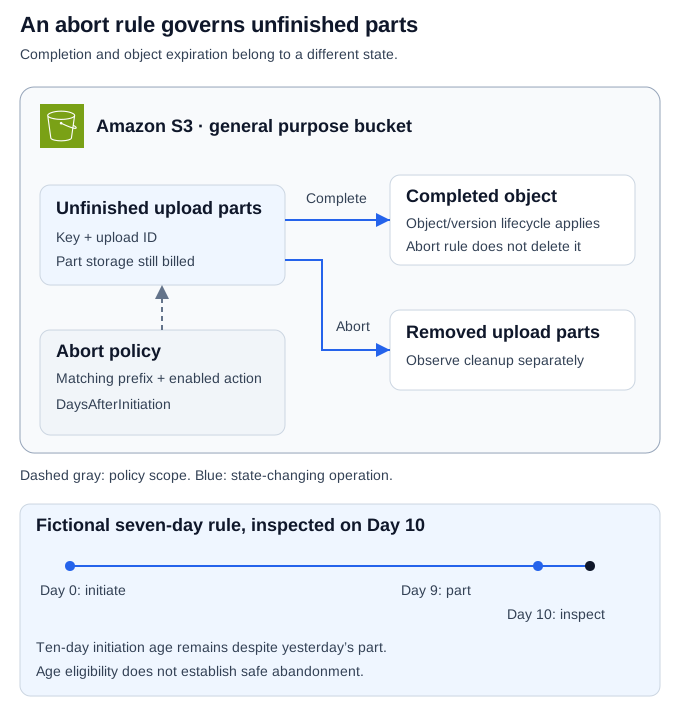
Reference state-and-clock view, not an execution trace. The recent-part counterexample explains eligibility, not permission to abandon the upload or a precise future abort time.
4. Collect upload-level evidence without fetching payloads
Use approved read access to ListMultipartUploads for a bounded prefix. Preserve initiation time, key, upload ID and storage class. For general purpose buckets, truncated results require both NextKeyMarker and NextUploadIdMarker on the next request. A delimiter can group entries under common prefixes; do not treat grouped prefixes as a complete list of uploads.
For selected IDs, ListParts supplies part sizes and last-modified times. Follow its part-number pagination. Parts still uploading are not represented as completed parts in that listing, as the multipart overview explains. A byte sum is consequently a bounded observation, not a promise that no additional part is in flight. Record the capture interval and reconcile application changes during the read.
Retain the returned x-amz-abort-date and x-amz-abort-rule-id when present. For a matching configured abort rule, ListParts describes them as the upload's eligibility date and applicable rule ID. They are not an observed-removal timestamp. If your client hides those response fields, record that inspection gap rather than invent a date or conclude that no rule matches.
The read principal needs the relevant multipart listing permissions. For SSE-KMS or DSSE-KMS uploads, the ListParts reference also requires kms:Decrypt. A denied part listing is UNKNOWN, not zero bytes or evidence that no transfer remains. Ask the authorized owner for the missing metadata; do not expand privileges or fetch object payloads merely to finish a cost worksheet.
Restrict the packet. Keys and initiator identities can contain customer or operational information. A broadly shared review can use aliases while a restricted record retains the exact upload ID and key. Application evidence should identify the job, state and accepted resume deadline, not copy its business payload.
5. Reconcile a fictional cohort before proposing removal
Assume one approved exports/ prefix inspected on October 7 at 12:00 UTC. The byte counts below are stipulated whole GiB units, where one GiB is 2³⁰ bytes. All uploads are incomplete. For A through C, assume complete part listings and no parts in flight; D's part state is unknown. These are not AWS output or observed savings.
| Upload alias | Initiated / most recent completed part | Stipulated parts | Owner evidence | Disposition for a proposed seven-day rule |
|---|---|---|---|---|
| A | Sep 20 / Sep 20 | 12 GiB | Job canceled; owner permits abandonment | Old initiation; cleanup candidate pending approval/readback |
| B | Sep 20 / Oct 6 | 8 GiB | Resume allowed through Oct 10 | Old initiation; policy conflicts with legitimate resume |
| C | Oct 6 / Oct 7 | 5 GiB | Job active | Young initiation; outside the modeled old cohort |
| D | Sep 15 / UNKNOWN | UNKNOWN | Part read denied; activity unresolved | Evidence hold; no byte or abandonment conclusion |
The known listed storage is 12 + 8 + 5 = 25 GiB. The known old-initiation subset is 12 + 8 = 20 GiB. Only A's 12 GiB has stipulated abandonment evidence. Neither 20 nor 25 GiB is an approved removal amount. D remains an unknown quantity outside those known-byte totals, not an invented zero. The totals are intentionally not represented as the bucket's complete storage.
This example uses ages comfortably away from equality boundaries. It does not calculate an exact service-processing deadline. In particular, B would remain a policy problem even if its part byte count were small: the conflict is about losing the ability to finish an accepted job.
A completed object with the same key would belong in a separate object/version record. Do not subtract its size from the unfinished parts or assume abort deletes it. The incomplete-upload lifecycle guide states that this action does not delete completed objects and applies to existing as well as future incomplete uploads.
6. Review the rule's scope and the full configuration
Choose a prefix whose application ownership and maximum duration are understood. AWS's lifecycle elements prohibit an incomplete-upload abort action in a rule using an object-tag filter. A tag-based completed-object retention rule cannot simply acquire this action. Review an independently scoped prefix rule instead; an empty prefix would include the whole bucket.
Here is a fictional rule fragment for discussion, not a complete configuration or a deployment request:
{
  "ID": "reviewed-export-upload-window",
  "Status": "Enabled",
  "Filter": { "Prefix": "exports/" },
  "AbortIncompleteMultipartUpload": { "DaysAfterInitiation": 14 }
}
Fourteen days is an invented candidate, not a safe default or a conclusion from the seven-day metric. It needs the upload-duration contract and the existing-upload cohort first. Existing stalled uploads can fall inside the new action immediately on age grounds. Do not evaluate only uploads initiated after the planned change.
PutBucketLifecycleConfiguration replaces the existing configuration. A request containing only this fragment could remove unrelated rules. Preserve the full deployed configuration and inspect the tool's complete planned request, including the transition minimum-size behavior. The existing transition-default article owns that separate edit risk.
The storage and application owners should review the proposed scope, duration, exclusions and effect on current uploads. If ownership or resume limits remain unknown, hold the policy. Disabling an abort rule later cannot reconstruct parts already removed. Application failure cleanup should still handle known cancellation promptly rather than relying on a background age policy to decide every job's fate.
7. Keep cleanup evidence separate from the financial claim
For a separately authorized explicit-abort procedure, first resolve active part requests with the uploader. The AbortMultipartUpload API warns that in-flight part requests may still succeed or fail; repeated aborts can be necessary. It directs operators to verify with ListParts that the parts are gone. A successful abort response alone is not a complete-storage-removal receipt. No abort command is provided or executed here.
For lifecycle-managed cleanup, retain the configuration readback and independently observe the selected uploads and subsequent metrics. A later empty or absent result needs authorized scope and response interpretation; access denied is not cleanup success. Do not retry destructive actions indiscriminately because a historical aggregate chart still contains yesterday's bytes.
The lifecycle guide says removing incomplete-upload parts does not incur early-delete charges. That does not erase upload request charges or the cost already incurred before removal. Completion also ends the separate unfinished-parts state but creates a completed object that has its own storage cost. Therefore, a falling incomplete-upload metric alone does not prove a lower total bill.
Do not multiply a single byte snapshot by a monthly rate and call it savings. Finance needs a dated storage-class/Region billing basis, the byte-time actually avoided, later completed-object storage, recurring new uploads and relevant request costs. Long-running valid transfers can be part of useful work. Restarting them after premature abort can create more traffic and repeated work than the policy removes.
8. Take one upload cohort to the owner
Use this record before proposing an abort policy. Unavailable fields stay UNKNOWN and receive an evidence owner.
Account / general purpose bucket / Region / read principal:
Prefix / exact restricted key and upload ID / public alias:
Metric name / date / scope / displayed unit / source reference:
Upload initiation / last completed part / capture interval:
Upload pages and part pages complete / concurrent-write caveat:
Known part bytes / unknown quantities / encryption read gap:
Application job / accepted state / evidence reference:
Maximum permitted initiation-to-completion time / pause-resume contract:
Abandonment decision / owner / unresolved activity or recovery need:
Existing enabled abort action / matching prefix / configured days:
Returned abort eligibility date and rule ID / absent or client-omitted fields:
Proposed days / existing cohort impact / full configuration comparison:
Disposition: candidate / policy conflict / young / evidence hold:
Separate change authority / stop conditions / irreversible consequences:
Observed configuration and cleanup readback: NOT EXECUTED or evidence:
Financial comparison basis / byte-time / charges retained / limitations:
Start with one bucket's incomplete-upload signal, then identify a small authorized cohort and ask its application owner to explain the oldest valid resume. If that duration conflicts with the proposed abort window, resolve the contract before changing the rule. If metadata is missing, close the review as an evidence hold. The useful result is a policy that can be explained for both a canceled job and a legitimate paused transfer, with cleanup and savings still requiring their own observations.