A Cloud Business Case That Survives Incentive Denial
Compare unfunded workload alternatives, recurring and retained obligations, benefit recipients and commitment gates before relying on cloud incentives.
Abstract and decision brief
A workload should not become an attractive investment merely because a conditional benefit is placed in its first-year spreadsheet. Build the case without that benefit first. Establish what the workload must deliver, which alternatives can deliver it, the complete obligations of each alternative, and who can finance the adverse path. Then add confirmed benefits as separately bounded scenarios. If the unfunded case is unacceptable, name the dependency and limit commitments until its conditions are resolved.
This paper is for senior finance and engineering owners reviewing a cloud migration or a proposed cloud-backed capability. Its output is an accountable investment record, not an incentive application, eligibility determination, cloud quote or migration authorization. It separates technical value from financial affordability and a customer's bill reduction from somebody else's funding receipt. A worthwhile mandatory change can cost more than staying. An invoice offset can improve affordability without making the underlying system cheaper to operate.
The worked example is entirely fictional. It uses planning units, not a real currency, AWS rates, approved benefits or customer results. Local arithmetic can be reproduced with the companion, but no AWS account, funding portal, provider model or customer workload was accessed. The methods are deliberately bounded: they do not calculate tax, financing, foreign exchange, discounted value, accounting treatment or legal rights. Qualified owners must supply those decisions where material.
1. Start with the obligation, not the incentive
Write the business obligation as an accepted outcome. Identify its users, required population, time window, reliability and recovery constraints, and accountable owner. A statement such as “move to AWS” names a placement, not the value being purchased. “Continue accepted invoice dispatch with an owned support horizon” gives reviewers something to test across alternatives. For an AI workflow, accepted results and permitted data use matter more than token throughput or a demonstration score.
Explain why a decision is needed now. A support deadline, capacity limit, unavailable operating skill or an accepted new capability can justify change. Attach the actual evidence for that trigger. Do not monetize a hypothetical incident or revenue opportunity just to make the proposed architecture win. A mandatory constraint is a feasibility gate; a hoped-for improvement is a benefit hypothesis until its causal evidence and owner are supplied.
AWS portfolio assessment guidance treats application and dependency information as inputs to the business case, with assessment continuing as knowledge improves. This supports an evolving record rather than an immutable early estimate. The organization's required outcome, scope and acceptance conditions still need its own evidence. A public methodology cannot discover the workload's missing dependencies or approve its purpose.
Keep current performance separate from claimed future value. Record the present operating limitation and how the proposed option would change it. If the change replaces infrastructure but leaves the business bottleneck untouched, the benefit claim needs revision. If the sponsor values reduced responsibility even without lower expense, state that preference honestly. A finance owner can then assess its price rather than being asked to accept a disguised savings claim.
Use the record to bound the first decision. The sponsor may authorize discovery or a controlled compatibility test without authorizing production movement. Specify the maximum cost and the artifact that ends that stage. A small evidence purchase can be worthwhile even when the full migration is not yet viable. It must not silently trigger a purchase commitment, a source termination notice or a promise that funding will arrive.
2. Separate feasibility, value and affordability
Review three different questions. Feasibility asks whether the alternative can meet the agreed obligation and legal, security, support and operational requirements. Value asks why delivering it is worth the sacrifice relative to credible alternatives. Affordability asks whether the organization can meet the dated obligations, including an adverse path. A favorable answer to one does not establish the others.
Keep unknown required evidence visible. An untested recovery path does not become acceptable because a modeled invoice is small. A financially costly option can remain necessary when cheaper options conflict with a mandatory requirement. Conversely, an impressive technical improvement does not supply money for its implementation or its recurring operations. Use explicit outcomes: evidenced within scope, conflict, or UNKNOWN. Avoid weighted averages that wash out a required conflict.
AWS's cost optimization pillar connects cost-effective outcomes with functional requirements. This paper uses that separation: judge a price for an accepted workload, not a weakened workload with the same name. The pillar is guidance, not a certificate of this candidate's reliability or economics. Reviewers must establish the actual service contract and the cost boundary.
For each material benefit, name the mechanism, evidence, owner and realization condition. Less administration might free capacity for another task, but it is not automatically a payroll reduction. A shorter release cycle is not automatically additional revenue. Report a measured noncash improvement separately when finance has no defensible monetary conversion. This prevents the same staff time from appearing as both a cash saving and a new revenue contribution.
The resulting comparison has two layers. First remove or hold options that cannot presently meet required constraints. Then compare the consequences of the evidenced candidates on a common basis. Record the sponsor's preference and the first piece of evidence that could reverse it. That is more useful than an unexplained score which survives every changed assumption and leaves no owner for a missing gate.
3. Compare real alternatives before choosing a platform
Include an evidenced current-state option where it remains permissible. Staying is not free: support, operations, renewal, capacity and unresolved risks continue. Improving the current environment is a separate alternative when a bounded change can address the trigger without a platform move. Migration and staged migration need their own scopes rather than appearing as cheaper versions of an identical design.
The fictional comparison later in this paper uses four alternatives: retain the current workload; improve it in place; migrate the whole declared workload; or stage a contribution while retaining a source dependency. It also tests a six-month deferral of the whole migration. Their capabilities are stipulated equal solely for arithmetic. In a real record, that equality must be evidenced. No cheap option is admitted if it omits a required contribution.
AWS detailed business-case guidance supports refining scenarios and the current and future operating models. Do not mistake the refinement for a guarantee that every migration lowers costs. A legitimate conclusion can be to improve in place, narrow the scope, defer or pay more for an accepted constraint. The decision needs reasons, not a predetermined platform preference.
For each alternative, state what remains, what changes and when the obligation becomes deliverable. A staged move can increase cost through dual ownership even if its target resources are small. A deferred move can preserve flexibility while postponing value or missing a deadline. Include the exit from a temporary arrangement. If the next stage lacks budget or an owner, the temporary state is the actual proposed operating model.
The database-led scope paper owns placement and dependency admission for database-centered obligations. Use its output when the workload's boundaries are contested. This paper does not repeat compatibility analysis, pick a database target or select a migration mechanism. It consumes an accepted scope and exposes how its obligations affect the investment decision. A changed boundary reopens both records.
4. Identify who receives each benefit
A provider credit, a partner's funding receipt and a customer's contractual discount are different instruments. Record the actual recipient and the obligation the instrument can offset. Do not place a partner's potential receipt into the customer's invoice model without an independently established pass-through contract and payment basis. Nor should a customer's promotional credit be presented as unrestricted money for the delivery team's payroll.
AWS's public partner funding page describes benefits dependent on a partner's journey and program participation, with requests managed through the relevant partner systems. That page does not establish an award, an amount, compatibility between instruments or a customer's right to receive a partner benefit. This paper makes no claim about Ampity's participation, eligibility or private commercial arrangement.
AWS promotional credit terms limit credits to designated eligible charges, specify exclusions and expiration, and do not give them cash value. The actual account, project conditions and instrument terms matter. Government-related project provisions require particular treatment; qualified commercial and legal owners should review applicability rather than generalizing this paper's private-company illustration to those recipients.
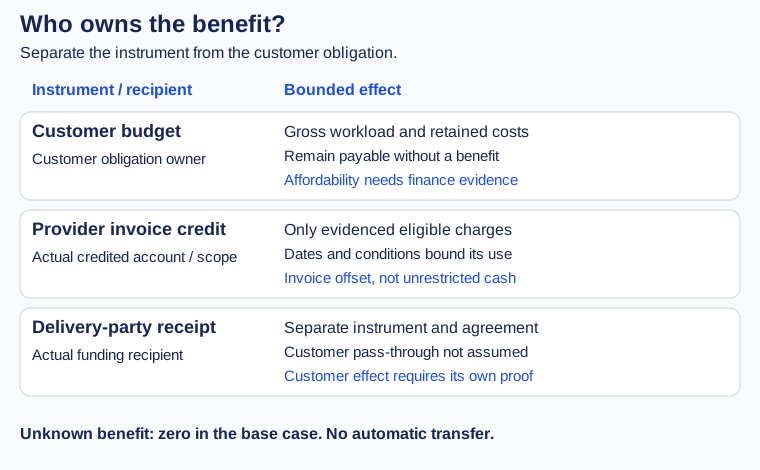
Figure 1. Commercial-context view, not an AWS funding flow or entitlement claim. Separate rows distinguish customer obligations, invoice credits and delivery-party receipts; no automatic transfer is implied. Unknown benefits contribute zero to the base case, without implying they can never become available.
An instrument record needs its issuer, recipient, account or contract scope, currency, form, eligible charges, availability, expiry, conditions and evidence reference. Distinguish an application, a conditional offer and an issued usable balance. Keep account identifiers, contracts and award correspondence in the organization's controlled evidence store. An opaque reference in the decision record is enough for public teaching material; it is not a substitute for the reviewer reading the actual evidence privately.
Check combination rules and scope independently for each instrument. A single attractive “funding total” can hide incompatible conditions or two claims against the same cost. If compatibility is unknown, keep separate scenarios instead of adding face values. A program name cannot resolve those questions. Changes to a recipient, account, project or contract reopen the benefit gate before any dependent commitment is authorized.
5. Build the gross case and retained-obligation ledger
Gross workload cost here means the declared obligations before promotional incentives, after any separately justified contractual rate treatment. It includes service consumption, licenses, support, operating work, change work and retained responsibilities within the chosen scope. It is not simply an undiscounted list price. Residual source cost means an obligation that remains after the primary workload moves. These two uses must stay explicit to avoid confusing source commitments with an invoice after credits.
Use one currency or one declared planning unit, a common horizon and a consistent cost basis. Do not convert labor capacity into cash savings unless the cash obligation actually changes. Distinguish an existing commitment that is payable under every option from a new commitment caused by an option. Include unavoidable amounts in total affordability, but do not claim their relocation is incremental savings.
AWS directional business-case guidance includes program setup, migration work, transition infrastructure, service ramp-up, source ramp-down and decommissioning. This is a useful completeness check, not a set of rates for this workload. Ask the owning team for quantities and the dated basis of each estimate. An omitted material item is UNKNOWN, not zero.
Source retirement needs evidence that traffic, data, recovery, retention and commercial obligations permit the proposed release. Turning off a machine may stop consumption while leaving licenses or a minimum contract payable. The migration overlap budget and sunk commitments guide own those focused problems. Bring their dated obligations into this ledger rather than assuming source costs disappear at cutover.
Separate capital outlay, expense, amortization and actual payment timing where those affect the decision. The simple example below uses nominal planning obligations paid in their stated month. It does not replace an accountant's treatment or establish tax consequences. A real investment committee may require discounted cash flows or financing analysis. Add them with approved assumptions, but retain the original gross obligations so that a presentation change cannot erase the adverse path.
6. Distinguish reversible evidence work from commitments
Reversibility has degrees. A bounded assessment can stop with a small known cost. A new operating contract, prepaid commitment, notice to terminate a source facility or irreversible data disposal can create a larger obligation. A technical rollback may restore service while failing to undo the commercial commitment. The investment record should state both kinds of reversal and who owns their consequences.
Classify each proposed commitment by latest safe decision date, cancellation terms, sunk amount and recovery consequence. Check whether the date falls before confirmation of a dependent benefit. If it does, the sponsor must either authorize the unfunded exposure, renegotiate the commitment or hold it. “Approval expected” is not a payment source. A deadline created by a sales process does not establish the workload's business necessity.
The public Migration Acceleration Program overview describes Assess, Mobilize, and Migrate and Modernize. It also describes support intended to offset initial migration costs. It does not promise an award to this reader or erase the costs of execution. Use the stages to discuss different decision scopes, not to infer that later work is funded because an assessment has begun.
Write an authorization that can be read without the funding slide: the permitted task, evidence output, maximum exposure, stopping condition and person who can change the scope. For example, a sponsor might permit an isolated compatibility assessment while holding a long-term purchase. Whether that is an appropriate real action depends on the organization's authority and security requirements; this paper grants none.
Do not confuse a low provider bill with a reversible design. Data placement, interfaces, operating skill and contractual commitments can make exit expensive even while an invoice is covered. Record the smallest feasible exit, the evidence needed to execute it, and which obligations remain afterward. The funded and unfunded cases need the same technical and recovery gates unless the scope itself changes and is reviewed again.
7. Work through the unfunded comparison
Packet I006 is an invented investment record for one workload over 24 operating months, plus change work paid in month zero. Every amount is a fictional planning unit. No demand growth, inflation, tax, foreign exchange, financing, revenue uplift or incident-loss reduction is modeled. The operating scope and acceptance capability are stipulated equal, not proven. All real technical and commercial gates remain UNKNOWN.
Retain costs 12,000 per month. Improve in place pays 18,000 in month zero and 10,500 per month. Whole migration pays 45,000 in month zero, 9,000 target cost in every operating month, the full 12,000 source cost in months 1 and 2, residual source obligations of 2,000 in months 3 through 12, and 6,000 retirement work in month 3. No source cost is counted twice in those transition months.
Staging pays 18,000 initially, retains a source cost of 10,000 monthly and adds 4,000 monthly for the moved contribution. The source reduction from 12,000 is stipulated, not an observed saving. If that reduction is not evidenced, the option must be recomputed with the higher retained cost. The temporary boundary also needs an operating owner and exit plan before real admission.
| Alternative | Calculation in fictional planning units | 24-month gross obligations |
|---|---|---|
| Retain | 24 × 12,000 | 288,000 |
| Improve in place | 18,000 + 24 × 10,500 | 270,000 |
| Whole migration | 45,000 + 24 × 9,000 + 2 × 12,000 + 10 × 2,000 + 6,000 | 311,000 |
| Stage a contribution | 18,000 + 24 × (10,000 + 4,000) | 354,000 |
- Retain
- Calculation in fictional planning units: 24 × 12,000
- 24-month gross obligations: 288,000
- Improve in place
- Calculation in fictional planning units: 18,000 + 24 × 10,500
- 24-month gross obligations: 270,000
- Whole migration
- Calculation in fictional planning units: 45,000 + 24 × 9,000 + 2 × 12,000 + 10 × 2,000 + 6,000
- 24-month gross obligations: 311,000
- Stage a contribution
- Calculation in fictional planning units: 18,000 + 24 × (10,000 + 4,000)
- 24-month gross obligations: 354,000
Migration's lower eventual monthly cost does not make it the lowest whole-horizon obligation. It exceeds retain by 23,000 and improve by 41,000 in this packet. The comparison establishes arithmetic only. If improvement cannot satisfy a mandatory constraint, its lower total is irrelevant to admission. If migration's technical value is preferred, the sponsor must explicitly accept its cost and evidence gates rather than label it cheaper.
The horizon matters, but extending it is not free evidence. Actual workload growth, renewals, support horizons, service rates and residual commitments may change. Do not extrapolate 9,000 forever or manufacture a break-even promise. Request a finance-owned longer-horizon scenario when appropriate, retaining the assumptions and the point at which the current evidence expires. A precise sum over an assumed future is still an assumed future.
8. Add benefit scenarios without changing the workload
For illustration only, assume a credit with a face amount of 60,000 can offset only the target's 9,000 monthly charge. Every other obligation is excluded in this fictional model. This is not a statement about any actual AWS service or award. The on-time scenario makes the credit usable in months 5 through 16. It covers six full target months from 5 through 10 and 6,000 of month 11, using all 60,000.
The denial scenario provides no benefit. The delay scenario makes the same face amount usable only in months 13 through 16 while retaining the same last eligible billing month. Only four target months fit, so 36,000 is used and 24,000 expires unused. Delayed availability and the shortened usable window are stipulated adverse terms, not a description of an AWS award modification or billing policy.
| Whole-migration scenario | Applied offset | Unused expiry | Uncredited obligations |
|---|---|---|---|
| No benefit or denied | 0 | 0 | 311,000 |
| On-time illustrative benefit | 60,000 | 0 | 251,000 |
| Delayed illustrative benefit | 36,000 | 24,000 | 275,000 |
- No benefit or denied
- Applied offset: 0
- Unused expiry: 0
- Uncredited obligations: 311,000
- On-time illustrative benefit
- Applied offset: 60,000
- Unused expiry: 0
- Uncredited obligations: 251,000
- Delayed illustrative benefit
- Applied offset: 36,000
- Unused expiry: 24,000
- Uncredited obligations: 275,000
“Uncredited obligations” is the nominal obligation after the modeled invoice offsets, not cash received. AWS's credit terms exclude transaction-based taxes and restrict eligible charges; the actual instrument and billing evidence would determine applicability. The credit runway guide owns issued-balance consumption, eligibility and expiry diagnosis. Here those details are an input to the investment comparison, not a second credit administration tutorial.
The on-time case is 19,000 below improve in place, but denial is 41,000 above it and delay is 5,000 above it. A recommendation based only on the on-time line conceals the decision's dependency. Do not invent a probability of approval and average these totals into a confident expected saving. Use separately stated scenarios until an authorized decision owner supplies a defensible probability basis and risk policy.
Keep partner payments out of this example. No private funding rate, threshold, reimbursement schedule or pass-through assumption is modeled. If a real agreement changes the customer's costs, add a separate dated instrument with its own recipient and conditions. Reconcile it against the same cost rows to avoid subtracting the same obligation twice. Preserve the no-benefit line even after an instrument is confirmed.
9. Test the early cash gap and denial path
A 24-month total cannot show whether the organization can meet an obligation next month. Against retaining the current workload, whole migration creates 45,000 additional exposure in month zero. Months 1 and 2 each add 9,000 because both environments operate. Month 3 costs 17,000, including target, residual source and retirement work, adding another 5,000 against the 12,000 baseline. The peak incremental cumulative obligation is 68,000 at month 3.
Month 4 costs 11,000 and reduces that cumulative difference to 67,000. In the on-time scenario the first offset arrives in month 5, after the peak. The denied and delayed scenarios therefore have the same early peak as the on-time case. A benefit that arrives later cannot meet earlier payment obligations without a separately evidenced financing arrangement. No financing is assumed here.
This 68,000 is not the company's required bank balance or a liquidity forecast. It is an incremental comparison against one baseline under stipulated payment timing. The organization still needs to fund baseline operations, other workloads, payroll, taxes and settlement timing. Finance must assess actual due dates and reserves. Treat the figure as a question to investigate, not a bank-runway claim.
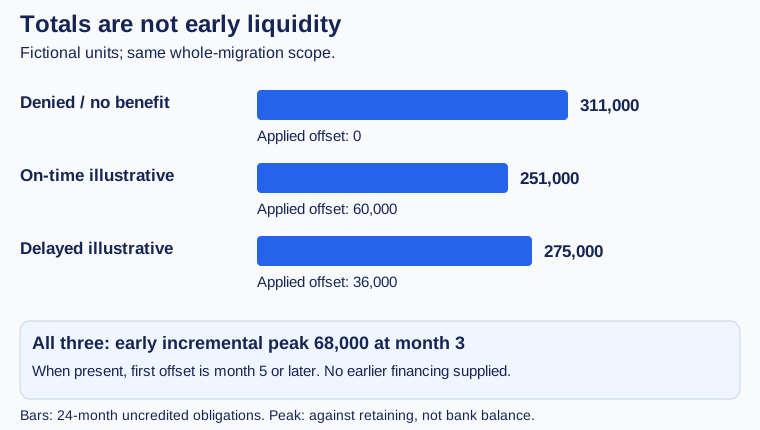
Figure 2. Two different comparisons in fictional units: whole-horizon uncredited obligations and earlier incremental exposure. The equal early-peak values are not total company liquidity. No AWS funding or payment was observed.
Write the denial response before accepting a dependent commitment. It can be an authorized unfunded continuation, a scope reduction that still meets the obligation, a bounded hold or a different evidenced alternative. “Wait for funding” is incomplete if bills keep accruing while waiting. Name who owns that waiting cost, its maximum duration and the action when the limit is reached.
10. Challenge delay, residual costs and operating assumptions
Moving the migration's operating start six months later, while paying the same change work in month zero, creates a different ledger. It pays six months of retained operations before 18 target months, with the same two-month overlap, ten residual months and retirement work. The calculation is 72,000 + 162,000 + 24,000 + 20,000 + 45,000 + 6,000 = 329,000. The reduced target-month count is not a saving when the preceding source months remain payable. A different change-payment schedule needs its own timing scenario.
That deferral is 18,000 more than immediate unfunded migration and 59,000 more than improvement. It may still be sensible if it buys decisive evidence or aligns with a permitted business window. It is unacceptable if it misses a mandatory deadline. This arithmetic does not settle either question, and no incentive is modeled for the deferral. Evaluate the changed eligibility window separately rather than copying the immediate scenario's benefit.
Challenge source-release assumptions next. If the residual 2,000 continues through month 24 rather than ending after month 12, add 24,000. Whole-migration gross obligations become 335,000. A benefit does not cancel that retained contract. The owner of the source obligation must identify the actual release condition and evidence, or the long-residual case remains a required adverse scenario.
Operating cost uncertainty can also reverse a favorable funded result. If target cost is 10,800 instead of 9,000 monthly, the additional gross obligation is 43,200 over 24 months. Keep fixed illustrative offsets capped at the benefit's usable amount rather than applying a constant discount percentage. Real eligibility and usage changes may also change how much can be consumed; recompute those rows instead of treating the offset as independent of every workload change.
Use adverse scenarios that challenge a decision, not every imaginable disaster. Select the missing evidence with the largest consequence: retirement date, required operating labor, untested technical constraint, benefit availability or early payment exposure. Record which sensitivity changes the recommendation and which merely changes contingency. This makes the next investigation specific and avoids replacing uncertainty with a giant unowned spreadsheet.
11. Keep technical value and operating ownership accountable
For a migration, useful technical value can include a required support horizon, an accepted recovery design or a capability the retained system cannot provide. For AI, it can include an accepted task with permitted data, adequate review capacity and a safe release boundary. State the evidence needed for each claim and what failure would mean. Neither cloud placement nor a successful demonstration supplies all of those outcomes.
AWS's shared responsibility model makes clear that customer responsibilities depend on the service selected. A managed service changes the responsibility boundary; it does not eliminate application, data, access and operating ownership. Cost the remaining responsibilities and the changed ones. Do not count an entire team's salary as saved merely because an infrastructure layer becomes provider-managed.
Security and recovery evidence belong to technical owners with authority to evaluate the actual environment. The investment record can request their findings and state held gates; it cannot certify compliance, authorize data disposal or grant access. A failed required gate may eliminate an attractive financial option. Preserve that result rather than reducing its weight until the sponsor's favored option wins.
For an AI proposal, use the pilot decision paper to separate a bounded learning experiment from a production decision. This paper does not determine evaluation sample size, model acceptance or safe tool authority. Its financial model must consume the implementation and operating boundary, including review, integration and support costs, rather than treating provider usage as the complete route cost.
The operating handover needs an accountable budget owner, service owner and evidence custodian. Establish who can invalidate the record after a changed source contract, workload volume, data permission or rate. Reopen only affected claims, but justify that boundary. An unchanged spreadsheet is not evidence that the organization can still meet the obligation when the team, system or contract has changed.
12. Apply evidence gates to the next commitment
Gate one establishes the accepted obligation and coverage. Gate two admits each alternative technically and commercially. Gate three reconciles its gross, transition and residual obligations on the same basis. Gate four tests affordability and the adverse path. Gate five establishes any benefit-dependent permissions and conditions. Gate six authorizes a specific next commitment, with limits and a review date. These are decision questions, not commands to execute a migration.
Missing required evidence holds the relevant claim or commitment. It does not automatically prohibit all investigation. An authorized owner can approve bounded evidence work while holding production execution. Specify the investigation's inputs, confidentiality, cost limit and output. Closing an administrative review record with unresolved items is different from declaring those items satisfied. Retain the UNKNOWN values and the next accountable action.
For packet I006, the arithmetic supports comparing totals but no real option has passed admission. A defensible teaching outcome is to request technical admission for improvement and migration, confirm residual release evidence, and obtain a finance review of the early exposure. If an actual sponsor chooses migration for a required nonfinancial value, its unfunded 311,000 obligation and adverse path must remain explicit.
Do not publish private award evidence in a proposal or companion. Store references under controlled access and record who read them. A reviewer can confirm that a relevant condition was checked without placing the account identifier, bank detail or confidential funding formula in a public PDF. The fictional companion deliberately contains none of those items and performs no provider calls.
An authorization should identify rejected alternatives and reasons, not merely a winning total. Include the action if the benefit is denied, delayed or made incompatible with the selected scope. Keep cancellation and source-retention authority separate. An investment decision may authorize funding for a plan; production change permission still belongs to the operational process and its accepted evidence.
13. Reuse the investment record and offline companion
Copy these fields for the actual decision. Attach controlled evidence by reference, leave unknown values explicit and have each owner accept their portion. A filled form is not authenticated evidence. The companion supplies a blank record, the stipulated monthly packet and a small offline model with tests. It is not a pricing tool, award estimator, funding application or completed customer assessment.
| Review field | Required record |
|---|---|
| Obligation and trigger | Accepted outcome, population, deadline, constraints, sponsor and evidence |
| Alternatives | Scope, retained contributions, admission outcome and reasons for rejection or hold |
| Technical value | Mechanism, acceptance evidence, owner and noncash versus monetary treatment |
| Gross cost boundary | Horizon, units, quantity/rate evidence, operations, change and exclusions |
| Residual obligations | Source amount, release condition, dated owner evidence and adverse duration |
| Benefit instruments | Issuer, actual recipient, eligible scope, availability, expiry, conditions and controlled reference |
| Timing and exposure | Dated payments, baseline, early peak, finance basis and limits of the calculation |
| Adverse scenarios | Denial, delay, residual extension, operating sensitivity and consequence |
| Commitment and exit | Authorized next action, cancellation terms, maximum exposure, recovery and hold conditions |
| Decision accountability | Approving roles, unresolved gates, next evidence request, review date and invalidations |
Download the offline investment-record companion ZIP. Extract it locally and read its README before running the bounded model. Its included records are fictional, its blanks are not recommendations, and its computations do not establish eligibility or legal rights. No email, upload, account login or credential is needed by the files.
For a real worksheet, keep sensitive input copies within the approved evidence environment. Do not send them to a provider or public calculator merely because this offline packet is portable. Establish the organization's handling and retention rules before collecting contracts, account exports or personnel estimates. Delete or correct copies through an authorized process; this paper cannot decide a retention exception.
Review the record with finance, the workload owner, architecture, operations and the appropriate commercial or legal owner. Ask each for the first unsupported assumption that could change the next commitment. Record objections and the required evidence, not an invented reviewer signature. The useful outcome is a bounded decision with a funded adverse path, or a clear hold with a responsible next action.
14. Conclusion: let benefits improve a case, not conceal it
The fictional packet demonstrates why three figures must remain separate: 311,000 gross migration obligations, scenario-dependent invoice offsets, and 68,000 earlier incremental exposure. The on-time benefit changes the whole-horizon comparison; it does not meet the earlier obligation or establish technical admission. Denial, delay and retained-source duration can change the recommendation without changing the headline target architecture.
A cloud business case survives incentive denial when its owners can explain the accepted outcome, credible alternatives, complete unfunded obligations and the authorized response to an adverse path. It need not assert that migration is always cheapest. It may justify a more expensive required capability, choose an improvement in place, or authorize only the next evidence purchase. What it must not do is disguise a conditional recipient benefit as proven workload value or unrestricted cash.
The evidence is local to a workload, scope, period and decision. Public program pages and current terms are starting sources, not customer approvals. Prices, eligible charges, contracts, staffing and technical requirements can change. Recheck material conditions before a dependent commitment and after an invalidating change. This paper offers an accountable review framework, not legal, tax, investment or licensing advice.
Bring the unfunded comparison, instrument record and dated adverse path to the next sponsor review. Ask whether the next commitment remains acceptable if the benefit never arrives. If the answer is no, record exactly what is held, who can resolve it and what bounded investigation is permitted. That is a useful business decision even when it produces no migration, no funding application and no new purchase.
Related resources
Cloud Cost Optimization: Attribution, Workload Models, and Change Evidence
Build a traceable cloud cost program with allocation rules, workload models, commitment scenarios, safe change gates, and a ledger that separates realized reductions from modeled avoidance.
AWS Cloud Credits: Runway and the Bill After Expiry
Separate eligible credit offsets from the gross operating bill using an exact monthly ledger, expiry loss, excluded charges and post-credit scenarios.
Database-Led Migration: Choose the Workload Boundary Before the Target
Compare managed SQL Server, retained self-managed hosting and staged relocation using obligation-complete groups, explicit cut edges and whole-scope decision records.
Related services
AWS Consulting Services for Architecture, Cost & Migration
AWS consulting for architecture and Well-Architected reviews, cost optimisation, FinOps and migration. Plan changes around workload evidence and recovery needs.
AWS Cost Optimization & FinOps Consulting
Make your cloud bill explainable, forecastable, and defensible to finance. We audit your spend, eliminate waste, and build cost governance that holds.