Rehearse an RDS PostgreSQL Snapshot Restore Without Hiding the Lifecycle Choice
Build an isolated RDS PostgreSQL snapshot restore evidence packet that separates lifecycle request settings, observed engine and maintenance outcomes, compatibility...
1. Set the recovery question before creating anything
Restoring an old snapshot is not only a data-recovery action. The new instance's engine lifecycle can differ from the environment the application team remembers. This playbook asks one bounded question: does the selected snapshot restore path produce an engine and support state the team can inspect, use safely and fund, rather than infer from a checkbox?
The working cohort is RDS PostgreSQL 13, reviewed October 8, 2026. The current RDS PostgreSQL release calendar lists its standard-support end as February 28, 2026 and Extended Support year-one pricing start as March 1, 2026. Those dates do not establish that every historical 13.x minor can be restored in your Region. Snapshot contents and current supported paths still need inspection.
Scope is a same-account, same-Region DB-instance snapshot restore into a new isolated DB instance. Aurora, Multi-AZ DB clusters, RDS Custom, cross-account copies, MySQL, S3 import, PITR, Blue/Green deployments and production traffic changes are excluded. Do not adapt cluster-level behavior by changing a label. This is an educational procedure: no AWS request, compatibility check, charge or customer outcome was executed or observed while writing it.
Owner/output/gate: database owner creates a scope record with account, Region, snapshot, engine cohort and exclusions. Stop if the required task belongs to an excluded path. For recovery-target and business-integrity mechanics, use the existing PostgreSQL restore drill; this procedure adds lifecycle evidence rather than replacing that drill.
2. Assemble the input packet and assign decision owners
The platform operator obtains sanitized snapshot metadata: ARN/identifier, capture time, status, exact engine/minor version, allocated storage, encryption/key identifier and source configuration evidence. Identify whether this snapshot represents an application release the team can still build. A snapshot timestamp is not proof of a complete business transaction or a retained application dependency.
Record the target name separately from the source name. Require a unique exercise identifier and a bounded cost/retention window. The owner supplies a network/subnet/security-group design, target parameter-group decision, instance/storage choice, approved credentials path and observer. Never rename the original instance to make an example command work. Keep the original snapshot and production instance outside the mutable target list.
Each field gets a value, capture time, evidence reference and owner. Use UNKNOWN for a denied read, absent historical configuration, ambiguous version, unavailable key or unsupported return field. Unknowns are not false values. Security/engine/snapshot/cost unknowns block creation; after creation, unknown outcome fields block acceptance and route to owned investigation.
The application owner defines representative read checks, permission-negative checks and the compatible build. The financial owner approves the spending envelope, including a failed-upgrade branch. The independent observer records what actually happened, without administering the instance or retrospectively replacing the chosen expected result.
3. Verify current engine admission in the selected Region
The database operator compares snapshot metadata with a fresh, Region-specific engine/version read. DescribeDBEngineVersions can include unavailable versions when IncludeAll is selected; its ordinary default includes available versions only. Inspect status and follow pagination. A missing result from a filtered query is not proof that the snapshot is permanently unrecoverable.
The current major-version target guidance uses ValidUpgradeTarget for the exact source version. Retain the complete response relevant to the decision, not only a copied major-version number. Recheck immediately before a separately approved exercise, because a static table and an earlier Region response can drift.
An unsupported exact snapshot-engine restore path is a hold, not the same thing as a major version having passed standard support. The restore API requires upgrading an unsupported snapshot engine first. Hand off to a separately scoped and approved PostgreSQL snapshot-upgrade decision, including eligibility and preservation risks. Automated snapshots cannot be upgraded by that operation. Do not mutate the preserved original snapshot or treat a snapshot upgrade as part of this admitted restore rehearsal.
These are illustrative read-only requests. Replace each placeholder explicitly after confirming identity and permissions. They were not run for this article and do not authorize restore or spending:
aws sts get-caller-identity --profile EXERCISE_READ_PROFILE
aws rds describe-db-snapshots --profile EXERCISE_READ_PROFILE --region APPROVED_REGION --db-snapshot-identifier APPROVED_SNAPSHOT
aws rds describe-db-engine-versions --profile EXERCISE_READ_PROFILE --region APPROVED_REGION --engine postgres --engine-version EXACT_SNAPSHOT_VERSION --include-all
Output/gate: operator retains dated source-version and possible-target evidence with account/Region/CLI version. The database owner resolves missing or contradictory admission evidence before restoring. A catalog upgrade target does not prove application compatibility or choose the actual service-managed upgrade target for you.
4. Review permissions, encryption and spending as separate gates
Security review begins with named actions and actual resource scope, not an administrative policy pasted into the article. The RDS service-authorization reference distinguishes describe actions from RestoreDBInstanceFromDBSnapshot, resource types and dependent actions. Review snapshot/target/subnet/parameter resources and tagging dependencies for the proposed request. Add role-passing permissions only when the selected configuration actually passes a role. This list is not a complete deployable IAM policy.
Read evidence can require rds:DescribeDBSnapshots, rds:DescribeDBEngineVersions, rds:DescribeDBInstances, rds:DescribePendingMaintenanceActions, rds:DescribeEvents, rds:DescribeDBLogFiles and rds:DownloadDBLogFilePortion, with EC2 configuration reads if network inspection uses them. SQL authorization remains separate from AWS control-plane permission. Permission to describe an endpoint does not permit the observer to read customer tables.
For an encrypted snapshot, inspect key availability and effective use authorization against RDS encryption guidance. A named key, a policy screenshot or an authorized metadata read is not proof that the restore service path can use the key. Key access failures are hold conditions; do not substitute an unencrypted copy to bypass the problem.
The financial owner approves compute, retained storage/backups, logs and conditional Extended Support exposure for the exact Region/class/runtime. Use dated RDS PostgreSQL pricing evidence, not a universal dollar example. A budget alert is monitoring, not a guaranteed spend ceiling. Set an operator-owned observation deadline and escalation before the exercise. If the owner cannot fund the documented failure branch, stop at the read-only packet.
5. Select an explicit lifecycle request and preserve the interface
AWS's restore lifecycle guide describes different interface defaults. In the console, not selecting Enable RDS Extended Support on an expired major leads to automatic upgrading. An omitted lifecycle option in CLI/API defaults to Extended Support enabled. These are not equivalent omissions.
For this rehearsal, the owner explicitly chooses either open-source-rds-extended-support or open-source-rds-extended-support-disabled; record the exact interface and submitted value. The snapshot restore API defines EngineLifecycleSupport and its enabled default. Do not call this a billing-only switch or confuse it with minor-version upgrade settings.
The restore guide permits the disabled option for PostgreSQL 12 and higher. For expired majors it describes a post-restore upgrade in a future maintenance window. It also documents failed-precheck rollback to Extended Support, charges until manual upgrade and no subsequent automatic retry after the first attempt. Disabled is an intention, not guaranteed zero-charge evidence.
Owner/output/gate: database and financial owners sign a request decision, expected branches and an observation deadline. Request fields are recorded in an inert checklist, not an executable restore command:
Interface / client version / operator / request time:
Account / Region / source snapshot ARN / exact source engine:
New exercise-only DBInstanceIdentifier:
Explicit EngineLifecycleSupport value (not omitted):
Target class / storage / subnet group / security-group IDs:
Public access decision / parameter group and family:
Encryption/key evidence / tags / maintenance expectations:
Budget / observation deadline / failure owner / cleanup approval:
Expected behavior source and date / unresolved request fields:
6. Make the isolated restore request observable
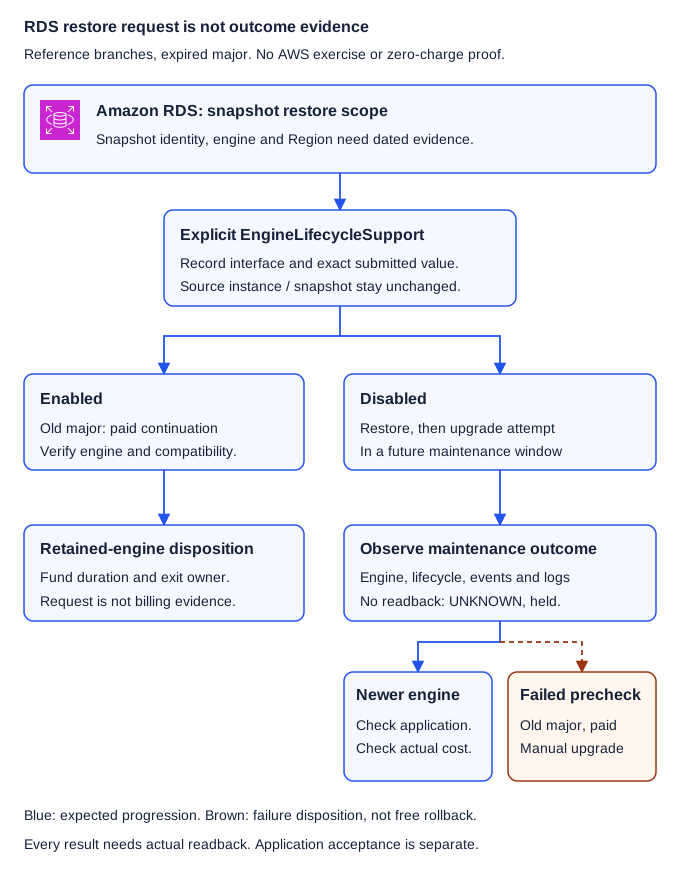
Reference outcome branches for an expired PostgreSQL major, not observed AWS execution. Request settings do not establish the actual engine, application readiness or charge outcome. A failed disabled-path upgrade needs a manually owned disposition.
The operator submits only the separately approved restore request. Retain the request ID, target identifier/ARN, submitted options, response and timestamps in the restricted exercise record. Compare them with the signed packet. A response acknowledging creation is not a restored database, a completed maintenance action or an accepted application.
The snapshot restore guide describes default parameter and network choices when custom settings are not selected. Inspect the actual target subnet/security groups, public exposure and parameter family before any application connects. Original custom settings must not be assumed inherited. A different endpoint alone does not establish outbound-effect isolation.
Keep recovered applications disconnected from production queues, payment systems, email delivery and scheduled workers. Prefer inert read fixtures for the first compatibility pass. If writes are needed, require a separately approved synthetic dataset and effect-suppression mechanism. The operator and security reviewer produce an isolation readback. Any unexpected public access, production integration or identity mismatch stops application attachment and triggers the agreed containment procedure.
7. Read the restored state and maintain an outcome timeline
The observer captures DBInstance response fields: immutable DbiResourceId, current DBInstanceArn and identifier, engine/version, lifecycle support, status, maintenance window, pending modifications, parameter-group apply state, security groups, subnet group and endpoint where present. Retain observation time; the ARN is a separate current field, not an asserted immutable identifier. Preserve absent fields as UNKNOWN. Distinguish an endpoint not yet returned while creating from a confirmed inaccessible endpoint.
aws rds describe-db-instances --profile EXERCISE_READ_PROFILE --region APPROVED_REGION --db-instance-identifier APPROVED_EXERCISE_INSTANCE
aws rds describe-pending-maintenance-actions --profile EXERCISE_READ_PROFILE --region APPROVED_REGION --resource-identifier APPROVED_EXERCISE_INSTANCE_ARN
Pending maintenance actions, pending modifications and configured maintenance window are different evidence fields. A blank maintenance result does not establish that no lifecycle action can occur or that an upgrade succeeded. Capture events/logs and repeated engine/lifecycle state around the expected transition. Follow pagination where applicable and retain observation timestamps.
Output/gate: a timeline distinguishes request accepted, database first available, transition observed, compatibility completed and owner disposition. If the approved window ends before the future maintenance outcome can be observed, mark that outcome untested. Decide whether to retain the bounded exercise or retire it; do not force a maintenance action merely to finish a content checklist.
8. Handle upgrade prechecks without deleting the evidence
The database owner examines source and target compatibility using the PostgreSQL major-upgrade procedure. AWS describes instance-wide prechecks and timestamped pg_upgrade_precheck.log evidence. Its checks include prepared transactions, incompatible types and extension constraints. The article does not provide a universal remediation SQL script.
If prechecks fail, retain the failure log, resource/version/lifecycle readback and time. Keep the application off that target. Assign each issue a database/application owner, remediation proposal and repeat-test approval. Do not drop extensions, alter roles, commit prepared transactions or remove data because a generic example mentions them. Each can affect the application's correctness or security.
Separate service-managed restoration of the old engine from your team's rollback. The documented failed-upgrade branch can leave the database in paid Extended Support and requires an owned manual upgrade. Do not wait for an automatic retry AWS says will not occur. Manual upgrade execution, schedule and compatibility plan need a new change decision. This rehearsal records the handoff, not a hidden production fix.
9. Verify compatibility after the observed engine outcome
The application owner checks the exact resulting engine rather than the requested one. Use a fixed compatible build and sanitized fixtures representing the selected critical workflow. Inspect extensions and grants, run supported reads, compare expected identities and business relationships, and test that a restricted identity remains denied. Report the build/configuration and each check's expected and actual result.
Include a query-plan/performance observation only with stated dataset and initialization conditions. AWS's restore guidance notes that availability can precede full data loading. Do not advertise a cold read as a steady-state regression, or warm every table without a storage/load cost plan. No throughput threshold or restore duration is prescribed here.
The upgrade procedure also distinguishes engine upgrades from extension upgrades and recommends refreshing statistics afterward. Any extension change or statistics operation must be planned by the database owner in the isolated target; those operations were not executed for this draft. A completed service upgrade is only one prerequisite for application acceptance.
Output/gate: application owner records pass, fail or untested for required checks, including permission-negative tests. Hold acceptance if a required extension, build, authorization or data invariant is unknown. The dual-run reconciliation playbook remains the owner for authority/cutover reconciliation. Passing this rehearsal does not authorize production endpoint changes.
10. Reconcile the cost disposition without inventing savings
The financial owner records lifecycle exposure from observed version/support state and separately checks available billing evidence for the exercise interval. Request flags are configuration evidence, not an invoice. An unavailable or not-yet-final charge remains UNKNOWN. Attribute compute, storage, retained snapshots and log costs separately from Extended Support rather than calling the whole test “the support charge.”
An approved short rehearsal may show the right engine but lack finalized financial records. Its acceptance record can state operational checks passed while financial reconciliation remains open with an owner/date. It cannot state zero charge. If the failed-precheck branch leaves an old major running, escalate its funded duration and manual-upgrade disposition before extending the test.
Do not compare hypothetical costs with an invented previous monthly bill. The lifecycle debt operating model addresses funded upgrade versus deferral. This procedure contributes actual evidence to that decision only after a separately authorized exercise supplies it.
11. Use a synthetic branch rehearsal before account execution
These cases are unexecuted tabletop inputs. They verify that the team can classify evidence and avoid a false successful result; they are not samples of real AWS responses.
- A, explicit enabled: request recorded enabled; fictional readback remains PostgreSQL 13. Outcome is paid-continuation exposure plus compatibility work, not a completed major upgrade.
- B, explicit disabled, later newer engine: fictional post-maintenance readback shows an admitted newer major. Require independent lifecycle/version, compatibility and cost evidence before acceptance. A request alone cannot satisfy this case.
- C, explicit disabled, failed precheck: fictional log reports incompatibility and old-major readback remains. Preserve the failed record, financial exposure and manually owned upgrade handoff. Do not mark zero charge or expect an automatic second attempt.
- D, no post-maintenance readback: creation succeeded but the observer has only the first available state. The final outcome remains UNKNOWN even if the configured maintenance window has passed.
- E, wrong identity or isolation: signed Region/account differs from the request, or production integrations are reachable. Stop attachment, contain the isolated exercise and investigate. Do not use an apparently healthy SQL query to override this gate.
Owner/output/gate: observer and database owner classify all five cases before spending approval. The team must explain how it distinguishes B from D and why C is not a cost success. Tabletop agreement proves understanding only, not recoverability.
12. Preserve an evidence worksheet with stop and reversal rules
Copy this record per proposed branch. Store sensitive identifiers, logs and fixture results under the approved access/retention policy, not in a public article or customer screenshot.
Exercise ID / database owner / observer / application and financial owners:
Approval references / excluded operations / budget and observation deadline:
Account / Region / identity readback / source snapshot / metadata evidence hash:
Snapshot version / status / capture time / encryption and key-use evidence:
Calendar source date / current Region admission / exact upgrade-target evidence:
Interface / submitted lifecycle value / complete request / request ID / time:
Target ARN and immutable ID / isolation readback / parameter family:
Observation time -> engine / lifecycle / status / pending changes / maintenance:
Events and precheck log references / no-log or denied-read UNKNOWN reason:
Application build / fixture / expected / actual / negative permission result:
Observed branch / required untested fields / failure or manual-upgrade owner:
Cost exposure / billing evidence / unresolved amount and follow-up date:
Stop trigger / actual containment / source unchanged evidence:
Retention decision / cleanup resource list / retirement readback:
Acceptance: operational / application / financial / cleanup separately:
Stop triggers include identity drift, unresolved key/engine admission, unexpected exposure, a request mismatch, failed prechecks, a compatibility failure, observer blind spots or the approved spending/time boundary. Stop means cease further test actions and notify the named owner. It does not mean deleting an instance while it is in a state the operator has not inspected.
The safe reversal boundary is this isolated target and its access, never production traffic. Do not claim that returning to an old instance undoes test writes or outside effects. Keep evidence before retiring resources. If any external effect escaped isolation, invoke the existing reconciliation procedure and suspend acceptance rather than declaring the sandbox harmless.
13. Retire the exercise and state exactly what is done
Acceptance criteria for the recovery evidence
Database, application and financial owners record PASS, FAIL or HOLD independently, with timestamps and evidence references. Do not collapse their decisions into one green restore status.
- Snapshot identity, exact engine path and Region admission match the authorized new isolated target. Unsupported engine paths or unavailable encryption/permission evidence remain HOLD.
- The retained request records the interface and explicit lifecycle setting. Observed engine, lifecycle and maintenance fields are connected to the restored instance's immutable identity rather than inferred from the request.
- Required application fixtures, extension/build compatibility, authorization-negative checks and data invariants have observed outcomes. Unknown or untested required checks block application acceptance.
- Pending maintenance and failed-precheck branches have an owned next action and funded time limit. A future upgrade that was not observed is labeled untested, not completed.
- Conditional charges, finalized or still-pending financial evidence and manual-upgrade responsibility are disclosed. Cleanup has dated resource/access readback and retained evidence; production endpoints remain unchanged.
An operational pass can coexist with an open financial reconciliation only when that limitation, owner and due date are explicit. It is not a zero-charge or production-cutover approval.
The database owner and security reviewer verify the exact exercise resource list before any separately approved removal. Follow RDS deletion guidance, including deletion protection, final-snapshot and retained-backup choices appropriate to the exercise. This article intentionally supplies no destructive command. The original recovery snapshot is not on the cleanup list.
Retain logs and evidence first. Decide whether a final snapshot contains sensitive data and whether its retention is justified. Confirm resource retirement and temporary access removal through readback, then record any intentionally retained snapshots/backups and their cost owner. A deletion request alone does not establish retirement or that every related charge has ended.
Done means the exact request and dated observations are connected; required engine/lifecycle and application outcomes are resolved or explicitly held; conditional charges and manual-upgrade ownership are disclosed; and cleanup has evidence. No unresolved branch is silently converted to pass. A failed rehearsal with complete evidence is useful, but it is not a successful recovery claim.
The next action is to take the read-only packet and synthetic cases to the database, application, security and financial owners. Agree the exact target, spending boundary and observation plan before requesting account execution. Ampity's AWS consulting and migration scope can support that evidence-led assessment. The procedure does not replace those owners' workload-specific technical review or authorize account changes.
Related resources
Run a PostgreSQL Point-in-Time Restore Drill
Rehearse an isolated PostgreSQL restore, verify the recovery target and business invariants, reconcile external effects and measure time to an accepted service.
Reconcile a Dual Run Before Moving the Write Boundary
Define matching data cuts, classify migration discrepancies and prove recovery before a replacement system receives authority to accept new business writes.
AWS Lifecycle Debt: Decide What to Upgrade, Defer or Retire
Compare EKS version support, node-image retirement, RDS paid continuation and Bedrock model removal using an explicit lifecycle register, bounded exceptions, funding alternatives and evidence required before implementation.