How to Attribute Shared RDS Cost to Applications Running on EKS
Reconcile RDS billing with stable EKS application identities, choose a defensible database usage proxy and preserve shared, idle and unallocated cost.
To track RDS cost for applications running on EKS, build a separate database allocation ledger. Start with RDS billing records, map them to the database resources the applications use, then apply a documented allocation rule. A Kubernetes namespace cost report does not automatically know which application caused activity in a shared database.
AWS's split cost allocation fields describe CPU and memory cost assigned to tasks and pods. Their parent resource mapping connects a pod to its EC2 host. That relationship does not identify the application's share of an RDS bill. Treat the database as another cost pool with its own evidence and policy.
This article is for platform engineers and FinOps practitioners whose EKS applications share an RDS database. The output is a reproducible showback statement: direct assignments, policy-based shared allocations, centrally retained capacity and unresolved cost. It is a reference method with a synthetic example, not an Ampity customer result. It does not estimate savings or prescribe a database resize.
1. Define the database cost pool before choosing a meter
Write down the reporting period, currency, usage accounts, Regions and database resources. Record whether the period is provisional. Choose invoice-oriented cost or an amortized economic view and retain a bridge between them. Mixing the two makes a product trend hard to interpret.
For an amortized view, account for reservation benefits and unused commitment cost explicitly. AWS defines reservation effective cost and unused reservation fields, including fields applicable to RDS. Do not sum amortized usage and the same reservation's full fee again. Have finance accept the calculation for the export schema you actually use.
Create separate components for provisioned database capacity, storage, backup and any other charges found in the chosen boundary. Review proxy, monitoring and transfer charges if they belong in the service cost view. They may have different billing identities and allocation drivers. Do not assume every database-related charge has an RDS instance ID or belongs under one service filter.
Preserve the export version and charge-row identities. AWS's line-item documentation explains resource IDs, charge types and UTC usage intervals. Resource IDs are optional in the report and can be blank for some charges. Include them where available, then retain exceptions. A missing ID is a mapping problem to investigate, not permission to drop the charge.
The pool must reconcile to its declared billing view. A subtotal that excludes taxes or credits can be useful, but its reconciliation needs a named adjustment bridge. “Matches AWS” is too vague when one person means the invoice and another means amortized usage.
2. Keep billing identity and application identity separate
Maintain two mappings with effective dates. The first maps billing resource identifiers to a database pool. The second maps application activity to that pool. Joining them produces an allocation input, not a vendor-generated cost per SQL request.
For the billing map, keep account, Region, resource identifier, resource kind, pool ID and mapping validity. Include writer, readers and restored resources where relevant. Validate an identifier's form against the actual export and inventory rather than assuming every field is an ARN.
For the application map, use an identity that survives deployments: application ID, environment, accountable owner and database pool ID. Cluster and namespace can be useful context, but namespace names are not necessarily unique across clusters. Pod names and IP addresses are transient. Preserve their historical mappings only when needed to interpret sampled activity.
| Mapping record | Illustrative contents | What it establishes |
|---|---|---|
| Billing resource to pool | account + Region + resource ID → orders-db-prod | Which billed resource belongs in the pool |
| Workload to application | cluster + namespace + workload → checkout-prod | Which application owns the workload |
| Database signal to application | pool + approved database principal → checkout-prod | How a measured activity group can be attributed |
| Exception | unknown principal, expired map or unmatched charge | What cannot yet be assigned |
The database signal might be a dedicated database user, a tested application identifier or application-side telemetry. It must be trustworthy enough for the decision. A user-supplied header is not an authoritative product identity. An application ID also does not prove tenant identity when that application serves many customers.
RDS resource tags can organize billed resources into cost groups. A tag on a shared database names its ownership or pool; it does not measure each caller. AWS also documents limitations for snapshot cost allocation tags. Keep backup exceptions visible rather than assuming a snapshot tag guarantees attribution.
3. Use a proxy that matches the charge component
An allocation proxy is a measurable basis for distributing cost. It is rarely exact economic causation. A query can wait on another application's lock, a request can hit cached data, and retained storage can remain after the writer stops running.
Compare candidate drivers before instrumenting production:
| Driver | Where it can help | What it misses |
|---|---|---|
| Database calls by application | Similar operations with comparable work | Query complexity, retries, batch size and background work |
| Application-observed database duration | Broad view of time spent on database calls | Network and pool waits; concurrent durations can overlap |
| Database activity grouped by mapped user | Sharing a provisioned capacity pool | Shared credentials, sampled activity, internal work and lock effects |
| Owned logical data footprint | Storage responsibility under an agreed policy | Indexes, dead space, shared tables and backup retention |
| Reserved share or equal share | Capacity deliberately funded by several products | Changes in actual consumption |
AWS describes Database Insights DB Load as session activity and supports views by waits, SQL, hosts and users. That is useful performance evidence. It is not a dollar meter. Before choosing it, check engine, Region, instance class and feature support for the actual deployment and mode. Do not promise an identical user-level attribution path across every RDS configuration.
When using a sampled activity series, integrate the selected measure over the same intervals and verify that the grouping reconciles to its parent measure. A screenshot of the top users is insufficient if lower-ranked or truncated groups are omitted. Keep an unknown group. Missing observation windows are different from observed zero activity.
Pooling can break a convenient identity assumption. RDS Proxy pools and reuses database connections. If applications share a database principal, the database user dimension cannot distinguish them. Confirm the attribution signal across the real pool or proxy path with a bounded test. Do not assume a client identifier is preserved, or change authentication solely to improve a financial report without security and application review.
Start with one driver for one material component. If the intended decision is simply whether a product uses a shared platform, a coarse reservation share may be more useful than maintaining fragile per-query instrumentation.
4. Keep four kinds of cost visible
The policy should distinguish direct, shared, idle or reserved, and unallocated cost. Those labels describe different reasons for assignment.
- Direct: a dedicated billed resource has a confirmed application owner. A schema in a shared instance is not automatically a directly billed resource.
- Shared: the component is divided using an accepted driver. Label the result as allocated cost and retain the driver and policy version.
- Idle or reserved: intentional spare capacity, a shared baseline or unused commitment cost stays with the chosen platform or reservation owner. Do not derive its dollar value by subtracting a DB Load percentage from the bill.
- Unallocated: incomplete ownership, unknown activity or missing evidence blocks assignment. Give the exception an owner and resolution condition.
Database capacity, storage and backup may use different rules. A policy can hold the baseline centrally, allocate the remaining capacity by observed activity, and allocate retained storage by ownership. The result is a financial agreement informed by engineering evidence. It does not claim each component varies linearly with the driver.
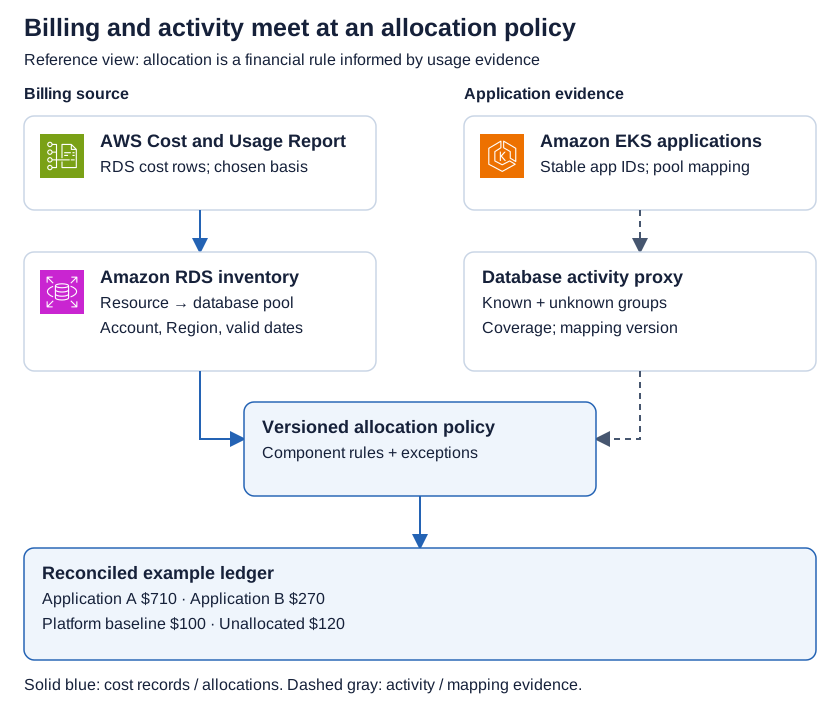
*Reference allocation view. Solid blue arrows carry billing or ledger data; dashed gray arrows carry activity and mapping evidence. The policy joins the two. No arrow claims that Kubernetes measures RDS dollars.*
5. Reconcile a small worked example
This fictional USD example uses a closed month and an agreed amortized RDS subtotal of $1,200. All amounts and activity units are invented for arithmetic, not AWS prices, measured customer usage or achieved savings. EKS compute, taxes, support, monitoring and transfer are outside this example. Finance would retain their separate reconciliation in a full service statement.
The reviewed cost ledger has four nonoverlapping slices:
| Slice | Amount | Policy |
|---|---|---|
| Dedicated database for application A | $200 | Direct assignment to A |
| Shared database capacity slice | $600 | Divide by reconciled activity units, including unknown activity |
| Shared storage and backup slice | $300 | Agreed retained-data ownership share: A 70%, B 30% |
| Baseline capacity retained centrally | $100 | Platform-funded reservation policy |
| Total in scope | $1,200 | Reconciles to the chosen billing subtotal |
The $100 baseline is an agreed funding slice, not a measured idle-cost claim. No part of the same charge is counted twice. For the $600 capacity slice, assume a complete illustrative meter recorded A = 50, B = 30 and unknown = 20 comparable activity units. Unknown is included in the denominator: 100 units.
Therefore A receives $600 × 50/100 = $300, B receives $600 × 30/100 = $180, and $120 stays unallocated. Storage and backup add $300 × 70% = $210 to A and $300 × 30% = $90 to B.
| Final recipient | Calculation | Allocated amount |
|---|---|---|
| Application A | $200 direct + $300 capacity + $210 retained data | $710 |
| Application B | $180 capacity + $90 retained data | $270 |
| Platform baseline | Centrally retained | $100 |
| Unallocated | Unknown activity share | $120 |
| Total | $710 + $270 + $100 + $120 | $1,200 |
Activity identity coverage is 80/100 = 80%. Application-assigned cost is $980/$1,200, approximately 81.7%. These are different denominators. Centrally retained cost is explained, while the $120 has unresolved attribution.
If unknown activity is discarded and only 80 identified units form the denominator, A receives $375 and B $225 of capacity cost. That silently transfers the unknown $120 to known applications. If no activity is recorded at all, do not divide by zero or label the database free. Retain that component centrally or unallocated under the declared fallback.
Test policy sensitivity too. An equal split of the same $900 shared slices would produce A = $650, B = $450 and platform = $100, still totaling $1,200. That is another policy, not another observed bill. Show this difference before using the activity allocation to decide product profitability.
6. Collect evidence without exposing query contents
Use the least detailed evidence that answers the allocation question. A monthly ledger generally needs application ID, pool ID, time interval, driver value, identity coverage and mapping version. It does not need SQL literals, request payloads or customer names.
Keep source billing data access separate from application telemetry access. Restrict readers, define retention and record which fields were removed. AWS's RDS tagging guidance specifically warns against putting confidential or personal information in tags. Use stable internal application codes.
Read existing exports and approved metrics first. New logging, tracing, database principals or monitoring modes are deployment changes with overhead, access and cost consequences. Review them with the database and security owners. A cost investigation is not a reason to enable full query logging across production. Check collection gaps, sampling bias, retention and feature coverage before claiming historical reconstruction.
For a bounded identity test, select one application and an approved test window. Confirm that its known operations reach the intended pool and appear under the expected attribution signal. Repeat through the actual connection path after a deploy or failover if those events can change mapping. Preserve only the sanitized evidence needed to establish the join.
7. Close the period with an allocation record
Keep the following record next to each pool. Another engineer should be able to rerun the calculation without guessing how the report was built.
Period, UTC interval, currency and provisional/closed status:
Billing export version, cost basis and adjustment bridge:
Included accounts, Regions, resource IDs and charge components:
Resource-to-pool and workload-to-application mapping versions:
Driver definition, aggregation query and observation coverage:
Direct, shared, baseline/idle and unallocated rules:
Policy version, effective date and change rationale:
Rounding treatment and source-to-ledger reconciliation difference:
Unallocated exceptions, owners and resolution conditions:
Finance and workload review decisions, still required or recorded:
Round only at the reporting boundary. If cent rounding leaves a residual, record how it is assigned; never lose it silently. Preserve restatements when late billing adjustments or corrected identities affect an already closed period.
Track three diagnostic signals: reconciliation difference, unresolved attribution cost and driver observation coverage. A zero reconciliation difference proves the arithmetic balances. It does not prove the driver is fair. A falling unallocated balance is useful only when the missing evidence was resolved, rather than redistributed by changing the denominator.
Begin with one shared database and one closed period. Ask its application owners to review the identity map, driver and centrally funded slice, then reproduce the ledger. Once they can explain both the assigned amounts and the remaining uncertainty, expand the method. For the broader finance operating model, use Enterprise FinOps: Allocation, Forecasting, and Cost Decisions. The immediate next task here is a defensible RDS pool ledger, not a savings claim.
If the investigation also exposes pool acquisition waits, review the database fleet connection budget before adding replicas or increasing every pool. Connection pressure is capacity evidence, not a dollar-allocation meter. Keep that operational review separate from the agreed billing driver.