CloudFormation Failed Rollbacks: Choose the Continuation and Reconcile What Was Skipped
Separate rollback failures from cancelled updates, identify nested resources correctly and review persistent role choices. Use a synthetic continuation packet that...
Primary sources checked
Establish the failure before clearing the stack
For a stack in UPDATE_ROLLBACK_FAILED, identify the resource and cause that prevented rollback. Repair that cause and continue without skips when the repair is supported and authorized. Consider a minimal, explicitly reviewed ResourcesToSkip set only for eligible rollback failures that cannot currently be repaired. Keep a separate reconciliation record: successful continuation does not prove that a skipped physical resource matches its template or that the application recovered.
This guide helps a platform operator produce a continuation decision and a next-update gate for one parent stack with a nested worker stack. It covers failed update rollback, not failed initial creation, deletion recovery, StackSets, resource import, custom-resource handler implementation or database restore. Those need their own operating procedure. No command here changes a stack, and the supplied aliases cannot identify a real AWS account.
All events, times, policy changes, resource states and outcomes in the worked case are stipulated synthetic records. The offline fixture checks bookkeeping and explicit decision rules. No AWS API, actual permission, rollback or application test was executed. A declared evidence reference is an assumption to review, not proof the evidence exists.
The infrastructure-as-code assessment covers Terraform change safety. The control-plane outage article covers serving versus change dependencies. Use the deployment acceptance pack for release-wide evidence. This guide adds CloudFormation-specific continuation identity, skip eligibility and post-skip consistency records.
Preserve a reconstructable event and resource record
Stop competing stack writers through the team's approved operating control. Name the incident owner and the engineer collecting read-only evidence. An automatic retry pipeline should not race a recovery decision. Keeping the application serving and making the stack operable are separate responsibilities; assign both if the incident spans them.
Record account, Region, unique parent stack identity, current status, attempted template/parameter revision and the rollback target revision. Keep the resource inventory with logical and physical identifiers. A physical resource may have changed during the failed update, so an identifier from the original template is not an adequate current-state record.
DescribeStackEvents returns events in reverse chronological order and paginates. Preserve all pages needed for the relevant operation; an initial page is not necessarily the beginning of the failure. Retain event IDs, timestamps, stack/resource identity, status and reason, with acquisition time and scope. Event API.
Order the selected events into a timeline and distinguish forward update, rollback initiation and rollback failures. Keep current resource readbacks alongside that history. A historical failure event and today's resource status can describe different moments. If you cannot determine which operation an event belongs to, hold the proposed skip until the ambiguity is resolved.
AWS's troubleshooting guidance uses failure reasons to distinguish permission, stabilization, dependency and out-of-band change problems. Collect the underlying service evidence needed for the selected cause rather than changing permissions or skipping resources from the status label alone. Troubleshooting.
Never store credentials, full sensitive resource properties or private application payloads in the shared incident packet. Keep restricted evidence in its approved location and use aliases for discussion. Access denied while collecting evidence means unknown, not that a resource or event is absent.
Separate repair, minimal skip and HOLD
The continuation operation applies to UPDATE_ROLLBACK_FAILED. It can resume rollback after a cause is repaired. Supplying a client request token identifies a continuation request for retries; preserve request identity and response evidence instead of issuing unrelated requests when a response is uncertain. ContinueUpdateRollback API.
A repair path needs a cause, responsible owner, bounded change and evidence that the blocking condition was addressed. For a permission failure, review the intended execution role and exact denied operation before any access change. Restoring an approved permission and granting a broad administrator policy are different changes. A successful operator read does not prove that the execution role can perform rollback.
For skips, AWS limits selection to resources in UPDATE_FAILED because rollback failed, not failures for other reasons such as cancelled updates. Skipped resources are marked UPDATE_COMPLETE, while their physical state can remain inconsistent with the template. AWS requires that inconsistency to be resolved before another update and advises the minimum necessary skip set. Continuation and skip rules.
Do not calculate “minimum” as every red row in the console. A parent or dependent resource can fail because one underlying resource could not return. Review the dependency and root cause. If a second skip has no independent explanation, do not add it to make the first request succeed. The fixture accepts a declared reviewed minimal set; it cannot prove that set is truly minimal in AWS.
HOLD is appropriate when parent identity, failure phase, reason, repair effect, role choice or physical resource is unknown. Name the missing observation and its owner. The local HOLD result is not an API state or a way to suspend a stack operation already in progress.
Keep nested names and logical identifiers in their proper fields
The worked root is InfraDemo, with parent logical resource Workers of type AWS::CloudFormation::Stack. Its generated child stack name is InfraDemo-Workers-Q7DEMO. The resource inside that child has logical ID WorkerGroup. These values have different jobs.
AWS directs continuation at the parent rather than the nested stack. For a resource inside a nested stack, a skip value uses the generated nested stack name plus the resource logical ID, separated by a period. Skipping the stack resource itself has an additional embedded-stack status restriction. Do not substitute the parent's logical child identifier for the generated child name. Nested resource naming and restrictions.
| Record | Fictional value | Meaning |
|---|---|---|
| Continuation target | synthetic-root-id | Unique parent stack alias, not the child target |
| Child resource in parent | Workers | Logical ID in the parent template |
| Generated child name | InfraDemo-Workers-Q7DEMO | Child name used to qualify its internal resource |
| Resource inside child | WorkerGroup | Logical ID within that child's template |
| Proposed nested skip | InfraDemo-Workers-Q7DEMO.WorkerGroup | One reviewed child resource, not the entire Workers stack |
Continuation targetFictional value: synthetic-root-idMeaning: Unique parent stack alias, not the child target
Child resource in parentFictional value: WorkersMeaning: Logical ID in the parent template
Generated child nameFictional value: InfraDemo-Workers-Q7DEMOMeaning: Child name used to qualify its internal resource
Resource inside childFictional value: WorkerGroupMeaning: Logical ID within that child's template
Proposed nested skipFictional value: InfraDemo-Workers-Q7DEMO.WorkerGroupMeaning: One reviewed child resource, not the entire Workers stack
Workers.WorkerGroup fails the fixture's identity check. Selecting Workers instead requests a different resource, the embedded stack. The fixture rejects that choice when its embedded status is UPDATE_ROLLBACK_FAILED; it is not one of the documented deletion statuses permitted for this special skip. Do not delete a nested stack to manufacture an eligible status. That introduces a different consequential operation and potential data loss.
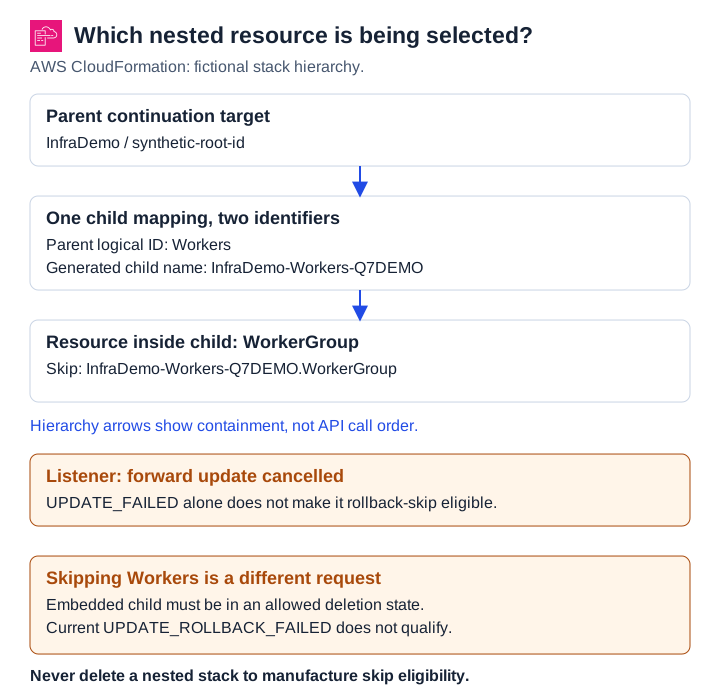
*Identity arrows show containment, not API calls. All identifiers and event causes are fictional. The exact nested skip qualifies WorkerGroup with the generated child name, not the parent logical ID. Local review and HOLD are not AWS authorization or a native pause state.*
Document figure 1. Fictional identity mapping and separate skip exclusions. Containment is not an API request; a local result does not authorize an AWS change.
Review execution-role persistence as part of recovery
Continuation can specify RoleARN. The API says that CloudFormation will use the supplied role for future stack operations, not only the current recovery. If omitted, the previously associated role is used, or a temporary session when no role is available. Record which path is intended. Role parameter.
AWS also warns that users authorized to operate on a stack can use its associated service role even without their own iam:PassRole permission. A service role is not removable once associated. Review trust, resource scope and future operator access before replacing the role. A recovery role can change the stack's continuing authority boundary. Service-role behavior.
The worked packet retains fictional execution-role-a and records an acknowledged persistence review. It contains no policy document, ARN, permission grant or evidence of actual IAM evaluation. A replacement-role variant requires its own review reference and named security owner. Do not infer approval from a field that says “reviewed” or use an incident deadline to bypass that decision.
Work the failed worker update and the cancelled listener separately
The synthetic attempted revision is template-r9; the rollback target is template-r8. During the attempt, an out-of-band edit removes a required permission from the existing execution policy. The worker group's rollback handler cannot restore its earlier configuration. This is a teaching cause, not an exact captured provider error or a tested Auto Scaling failure mechanism.
The packet's relative timeline puts the root listener's cancelled forward update at time 8, rollback initiation at 10, nested WorkerGroup rollback failure at 20 and the parent's Workers propagation failure at 21. Those integers only establish order inside the fixture. A real packet needs actual UTC events and operation context.
WorkerGroup is UPDATE_FAILED in the rollback portion with a specific unresolved reason. Listener also displays UPDATE_FAILED, but its event is a forward cancellation. It is not eligible for the same skip. Workers propagates the child failure; that does not establish that the whole embedded stack must be skipped.
First consider the no-skip repair. The permission owner can investigate restoring the previously approved execution policy through an authorized change. If evidence establishes that the blocking cause is repaired, the local classifier returns REPAIRED_CONTINUATION_REVIEW_READY. That output still does not execute or authorize a request. Observe actual continuation and application afterwards; a reviewed policy does not guarantee successful rollback.
The alternative packet stipulates that a bounded repair attempt cannot currently be approved and that an owner has reviewed the single child-resource skip. The classifier returns SKIP_CONTINUATION_REVIEW_READY, carrying the exact one-item set and a reconciliation obligation. It rejects the listener, wrong nested prefix, wrong target, missing reason, duplicate skips and an unacknowledged role change.
Whether to use this alternative depends on serving impact and recovery constraints. If physical worker configuration is unsafe, do not treat a successful skip as service recovery. Isolate or recover the application through its independently authorized procedure while preserving the stack investigation. This guide does not supply a universal worker resizing, routing or permission command.
Reconcile after the service-level continuation completes
The fixture's post-operation packet stipulates root status UPDATE_ROLLBACK_COMPLETE and an applied skip set matching the reviewed request. It also records that the skipped worker configuration does not match template-r8. The next-update result remains HOLD_NEXT_UPDATE with the worker key unresolved. A favorable root status cannot erase that row.
Record both what CloudFormation reports and what the underlying service currently has. Compare resource identity, relevant properties, dependencies and application behavior against the agreed target. If a replacement occurred, track old and new physical identifiers and retained objects. A stack status cannot recover deleted data or undo external work already performed by the application.
The fixture's favorable reconciliation path is deliberately narrow: restoring physical state to the identified rollback template, with physical, relationship and application evidence for every scoped resource. It does not implement adoption of changed infrastructure through a new template. That alternative needs a reviewed resource-specific plan, and changing a source file alone does not change the stack's stored template or a running resource.
CloudFormation drift detection covers supported resources and explicitly declared properties; it does not recursively inspect nested stacks from a parent operation. Some properties cannot be compared, including specified service-return limitations. Treat drift results as one evidence source, not complete application or data acceptance. Check relevant nested stacks and unsupported properties separately. Drift coverage and limits.
Do not automatically delete or import an object to make a mismatch disappear. Preserve the current mapping and ask the resource owner whether the agreed target is restoration, adoption or replacement. Each choice has a different risk and authorization path. Record which old resources remain billable or contain recovery material, and who owns their later disposition.
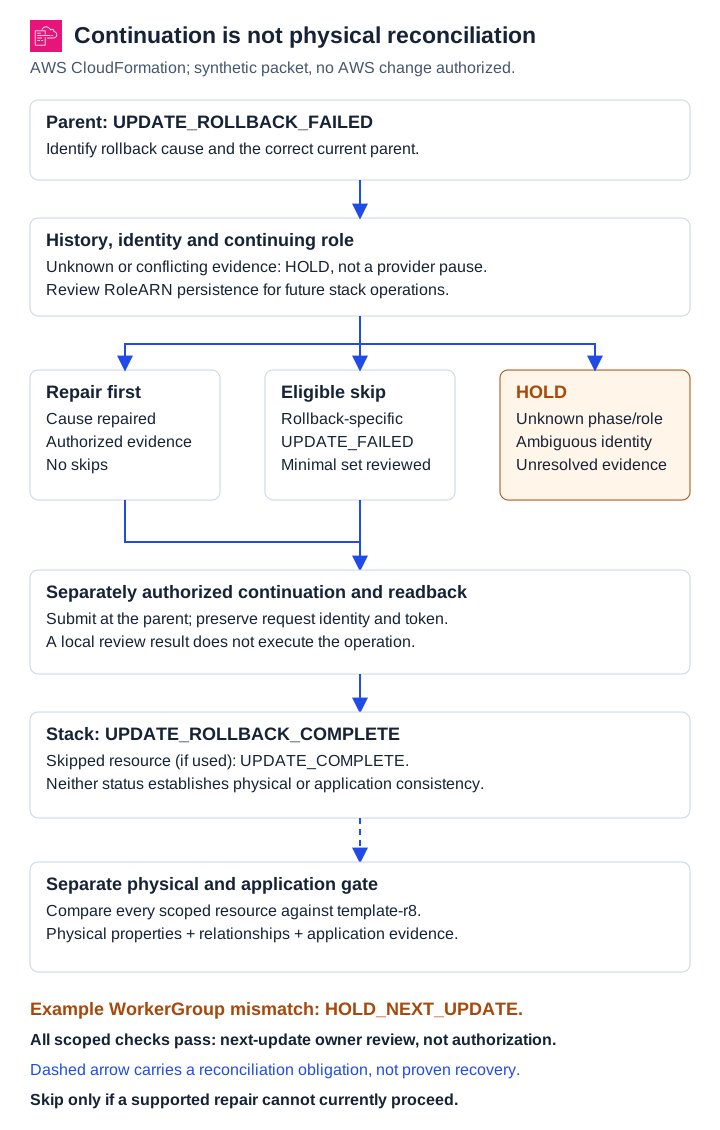
*Solid arrows show the bounded decision and observation sequence; the dashed arrow carries a separate unresolved reconciliation obligation. All events, causes and post-operation outcomes are stipulated examples, not observed AWS results. HOLD has no operation edge. Skipped UPDATE_COMPLETE is not recovered physical or application state.*
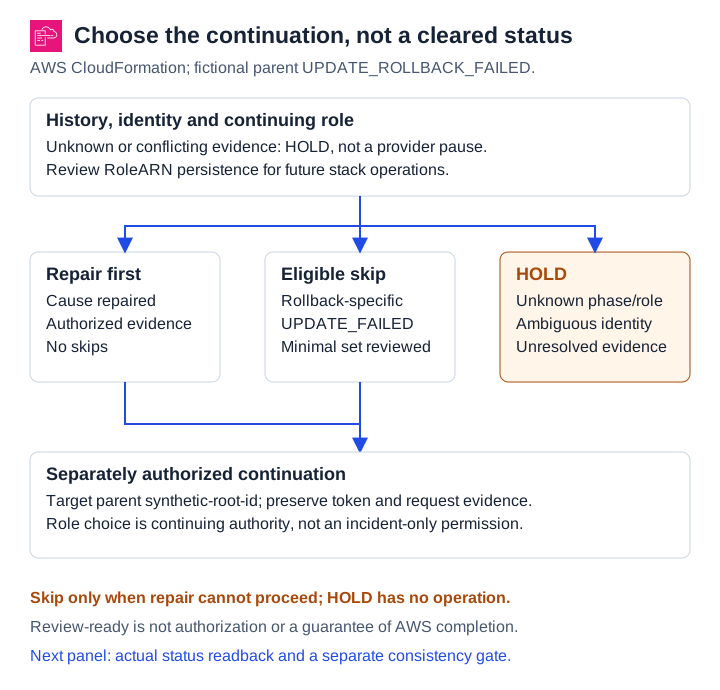
Document figure 2. Fictional continuation preflight and alternatives. Review-ready is not permission or successful recovery. Continue to the separate reconciliation panel.
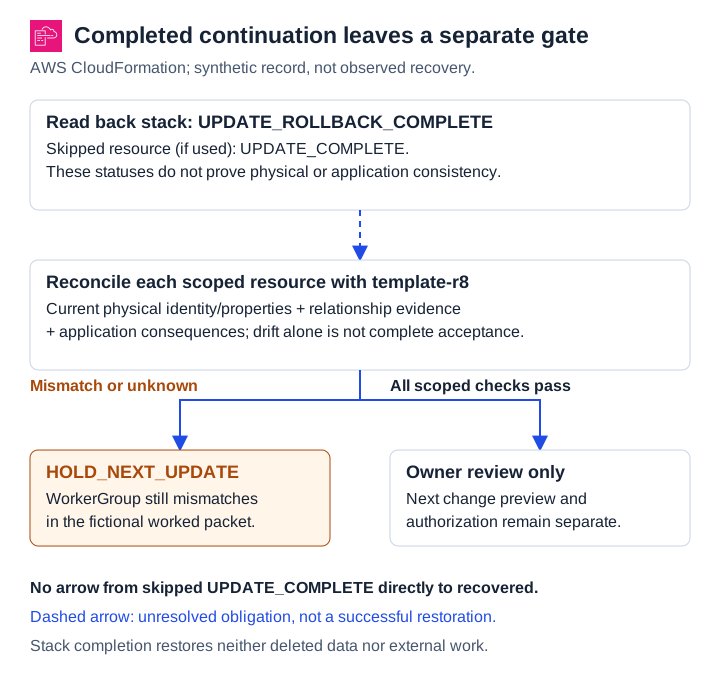
Document figure 3. Stipulated service completion does not resolve the fictional worker mismatch. Every scoped row still needs evidence; drift alone and a complete stack status cannot establish application recovery or next-change authorization.
Retain a filled and blank recovery record
The filled record is entirely fictional. References beginning with synthetic/ stand for evidence that an operator would have to acquire and review. They cannot establish permission, minimality or physical equivalence by themselves.
Filled fictional record
Identity and revisionPacket demo-r1; parent synthetic-root-id; root InfraDemo; rollback template-r8 after attempted template-r9. Region/account are not supplied or inspected.
Timeline and causesynthetic/reviewed-timeline; rollback starts at relative 10; WorkerGroup fails at 20; Workers propagates at 21. Listener cancellation at 8 is excluded from rollback skip eligibility.
Physical and logical mapParent logical Workers maps to child name InfraDemo-Workers-Q7DEMO. Child logical WorkerGroup maps to a fictional worker-group inventory, with no real physical ID.
Repair optionPermission owner reviews the out-of-band policy edit. synthetic/rejected-permission-repair stipulates that immediate repair is unresolved; it does not prove an actual request was rejected.
Skip rationaleOne child resource, InfraDemo-Workers-Q7DEMO.WorkerGroup, under synthetic/root-cause-skip-review. Parent propagation is recorded, not added as a second skip. Minimality is an owner assumption to review.
Role and requestRetain execution-role-a; synthetic/role-review acknowledges the continuing authority choice. Target synthetic-root-id; inert request token demo-r1. No request submitted.
Continuation readbacksynthetic/continuation-readback stipulates UPDATE_ROLLBACK_COMPLETE and the same one-item applied skip set. This is a supplied example, not observed AWS recovery.
Consistency and applicationWorkerGroup still mismatches template-r8, although Workers and Listener rows are stipulated matching. Serving references do not override that mismatch. HOLD_NEXT_UPDATE identifies the worker row.
Owner closure and next changeResource owner must choose and evidence reconciliation. A later reviewed change preview and release acceptance remain separate; no local result authorizes the next update.
Blank reusable record
Identity and revisionIncident/packet revision: ____; owner: ____; account/Region: ____; unique parent ID: ____; attempted and rollback template/parameter revisions: ____.
Timeline and causeCollector/time/pagination: ____; operation correlation: ____; rollback boundary: ____; selected resource status/reason/event: ____; cause owner and uncertainty: ____.
Physical and logical mapParent logical child ID: ____; generated child name/ID: ____; internal logical resource ID: ____; current/old physical IDs: ____; authoritative inventory reference: ____.
Repair optionBlocking cause: ____; bounded repair: ____; permission/approval: ____; repair evidence and failure limit: ____; reason repair cannot proceed: ____.
Skip rationaleExact proposed list: ____; rollback-phase eligibility per row: ____; minimal-set review: ____; dependent rows deliberately excluded: ____; unresolved physical consequence: ____.
Role and requestRetained/replacement/no-existing-role path: ____; effective authority and future-use review: ____; continuation target/token/revision: ____; submission/response evidence: ____.
Continuation readbackActual request correlation: ____; root/child statuses and times: ____; actually applied skips: ____; residual failure and next owner: ____.
Consistency and applicationPer-resource target revision: ____; physical/relationship comparison: ____; unsupported drift checks: ____; application/data consequences: ____; unresolved row owner: ____.
Owner closure and next changeAccepted reconciliation evidence: ____; retained objects/cost/recovery obligations: ____; reviewed next change preview: ____; separate release approval: ____.
Both records remain normal text at desktop and mobile widths. Empty fields are unknown. If a topic is outside scope, record why and who accepted that exclusion rather than deleting the row from the shared packet.
Use the offline packet to challenge favorable-looking evidence
Download the synthetic rollback review packet. Extract its four files into one directory and run node --test rollback.test.mjs with Node.js 22 or newer. The package includes the exact reviewed evaluator and packet, plus the 32 dependency-free decision tests; repository-only manuscript compilation, read-time and table checks are not included. Its README explains the boundary. There is no SDK or network path. Expected outcomes live in test assertions independently of implementation.
The model validates supplied parent/child identities, latest supplied resource events, phase order, selected skip eligibility, role-review declarations and a matching declared minimal set. It keeps pre-operation history separate from post-operation readback. Tests challenge wrong parent, parent logical ID used as child name, forward cancellation, missing reason, stale event, incomplete history, wrong role, malformed records and favorable completion with incomplete reconciliation.
Its scope stops before authenticating evidence, discovering dependencies, proving minimality, evaluating IAM, predicting AWS transitions or restoring physical state. A complete-history flag must be the boolean true, but even that is a declaration the tool cannot independently verify. REVIEW_READY output means a bounded record warrants owner review. Every result contains authorizesAwsChange: false.
For a separately authorized cloud rehearsal, use disposable resources, synthetic workload and a bounded failure mechanism that does not delete business data. Preserve real request/event identity, actual role selection, failure/recovery readbacks and the independent service check. Do not turn a missing permission into a broad grant or a failed rollback into a destructive cleanup exercise.
Review the next update only after consistency is evidenced
When reconciliation is complete, create a fresh change preview for the intended next revision and current stack context. Review replacement, deletion, permissions and dependency effects. AWS change sets preview proposed actions but do not guarantee successful execution. Change-set contract.
The incident owner should retain continuation request identity, effective role, exact applied skips, current template/resource mapping, per-row reconciliation evidence and application outcome. Leave any unknown row assigned and blocked under the agreed release control. Resume the delivery writer only after its owner accepts that record and separately authorizes the next change.
Related services
Infrastructure as Code & Terraform Consulting
Infrastructure as code consulting for repeatable cloud changes. Implement Terraform, policy checks, state controls and drift management with clear ownership.
Cloud Reliability Assessment & Resilience Consulting
Cloud reliability assessment covering production architecture, disaster recovery and incident readiness. Identify failure modes and prioritize resilience work.