The commercial and operating design of enterprise AWS tenants
Compare deployment variants by funded operating duties, release policy, customer exit and reconciled synthetic cash and capacity economics.
Executive summary: sell a supportable variant, not an unexplained exception
A dedicated enterprise deployment can belong to one SaaS product. A promise to keep a customer's chosen application version indefinitely, support an unbounded customization and provide an untested export is a different operating obligation. Price and accept that obligation explicitly, or narrow it before the sales commitment. A higher contract value does not resolve missing release authority, unfunded engineering capacity or a failed customer exit path.
This paper addresses a vendor with an established AWS-hosted B2B application. Product, platform and finance leaders must decide which deployment variants to offer. They will produce a variant definition, an obligation register, a bounded upgrade policy and a reproducible economic comparison. The multi-tenant architecture whitepaper owns isolation mechanisms and tenant-aware operations. This paper starts after those mechanisms have been identified and asks whether the vendor can sustain the resulting commercial promises.
All tenants, money, hours, releases and deadlines below are fictional teaching inputs. No customer deployment, accepted contract, achieved margin, AWS price or executed AWS operation is reported. The companion performs local arithmetic on supplied records. It cannot establish a contract, approve security, prove recoverability or authorize a deployment. Use qualified commercial and legal owners for actual terms, and separately authorized engineering tests for actual service behavior.
1. Separate product identity from deployment placement
A product identity includes supported business behavior, API contracts, schema transitions, entitlement rules, release policy and recovery obligations. A deployment identity describes where and how that product runs. Two tenants can occupy different accounts or databases while receiving the same supported product. Two tenants in one cluster can effectively receive different products if their custom code, incompatible schemas or indefinite version pins require separate maintenance.
AWS's full-stack silo and pool discussion describes dedicated and pooled stacks within a common SaaS experience. That is a useful distinction, not proof that every dedicated installation meets it. Inspect the release artifact, configuration policy and operations path actually offered. A shared repository alone does not establish a common product if separate branches need separate fixes and qualification.
Define the supported difference as a set of named dimensions. Placement, capacity class and a configured integration can vary without changing core behavior. Release timing can vary within a tested compatibility window. A changed approval workflow or customer-owned extension may create additional behavior that needs its own contract. Record the reason and removal condition for each difference. Otherwise a temporary concession becomes a permanent support promise without anyone making that decision.
Do not collapse isolation, tenancy and commercial tier into one label. Dedicated infrastructure does not establish residency, exclusive support access or tenant-specific recovery. A premium plan does not determine database topology. The product lead should be able to point to the requirement that each deviation satisfies and the evidence that would invalidate the proposed implementation.
2. Compare three concrete offers against one reference service
The reference service is a fictional reporting application with shared product development, a common API and vendor-operated support. Option P is a pooled standard placement. Option D is a dedicated standard placement with the same supported application stream and operating tools. Option C adds a bounded customer-controlled release ring to D. It permits agreed scheduling within a supported lag window, not indefinite refusal of necessary change.
These are alternative offers to the same fictional customer, not three revenues collected simultaneously. They include the same business workflow and baseline data-export scope. Additional recovery or capacity requirements must appear as separately named obligations. The comparison stops being fair if P excludes a required integration that D includes, or if C quietly acquires a new feature-development commitment. Amend the scope before using the totals.
Pooled standard: pooled capacity and shared rollout, with tenant-aware limits and recovery procedures. It is viable only if the required boundary and service behavior are actually supported. The lowest modeled cost cannot excuse a failed mandatory requirement.
Dedicated standard: separately placed workload and an automated fleet operating path. It may address a verified recovery or capacity requirement while preserving shared product evolution. Dedicated idle capacity, separate qualification and operational work must be costed, not treated as a one-time installation.
Controlled release: a distinct scheduling and compatibility obligation. The customer and vendor agree adoption windows, evidence, escalation and the response to an unsafe delay. Its extra revenue purchases a defined service, not a right to keep unsupported software forever.
A fourth alternative is to decline, defer or renegotiate the request. Another is a separately evaluated customer-operated installation. Neither belongs in the three-option arithmetic without a fresh duty allocation. Keeping an alternative outside this calculation is more honest than pricing an undefined offer as though it were operationally equivalent.
3. Convert sales language into observable obligations
Start with the words the customer expects to rely on: dedicated, private, controlled upgrades, recoverable, exportable, supported. Ask what each requires an operator to do during an ordinary week and during failure. Name a principal owner, evidence input, acceptance output and unresolved dependency. A requirement that nobody can describe operationally is not ready for quotation.
For dedicated recovery, distinguish restoring a database from restoring the customer's usable workflow. Search, files, identities, scheduled jobs and integrations may need reconciliation. For controlled upgrades, distinguish customer scheduling of normal changes from vendor containment of an urgent vulnerability. For exit, distinguish delivering an export from the receiving system accepting it, and both from permitted deletion of retained copies.
Use an obligation register with a stable identifier and version. A proposed change to one row should reopen only the affected evidence and economics, not silently replace the whole record. The platform lead records whether the capability is available today, estimated work, or unknown. The customer-facing description must not turn planned work into an existing product feature. Finance records who pays for its continuing operation, not merely who funds construction.
AWS's general SaaS design principles emphasize consistent management across tenant experiences and product-wide configuration rather than one-off versions. Our recommendation is to use that direction when defining offers, while retaining an explicit exception decision when the business chooses otherwise. An exception can be intentional, but it must not disappear into the standard service definition.
4. Bound configuration, extensions and true forks
Classify a request by the maintenance it creates. A validated configuration selects supported behavior. A versioned adapter translates a documented external interface. An extension executes within a declared compatibility and security boundary. A fork changes core behavior or its supported evolution so that the standard release no longer suffices. Naming a fork configuration does not change its testing burden.
The fictional dedicated customer requests its own export naming convention and a separate release window. The naming convention can be a product-wide configuration with validation and tests. The release window belongs to C's adoption policy. A third request, retaining an incompatible schema after the support window, would create another variant and is excluded from the proposed offer. The owner should reject or separately scope it, rather than use C's existing premium to justify unlimited differences.
Count supported combinations, not just flags. Two binary options may create four meaningful behaviors, but do not assume every theoretical combination is supported. Publish the allowed combinations and reject impossible ones. Separate extension failure containment from product availability. If a customer adapter fails, decide whether only its integration pauses or the entire tenant loses service, and retain that response in the offer.
Feature withdrawal also needs an owner. An old flag can prevent schema cleanup or retain a dependency with growing risk. The release policy should identify which changes need customer adoption, which are backward-compatible and which invalidate continued support. None of these decisions can be delegated to a pricing spreadsheet. The spreadsheet can reveal the cost of the agreed boundary after engineering defines it.
5. Keep one product authority while making variant duties visible
The first figure asks which promises stay within a common product and which add funded variant-specific obligations. The common stream supplies the application contract, security policy and compatibility qualification. Placement duties sit below that stream. C adds adoption coordination, additional supported-version qualification and an expiry response. The diagram intentionally has no AWS deployment topology: it describes duties, not an observed account layout.
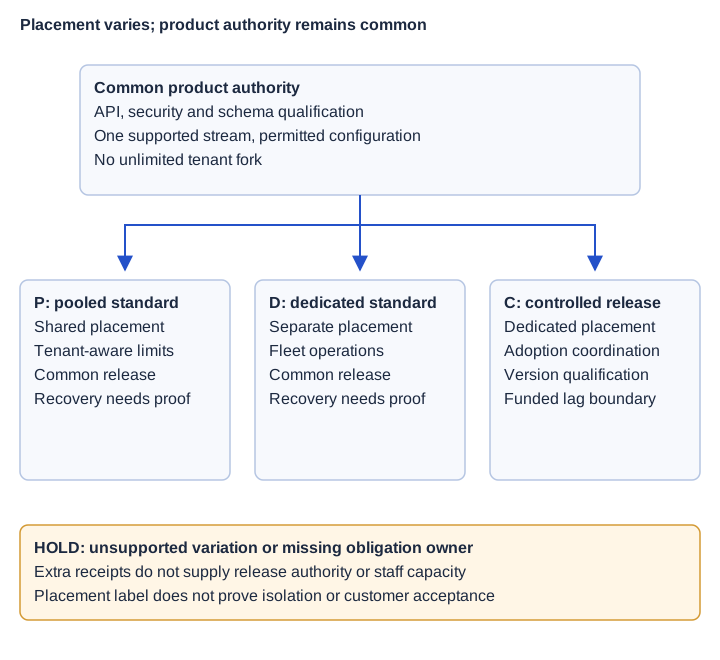
The illustrative arrows assign responsibility from the common product contract to each offer. They are not network requests or authorization grants. The mobile composition presents the same three offers as records. The document composition preserves the same duties at print width.
AWS's control-plane discussion supports a unified tenant operating experience regardless of placement. In a real product, verify the directory, provisioning, release inventory and support tools behind that experience. A central dashboard that cannot find one customer's effective configuration is not sufficient. The operational owner needs both fleet visibility and a precise record of what each variant currently promises.
6. Define supported lag and emergency authority before charging for it
For C, stipulate a fictional maximum of two supported application versions and a 30-day normal adoption window. These numbers are teaching policy choices, not AWS limits or recommended universal thresholds. The offer must state the reference release date, which version combinations are qualified and what occurs when a window expires. Evidence must bind application, schema, configuration, integration and recovery revisions, not just a friendly version label.
The customer may choose an agreed normal window while the vendor retains a separately defined security-response obligation. Do not claim that an emergency override is legally permitted because the engineering team needs it. The commercial owner must establish the actual rights and escalation process. Engineering must separately know whether it can contain a vulnerable feature, restrict access or apply a compatible fix without corrupting customer data.
If a delay requires three supported versions, C's stated policy is exceeded even when a test happens to pass. The options are to adopt within the boundary, change and fund the policy through review, reduce the service, or follow the agreed termination path. Quietly expanding the matrix creates an unpriced duty. It also makes the next customer request appear inexpensive because the first exception was never recorded.
Rollback belongs in this policy but is not synonymous with returning to yesterday's artifact. A database transition may remove backward compatibility, and accepted writes can require reconciliation. Record the last reversible point and the supported recovery response. Customer scheduling cannot manufacture a rollback route the product does not have. The release owner should demonstrate the proposed path with permitted non-production data before making it a support promise.
7. Model incremental cash and resource capacity separately
Use a 12-month comparison in fictional USD, excluding tax, financing, depreciation, foreign exchange and funding credits. Revenue in this example is stipulated receipt, not accounting revenue recognition. Costs are incremental payments attributable to the variant. Existing employee effort is displayed separately in hours; it is not added to cash and then added again as opportunity cost. The model reports neither gross margin nor enterprise value.
For each option define annual receipts R, setup cash S, monthly cloud cash I, monthly outsourced support cash O, annual release qualification cash Q, and an exit allowance E. The modeled balance is R minus S minus 12 times the sum of I and O, minus Q and E. E is a scenario allowance for an assumed exit event, not an actual reserve-account balance or a guaranteed future invoice. Show when it becomes payable in the cash timeline.
Shared product development is common to all three offers and excluded from this incremental comparison. That exclusion does not make development free. Finance must reconcile this view to the wider product budget before approving the business. A separate cost-allocation policy may allocate common development, sales and infrastructure. Do not insert a convenient share here without defining the pool, allocation method and residual.
Staff capacity is setup hours plus twelve times monthly operating hours plus annual release hours plus exit hours. The sample has 360 incremental available hours in the comparison year after existing obligations. That capacity is a stipulated budget, not an employee's total productive year. A positive cash balance can coexist with a capacity breach. Capacity cannot be recovered by relabeling internal effort as included in salary.
8. Reconcile the worked variant ledger
P stipulates receipts of 36,000, setup cash 3,000, monthly cloud 600, outsourced support 150, annual qualification 1,000 and exit allowance 2,000. Its recurring cash is 9,000 and total cash obligations are 15,000. The modeled balance is 21,000. Internal effort is 20 setup hours, 5 monthly operating hours, 20 release hours and 20 exit hours: 120 total.
D stipulates receipts of 54,000, setup cash 7,000, monthly cloud 1,500, support 300, annual qualification 2,000 and exit allowance 4,000. Recurring cash is 21,600, total obligations 34,600 and balance 19,400. Its 40 setup hours, 10 monthly operating hours, 40 release hours and 30 exit hours total 230. Dedicated standard is not rejected simply because its cash balance is below P's. If P fails a mandatory recovery requirement and D satisfies it with evidence, D can remain the only viable offer.
C stipulates receipts of 66,000, setup cash 10,000, monthly cloud 1,500, support 550, annual qualification 8,000 and exit allowance 6,000. Recurring cash is 24,600, total obligations 48,600 and balance 17,400. Its 60 setup hours, 18 monthly operating hours, 120 release hours and 40 exit hours total 436. This exceeds the stipulated available 360 hours by 76. More receipts do not make C supportable under the declared capacity plan.
The reproducible companion prints these components rather than a composite score. Its outputs remain bounded model observations. Positive balance is not approval; negative balance is not proof that the actual offer loses money; and supplied requirements cannot authenticate customer acceptance. The purpose is to expose which assumption or obligation needs a decision before the vendor commits.
9. Test adverse operating and receipt cases
First vary C's supported-version burden: annual qualification cash rises from 8,000 to 14,000 and release hours from 120 to 200. Everything else stays fixed. Total obligations become 54,600, balance 11,400 and capacity 516 hours. The additional 6,000 cash and 80 hours must appear once. This case shows why a release-policy exception cannot be analyzed solely as idle infrastructure.
Second vary D's support load: outsourced support rises from 300 to 650 monthly and internal operating effort from 10 to 22 monthly hours. Annual obligations become 38,800, balance 15,200 and capacity 374 hours. D now exceeds the available budget by 14 hours. Do not infer that the whole dedicated model failed. Find whether the extra load comes from missing diagnostics, an unsupported integration or a real service obligation before changing the offer.
Third retain D's annual receipts but delay the first installment. The stipulated baseline collects 27,000 in month 1 and 27,000 in month 7. Setup occurs in month 1, qualification cash in month 6, and exit cash in month 12. Delay the first receipt to month 4 while keeping the second in month 7. Months 1, 2 and 3 end at negative 8,800, 10,600 and 12,400 respectively. A stipulated 10,000 cash-bridge budget is breached by 2,400 even though the annual balance is unchanged at 19,400.
These cases deliberately separate operational capacity, annual economics and receipt timing. They assume no interest, cancellation or changed tax. In reality those effects may matter and require new rows. Do not invent their rates to make the example look complete. Show the omitted effects and ask finance which belong in the actual decision period. A useful model remains inspectable when uncertainty cannot be responsibly reduced to one number.
10. Distinguish floor cost, shared allocation and demand
Dedicated capacity has a floor even when a tenant is quiet. Pooled capacity may also have a floor, and its bill does not divide automatically by tenant count. The finance and platform owners should identify billing scope, usage proxies, shared pools and unallocated remainder before converting infrastructure totals into a price floor. A resource tag can locate a dedicated workload; it cannot necessarily allocate an application's shared worker time.
The fictional ledger assumes already supplied incremental monthly amounts, so it does not establish a cost-attribution method. In a real review, preserve dated billing records and explain what the amounts include: recovery copies, monitoring, connectivity, idle capacity, transfer and retained artifacts. A quote that excludes required operating resources is not comparable to one that includes them. Disclose estimates and unknowns instead of assigning them a zero.
Demand changes can reverse the choice. A dedicated customer may repeatedly exceed its capacity band; a pooled tenant may use an unusually expensive export path. Define a supported workload envelope and the evidence that triggers re-sizing or commercial reassessment. Do not promise unlimited service while using ordinary demand in the cost model. Conversely, one short spike does not prove that a higher permanent floor is warranted.
Pricing can include strategic value that this model does not measure. A vendor may intentionally accept lower incremental balance to learn about a valuable segment. Record that as a bounded investment with budget, owner and expiry, not as a fabricated financial benefit. Repeated exceptions should lead to a product-tier decision rather than a growing collection of undocumented deal-specific costs.
11. Customer-account deployment changes responsibility, not only billing
A customer-owned AWS account can move infrastructure payment and access control without transferring every application duty. Who supplies artifacts, applies upgrades, collects permissible diagnostics, manages encryption access, restores data and responds to an incident? Each duty needs a named owner and evidence path. If the vendor cannot inspect the environment, it may need customer-supplied diagnostics before accepting a support case. If the customer cannot operate it, calling it customer-managed does not fix that gap.
The AWS shared-responsibility model distinguishes AWS duties from customer duties according to the services used. It does not assign the business application's work between a SaaS vendor and its customer. That assignment remains a separate product, operating and contractual decision. Never describe an AWS assurance boundary as proof that your support, retention or recovery obligation has been fulfilled.
The AWS comparison of SaaS and MSP models also helps name a customer-version operating model honestly. A managed installation can be a valid business. It should not inherit the pooled product's staffing assumptions merely because deployment is automated. Its duty matrix and update authority must be evaluated separately before including it in an enterprise offer.
If the customer prevents a required change, record the agreed escalation rather than inventing vendor authority to enter the account. If vendor access is revoked, have a bounded response for health verification and incident handling. Account ownership is neither an automatic reason to reject the option nor an automatic solution to data-control requirements. It is one boundary whose consequences must be priced and tested.
12. Design customer exit as two continuing tracks
Exit is not a single delete operation. One track stops the active service, reconciles outstanding work and delivers an agreed export. Another governs retained copies, keys, billing and final expiry. Those tracks may finish at different times. The closure record must not claim deletion of everything when a backup remains intentionally retained. Nor should retained backup access keep ordinary users or integrations active.
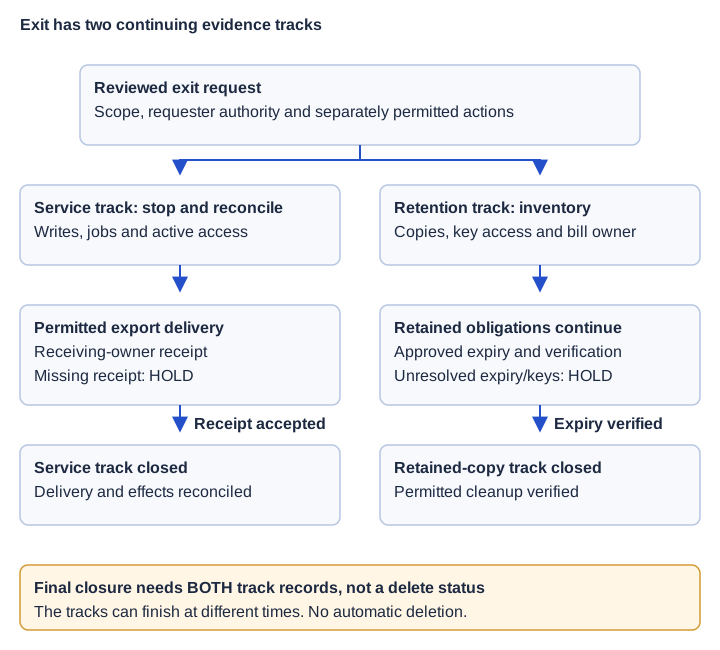
The fictional flow has separate delivery and retention evidence. A missing receiving-owner receipt holds the delivery track; it does not authorize broader deletion. The retention track records permitted copies, expiry, key access and final cost. Arrows describe proposed completion evidence, not executed AWS state. A compact document view preserves both tracks without shrinking a tall mobile figure.
For an actual RDS-backed product, instance deletion and retained snapshots or backups require separate inventory and cost decisions. For S3, Object Lock behavior means a delete marker is not proof that protected versions are gone; retaining bytes also does not guarantee usable encryption access. These bounded examples explain why the closure register must follow actual copies and dependencies rather than infer completion from an absent application row.
13. Use a filled obligation and decision record
The following fictional record is deliberately more precise than dedicated tenant approved. It can be reviewed without live identifiers. Real references belong in controlled evidence storage with approved access. The record names unresolved acceptance rather than assuming that a selected architecture has already passed its tests.
- Customer scope and decision
- Fictional tenant T17, reporting workflow, evaluate D before commitment. P remains an alternative only if recovery scope changes.
- Required boundary and evidence
- Tenant-specific recovery required; recovery rehearsal receipt R17 not yet collected. No assertion that D currently passes.
- Product and permitted variation
- Common API and application stream; dedicated placement and validated export naming. No custom schema fork.
- Upgrade ownership and limit
- Vendor release owner for D. C would require a separate adoption owner, two-version support and 30-day normal window.
- Incremental cash and omissions
- D total 34,600 USD, receipts 54,000, balance 19,400. Common product development, tax, financing and recognition treatment excluded.
- Capacity and cash bridge
- D 230 hours within 360 available. Delayed first receipt requires 12,400 bridge, exceeding 10,000 budget.
- Exit and retained obligations
- Data owner defines export scope and receiving receipt. Operations owns retained-copy inventory; finance owns remaining bills. Retention basis requires separate approval.
- Hold and next evidence
- No commitment until recovery evidence, receipt timing, access duties and exit ownership are reviewed. Product sponsor does not approve by spreadsheet alone.
The provisional recommendation is to evaluate D, narrow or defer C, and resolve the delayed-receipt exposure. It is not adopt D now. The required recovery receipt is missing. The same arithmetic would remain favorable if somebody falsely asserted the requirement passed; the companion has no means to authenticate that assertion. Treat supplied evidence references as inputs requiring external verification, not facts created by the model.
14. Blank record for the next enterprise request
Use the same fields before negotiating a new exception. State unknown explicitly when evidence is missing. Do not fill it with a sales assumption or reuse another customer's receipt. Record who can approve a requirement change and which acceptance evidence must be refreshed after it changes.
- Customer scope and decision
- Named workflow, comparison period, proposed variant and alternatives.
- Required boundary and evidence
- Requirement owner, actual acceptance criterion, evidence reference, observation date and unresolved gaps.
- Product and permitted variation
- Common product contract, allowed configuration, integration ownership and excluded fork behavior.
- Upgrade ownership and limit
- Supported combinations, adoption window, emergency decision authority and expiry response.
- Incremental cash and omissions
- Receipt schedule, setup, recurring payments, qualification, exit assumption, currency and excluded common costs.
- Capacity and cash bridge
- Setup, operations, release and exit hours; funded availability; monthly cumulative cash and budget.
- Exit and retained obligations
- Export acceptance, active-service stop, retained-copy inventory, keys, expiry and bill owner.
- Hold and next evidence
- Disqualifying unknowns, changing assumptions, responsible reviewers and next authorized evidence collection.
The companion's editable JSON and worksheet use these same concepts. Keep their financial scope separate from the responsibility record. A technical owner may accept recovery behavior while finance rejects receipt timing; neither result overrides the other. Preserve the reasons so that a revised offer can address the actual gap instead of rerunning a score until it becomes positive.
15. Acceptance checklist, reassessment and limitations
Before commitment, the sponsor should have a requirement-to-obligation mapping, comparable offers, dated source evidence and a supportable release boundary. Finance should reproduce the cash components and timeline without inventing unknown rows. The platform lead should identify funded effort and the response when the version matrix, support load or placement scope changes. Data and security owners should approve their actual boundaries separately.
Acceptance requires evidence for required isolation and recovery, an operating duty owner, a bounded update policy, a usable customer exit and a funding decision for both cash and capacity. Missing any of those is a hold, even when modeled balance is attractive. Keep rejected variants and the assumptions that would reopen them. If actual observations contradict the modeled scope, revise the offer rather than declaring the observation an exception outside the model.
Reassess after a release-policy exception, new workload class, increased retained-copy obligation, customer-account change, unplanned incident burden or revised receipt terms. A periodic calendar review is useful, but an invalidating change should not wait for it. Preserve the old record and link the replacement so that support can reconstruct what was promised and when it changed.
This framework supplies neither legal conclusions nor market prices, funding qualification, demand forecasts or achieved margins. The offline companion does not authenticate evidence or execute provider operations. Bring one current enterprise request, its promised variation and the largest unresolved operating duty to a joint product, platform and finance review. Fill the obligation record first; negotiate price only after the duty is understood.
Download the editable offline economics companion. Reading and downloading require no email. The companion performs only the fictional, bounded arithmetic described here.
Primary references
- AWS SaaS Lens: general design principles
- AWS SaaS architecture: full-stack silo and pool
- AWS SaaS architecture: control and application planes
- AWS SaaS architecture: SaaS versus MSP
- AWS SaaS Lens: tenant onboarding
- AWS shared-responsibility model
- RDS instance deletion and retained resources
- S3 Object Lock considerations
Sources were checked on 9 October 2026. Apply the current documentation to the exact services and customer agreement selected; these references do not establish deployed behavior or approve the fictional offer.