Buying AWS Implementation: Reconcile the Offer with the Outcome
Compare direct procurement and AWS Marketplace professional-services offers using the same workload, payment evidence, customer account boundaries and exit obligations.
Executive position
Choose a purchasing channel only after reconciling its offer with the workload the customer will accept. Price, payment approval, technical acceptance, production authority and exit duties need separate records with compatible terms. A convenient buying route cannot establish whether a migration recovered correctly, whether the buyer owns the deployment assets, or whether the proposed work satisfies a private spending commitment.
This whitepaper is for an engineering sponsor, procurement lead and finance reviewer comparing a direct services agreement, an AWS Marketplace professional-services private offer, or an authorized channel arrangement. Its output is an offer-to-SOW reconciliation record. That record identifies what matches, what needs a contract decision and what must remain on HOLD before someone accepts the purchase. It assumes a bounded implementation project rather than an indefinite managed-service subscription.
The recommendation is to keep the accepted workload constant while comparing channels. If the channel requires different payment timing or introduces another contracting entity, make that change visible and decide who bears the resulting risk. Do not relabel an invoice milestone as completed engineering to make the comparison look consistent.
The worked case is fictional. Its USD amounts and planning days are teaching inputs, not quotations, AWS fees, measured customer results or a legal interpretation. No offer was created, no payment request was submitted and no AWS workload was operated. The figures explain authority and evidence relationships, not an executed transaction.
1. Set the unit of comparison before asking for an offer
“Migrate the application” is too loose for a channel comparison. One seller may include the database, recovery rehearsal and handover; another may price server movement while leaving those tasks with the customer. Comparing the resulting totals would compare different obligations.
Write a bounded workload record first. For example: move a named application and its database into customer-controlled AWS accounts, demonstrate an agreed business transaction, rehearse the agreed recovery procedure, transfer deployment and operating assets, and close the temporary access path. List the exclusions alongside that sentence. Data cleansing, application redesign, a new compliance certification and ongoing on-call support are separate unless expressly included.
The sponsor should identify the evidence needed for each deliverable without choosing a buying channel yet. A deployment report can establish that a version reached an environment. It cannot establish that the customer's business operation passed, that a restore met its target, or that a receiving operator can run the service. Each requires its own accepted evidence and a customer decision maker.
The existing outcome-linked engineering delivery framework addresses those delivery agreements in depth. Here, the question is narrower: can the selected purchasing route carry those same obligations without changing their meaning? Freeze a versioned baseline before comparing offers. If the scope changes, revise the baseline and recompare every option rather than keeping an attractive but obsolete price at the top of the decision paper.
2. Separate the five records that people call acceptance
Use distinct names for offer acceptance, technical acceptance, payment-request approval, invoice status and payment settlement. Offer acceptance establishes a commercial agreement through the selected purchasing workflow. Technical acceptance records the customer's judgment against the agreed workload criteria. Payment-request approval concerns a request for invoicing. Invoice and settlement records answer later financial questions. None should silently overwrite the others.
AWS describes Marketplace professional-services purchases through private offers with negotiated service and pricing details. Its buyer documentation supports both manual and automatic approval of variable payment requests. Manual approval requires review before invoicing. Automatic approval provides a ten-day review window, after which an unanswered request is approved and invoiced. The mechanism is an approval workflow, not a workload-test result. Review the selected mode in the actual offer. AWS professional-services buyer guidance
For the reconciliation record, give each decision its own owner, reference and timestamp. A technical acceptor may recommend that a request be approved, challenged or investigated. Whether that recommendation satisfies the contract and who can act on it are explicit buyer decisions. A failed technical check in a spreadsheet changes no Marketplace state.
Avoid a shared status named “accepted.” It becomes impossible to tell whether somebody accepted legal terms, approved an invoice request or witnessed a restore. A status such as TECHNICAL_ACCEPTANCE_UNKNOWN is less elegant, but it preserves the missing fact when a finance reviewer opens the record two weeks later.
3. Compare three channels without inventing equal capabilities
Direct procurement can use the customer's normal supplier onboarding, agreement and payment process. It may suit a project whose acceptance or commercial terms need a bespoke workflow. The comparison must include the customer's cost and delay of that workflow, but neither is assumed here. Direct purchasing gives no automatic technical assurance; it still needs an accountable supplier and accepted evidence.
A direct Marketplace professional-services private offer places the negotiated purchase in the AWS Marketplace workflow. AWS documents seller-created private offers, attached custom legal terms and service pricing. The permitted attachments can include a statement of work and pricing addendums. That makes document reconciliation practical, but attachment alone does not resolve conflicting versions or precedence. AWS professional-services seller setup
An authorized channel arrangement adds a resale relationship. AWS Channel Partner Private Offers support professional-services products through a selling authorization between a provider and a channel partner. An existing authorization can support an offer; it does not establish the delivery responsibilities for a particular project. AWS channel partner authorization guidance
Do not assume that every pricing feature shown for a direct professional-services offer is available in a particular CPPO arrangement. Verify the proposed product, authorization, currency, pricing model and actual offer workflow. A general statement that CPPO supports professional services is insufficient evidence for a specific variable-payment configuration.
There is no preferred channel without the buyer's constraints. A valid option must carry the same agreed workload, identify the accountable entities, support an acceptable review process and pass the customer's security, tax and purchasing checks. A cheaper option with an unresolved contracting party is incomplete, not a winning price.
4. Reconcile identities before documents
Record the customer purchasing account, the customer contracting entity, the seller legal entity, any reseller entity and the intended workload accounts. The same organization can control several accounts, while different entities can appear in commercial and delivery roles. Do not infer those relationships from a logo, an email domain or a product listing.
AWS private offers target a designated buying account. Once accepted, the private offer becomes an agreement between buyer and seller. The buyer should therefore verify the offer in the intended account and reconcile the agreement parties with its own purchasing authority. AWS private-offer buyer guidance
The buying account field and the workload account field answer different questions. The first identifies where the purchase is made. The second identifies where implementation operates. A purchase in one account does not, by itself, grant a seller permission to alter resources in another. Record who authorizes account access, who pays workload consumption charges and which environments are excluded. Leave unconfirmed payer or entity relationships as UNKNOWN.
For a channel offer, include the provider-to-reseller authorization reference and the entity that will perform the work. Ask who owns implementation defects, support escalation and handover if the reseller and delivery team differ. A provider's technical competence cannot resolve an ambiguous contractual escalation path. The customer's contract reviewers must establish those responsibilities before acceptance.
This paper makes no claim that Ampity has a Marketplace product, selling authorization, partner designation or entitlement to supply through a particular channel. Those facts require current independent evidence for the specific transaction.
5. Use an offer-to-SOW reconciliation, not a pile of attachments
Create one row for each obligation that changes the buying decision. Each row needs the baseline SOW reference, proposed offer reference, observed difference, responsible reviewer and disposition. Preserve the actual document versions in controlled buyer records; the worksheet can point to them without exposing confidential terms.
Start with scope, acceptance evidence, price and currency, payment model, review timing, change handling, access, support, termination and handover. Also record which document governs if two documents conflict, as determined by authorized contract review. Do not invent a precedence rule in an engineering worksheet.
A practical review follows one obligation across the records. Suppose the SOW requires a successful recovery exercise before the final milestone, while the offer describes that milestone as “project completion.” The reviewer should obtain a matching definition or a documented authorized resolution. Writing “close enough” in the worksheet leaves a later buyer unable to establish what was purchased.
Preserve changes as new versions rather than silently editing the accepted reference. A revised offer price may come with a revised service description. A newer SOW may change customer prerequisites. After each change, recheck the affected rows and their dependencies. A new price does not automatically invalidate the access review, but a new delivery entity probably does.
The outcome is a list of resolved differences and remaining HOLDs, not a claim that the worksheet replaces the contract. Procurement owns the commercial reconciliation; the engineering sponsor confirms that the resulting scope still achieves the intended workload outcome.
6. Design the payment review around evidence availability
AWS professional-services variable payments use an agreed contract amount. The seller requests amounts during the agreement, and cumulative requests cannot exceed that value. The documented request model includes status and an optional deliverables description. Treat that description as a reference to evidence, not as the evidence itself. AWS also distinguishes cancelling a pending request from an already approved request; do not assume a buyer can undo approval through the pending-request cancellation action. AWS professional-services variable-payment guidance
Choose a review mode after estimating when the buyer can inspect the promised deliverable. If a recovery exercise requires a scheduled environment and several customer participants, a short invoice-review workflow may finish before that exercise. Obtain compatible scheduling or terms, or use a permitted review workflow with sufficient control. A reminder email does not allocate engineering time.
For manual review, name the authorized payment reviewer and backup, the technical evidence they need and the path for an unresolved request. Manual mode does not ensure diligence. A reviewer who approves every request without checking its evidence removes the practical control while preserving the appearance of a gate.
For automatic review, document an operational owner who can inspect and act within the actual review window. Record where notifications arrive, what happens during absence and who handles a dispute. Recheck the applicable timestamps and purchasing behavior in the real transaction. Do not translate the fictional planning days below into a production invoice timer.
An internal HOLD must produce an authorized workflow action or escalation before the relevant deadline. It has no effect on AWS simply because somebody entered it in a project tracker.
7. Keep the commercial boundary separate from workload authority
The system context has two independent paths. The commercial path connects the buyer's procurement reviewer, purchasing account, seller or reseller, offer, attached documents and payment requests. The delivery path connects authorized engineers, customer-controlled workload accounts, deployment assets, tests, recovery evidence and the customer's technical acceptor. Evidence crosses from delivery to the buyer's review process. Commercial acceptance does not create a test result or an execution permission.
For third-party AWS access, IAM documentation describes customer-created roles with trust and permission policies and temporary credentials. The customer controls what those roles permit. AWS discusses an external ID for appropriate multi-customer third-party access to address the confused-deputy problem; it is not a secret password or a substitute for permission design. AWS third-party IAM role guidance
The offer should identify access prerequisites without treating them as open-ended authority. Decide which party supplies the deployment repository, infrastructure state, key access and recovery credentials, and which assets remain in customer custody. Do not embed credentials in the SOW or attach sensitive production exports to an offer.
The detailed production-access framework covers execution controls and revocation. The procurement check here is whether the selected entity and delivery scope match that approved access model. A reseller authorization governs an offer relationship; it is not an IAM trust policy. A payment reviewer is not automatically a production operator.
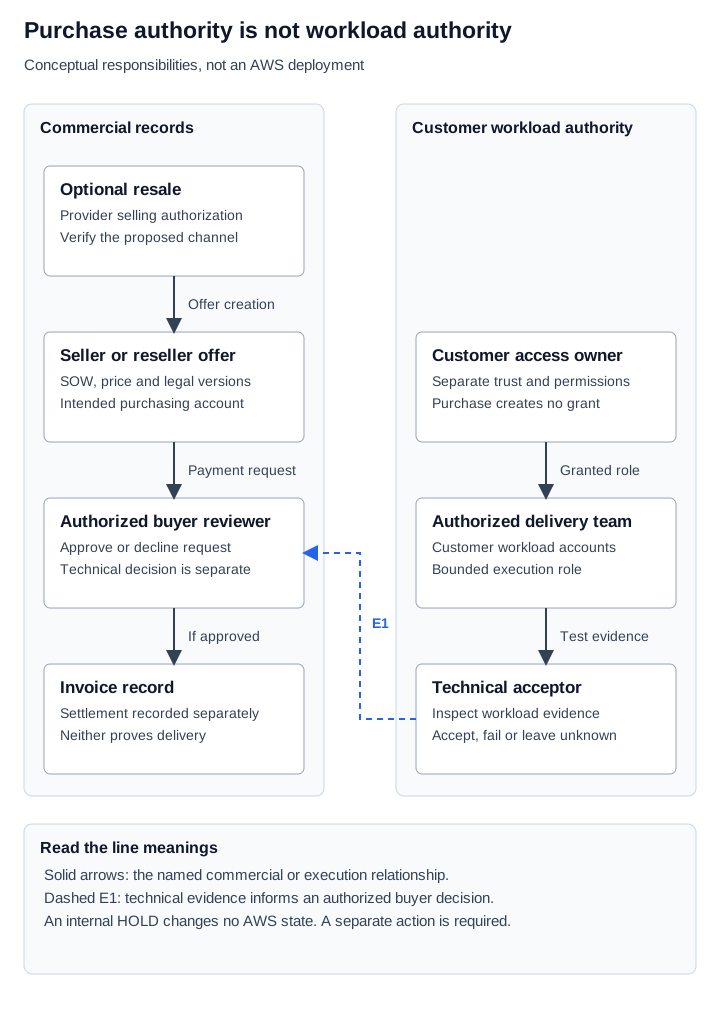
*Conceptual authority and record relationships, not an AWS account topology or executed purchase. Solid arrows have the explicitly named relationship; E1 is an evidence input to buyer review. Resale authorization does not grant workload permissions. An approved request can proceed to invoicing, while settlement remains a separate observation. An internal HOLD changes no AWS state and requires an authorized action or escalation.*
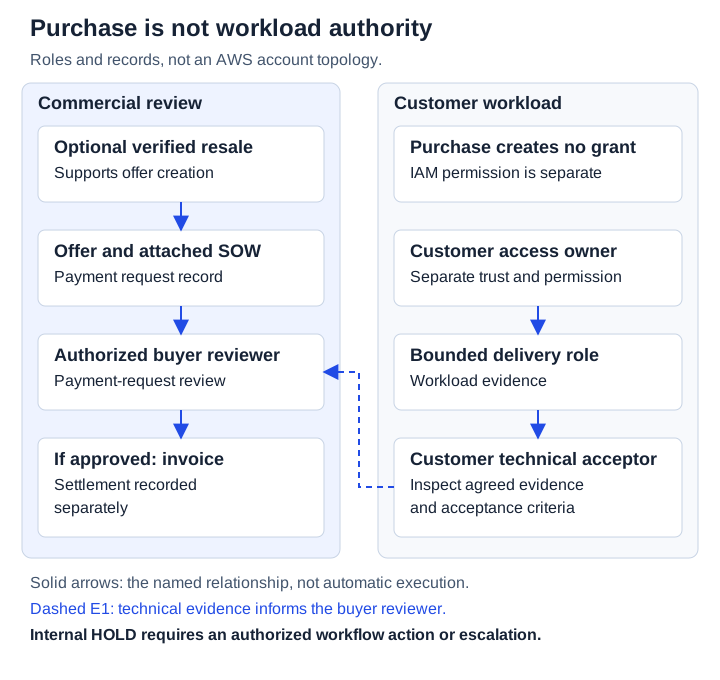
Conceptual responsibilities, not AWS account boundaries or an executed purchase. The dashed E1 relationship supplies evidence to buyer review. Purchase creates no workload grant; an internal HOLD changes no AWS state.
8. Work a complete fictional reconciliation
Assume a customer has already frozen SOW-3 for a bounded migration. Fictional OFFER-7 uses a direct professional-services private offer, one currency and variable payments. The cap is USD100,000. The customer has recorded a primary and backup payment-review role, a technical acceptor and an exit record. There are no claimed credit or spending-commitment benefits in the comparison.
The fixture makes one whole payment request per milestone. That is a teaching constraint, not an AWS limitation. Real partial requests, amendments and tax treatment need additional records. The implementation evidence below is stipulated failed; no AWS test was performed.
| Milestone | Scheduled USD | Requested USD | Stipulated technical evidence | Buyer worksheet disposition |
|---|---|---|---|---|
| Assessment and agreed workload record | 20,000 | 20,000 | ACCEPTED | Eligible for authorized payment review under the example policy |
| Implementation and recovery evidence | 50,000 | 50,000 | FAILED | HOLD and route failure to the contract and payment reviewers |
| Handover and access closure | 30,000 | 30,000 | UNKNOWN | HOLD until the evidence is inspected and accepted |
| Total | 100,000 | 100,000 | Mixed | No blanket project-accepted status |
Assessment and agreed workload record
Scheduled USD: 20,000
Requested USD: 20,000
Stipulated technical evidence: ACCEPTED
Buyer worksheet disposition: Eligible for authorized payment review under the example policy
Implementation and recovery evidence
Scheduled USD: 50,000
Requested USD: 50,000
Stipulated technical evidence: FAILED
Buyer worksheet disposition: HOLD and route failure to the contract and payment reviewers
Handover and access closure
Scheduled USD: 30,000
Requested USD: 30,000
Stipulated technical evidence: UNKNOWN
Buyer worksheet disposition: HOLD until the evidence is inspected and accepted
Total
Scheduled USD: 100,000
Requested USD: 100,000
Stipulated technical evidence: Mixed
Buyer worksheet disposition: No blanket project-accepted status
The schedule reconciles to the cap: 20,000 + 50,000 + 30,000 = 100,000. Requested value also totals 100,000, leaving zero unrequested capacity. Only 20,000 of requested value has stipulated accepted technical evidence. Known failed evidence accounts for 50,000, and unknown evidence for 30,000. Thus 80,000 of requested value lacks accepted technical evidence in this worksheet.
That 80,000 is neither a saving nor a refund, an invoice balance or a conclusion about payment liability. It classifies the evidence associated with the fictional requests. Contract rights, current request status and authorized buyer actions remain separate. The arithmetic stops an executive summary from saying “fully delivered” merely because all requested amounts fit the cap.
9. Test the timing counterexample before choosing automatic approval
Keep the same workload and amounts. In a second fictional schedule, the implementation request arrives on planning day20. The buyer uses day30 as a stipulated review deadline, while the technical recovery review is planned for day32. The review is two days late: 32 minus 30 equals 2. The numbers are integer elapsed planning days, with no workday calendar, timezone or AWS scheduling emulation.
The customer cannot depend on the day32 review to govern a decision required by day30. Move the evidence review earlier, obtain compatible terms or a supported review mode, or hold the proposed arrangement. Changing the spreadsheet status on day32 does not imply that an earlier invoice approval reverses automatically. The engineering lead should escalate the incompatibility before the buyer accepts the offer, rather than treating it as a reminder configuration problem.
Now consider the manual-review variant. The reviewer can wait for the stipulated technical evidence within the applicable contractual process rather than relying on silence. That removes this specific automatic-window mismatch, but failed implementation evidence still leaves the example on HOLD. The mode changes the control path, not the quality of the work.
A third variant proposes a lower nominal offer with the same milestone names but no accepted recovery obligation. Reject that comparison as a scope mismatch before calculating a price advantage. The proper counteroffer restores the missing obligation or changes the baseline with the sponsor's explicit approval. A discount cannot answer what happens after a failed cutover.
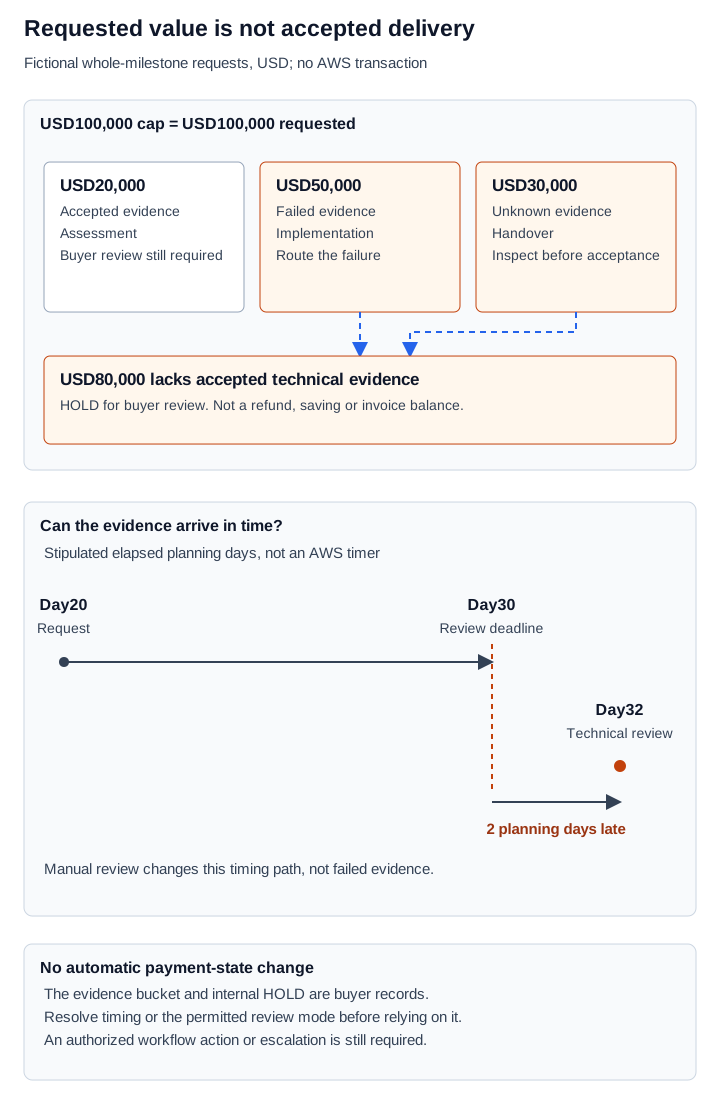
*The upper ledger classifies the evidence behind fictional whole-milestone requests, not savings, refunds, settlement or liability. On desktop, dashed blue arrows identify the failed and unknown evidence contributing to the USD80,000 review gap. Mobile presents those classifications as stacked ledger records without dashed arrows. The lower schedule uses stipulated elapsed planning days, not an AWS timer simulation; its arrows indicate chronological order, not automatic platform action. Manual review changes this timing path, not failed evidence. A HOLD still needs an authorized workflow action or escalation.*
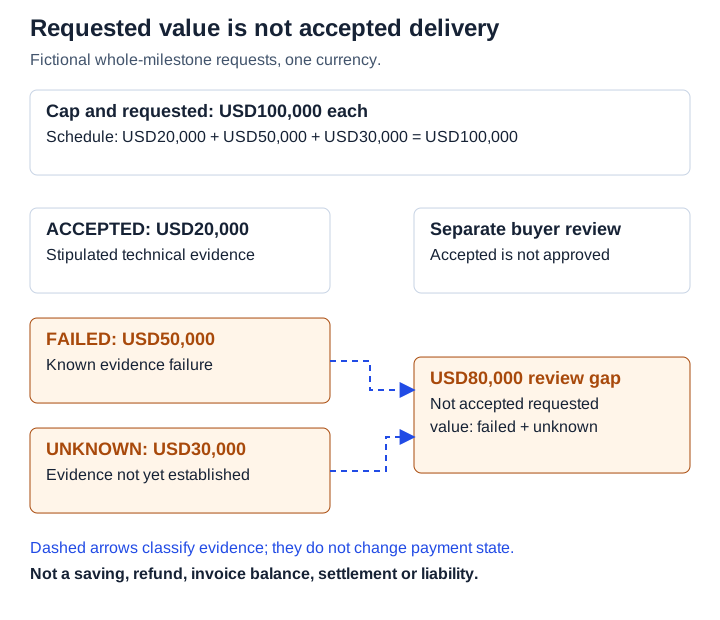
Fictional whole-milestone requests: 20,000 + 50,000 + 30,000 = 100,000. The 80,000 gap is requested value without accepted technical evidence, not savings, refunds, invoice balance, settlement or liability. Accepted evidence still requires authorized buyer review.
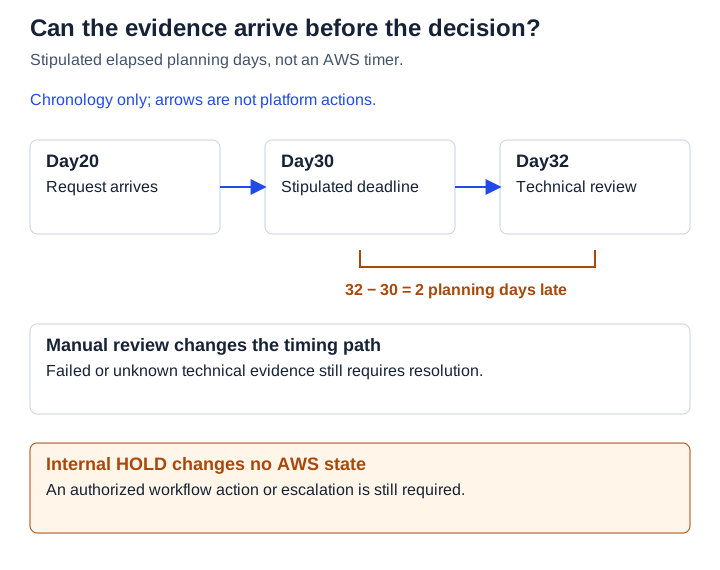
Stipulated planning chronology, not an AWS timer or platform action. Day32 minus day30 equals two planning days. Internal HOLD still needs an authorized action or escalation and reverses no payment automatically.
10. Treat credits and commitments as different unknowns
An enterprise spending commitment, a promotional credit and a seller discount are different instruments. Do not subtract them from the price because a transaction appears on an AWS-related purchasing path. Ask finance to establish the actual agreement, eligible charges, applicable entities, period, exclusions and any written confirmation needed for this purchase. Keep confidential pricing formulas outside the public worksheet.
AWS promotional credit terms exclude certain fees unless otherwise authorized, including Marketplace and AWS Professional Services fees. They also specify eligibility and expiry constraints. This does not establish how a private enterprise commitment treats a particular seller purchase. A documented exception for one credit is not evidence for a different commitment. AWS promotional credit terms
Record UNKNOWN when the governing contract or authorized interpretation is unavailable. Compare the gross stipulated purchase amounts first. If a verified benefit is later relevant, record its basis and limitations in a separate confidential finance schedule. Avoid counting the same benefit against the services price and again against workload consumption.
For this paper's USD100,000 case, no benefit is assumed. The full cap remains visible. A channel proposal that depends on an unverified commitment benefit stays on HOLD even if its delivery scope is otherwise aligned. This preserves the distinction between a workable implementation agreement and a justified financial decision.
The worksheet is not tax, legal or accounting advice. Cross-border supply, withholding, invoicing entity, indirect tax and currency availability require the buyer's qualified reviewers and the actual current transaction documents. No universal India-to-US purchasing rule follows from a product's availability.
11. Make authorized resale and delivery responsibility traceable
A channel option needs a connected record from the provider's selling authorization to the reseller's offer, then to the party responsible for the accepted workload. Verify the current authorization and proposed offer rather than relying on an old screenshot or a general partner claim. Product, entity, currency and legal terms must match the transaction being reviewed.
AWS documents that deactivating a selling authorization prevents new offers based on it, while already created offers are not affected by that deactivation. Therefore, do not assume an authorization's current inactive state has cancelled an earlier offer or agreement. Inspect the actual purchasing records and obtain authorized interpretation where needed. AWS authorization lifecycle
The engineering sponsor should still know who staffs the work, reviews its evidence and supplies post-handover support. If a provider changes a delivery subcontractor, the buyer needs the approved change path for access, confidentiality and acceptance. Authorization to resell a product does not settle those operating questions.
For the offline fixture, selecting CPPO adds two independent HOLD gates: verified authorization and verified payment-feature applicability. Passing one does not pass the other. The fixture does not query AWS or establish that any specific reseller is eligible. Its function is to prevent a reader from importing direct-offer assumptions into an unverified channel arrangement.
The general engineering-partner evaluation playbook remains the owner for supplier selection and proof of delivery capability. This whitepaper adds transaction reconciliation after an otherwise suitable supplier and workload have been identified.
12. Preserve exit duties when the buying workflow ends
Define what the customer must possess at handover: repositories and appropriate rights, infrastructure definitions, configuration inventory, operating instructions, evidence records, known defects and the agreed support transition. Specify who revokes temporary access and who confirms that recurring dependencies such as a provider-owned build identity have been removed or deliberately retained.
Separate the agreement's commercial duration from operational support and recovery custody. A purchase record that reaches its end does not teach the customer's on-call team how to restore a database. Conversely, a technically complete handover does not resolve an outstanding commercial dispute. Record both states without forcing one to stand in for the other.
A partial exit needs its own accepted boundary. If the customer stops after assessment, determine what was delivered and what remains unusable without additional work. If implementation fails, identify the recovery operator, available artifacts and permitted access while the dispute is resolved. Do not promise that unpaid work, credentials or proprietary tooling will transfer unless the actual agreement provides for it.
Before accepting a channel that introduces another party, test an escalation example. The technical acceptor rejects the final evidence, the delivery team says it has finished, and the payment reviewer receives a request. Who responds, which record governs, and who keeps the workload safe while the issue is reviewed? An answer such as “contact the Marketplace team” is insufficient without the specific contractual and operational owners.
Keep final evidence in customer-controlled records with an appropriate retention policy. A seller message or product page can change. The buyer needs the versions supporting its decision, with confidential access restricted to authorized reviewers.
13. Reuse this blank decision worksheet
Complete one worksheet per candidate offer against the same baseline. UNKNOWN is an acceptable intermediate answer and a visible HOLD, not permission to infer favorable terms. Store private identifiers in controlled records rather than publishing a completed customer worksheet.
Baseline workload and exclusions
Record the controlled reference or evidence. UNKNOWN remains unresolved.
Customer technical acceptance criteria and owner
Record the controlled reference or evidence. UNKNOWN remains unresolved.
Baseline SOW version and controlled reference
Record the controlled reference or evidence. UNKNOWN remains unresolved.
Channel
direct agreement / direct private offer / authorized channel
Buyer contracting entity and purchasing account reference
Record the controlled reference or evidence. UNKNOWN remains unresolved.
Seller entity; reseller and delivery entity if different
Record the controlled reference or evidence. UNKNOWN remains unresolved.
Offer/agreement reference and current observed state
Record the controlled reference or evidence. UNKNOWN remains unresolved.
Offer service description matches baseline
YES / NO / UNKNOWN
Attached terms versions and authorized conflict resolution
Record the controlled reference or evidence. UNKNOWN remains unresolved.
Price, currency, cap and scope of tax/other charges
Record the controlled reference or evidence. UNKNOWN remains unresolved.
Payment model and actual supported approval mode
Record the controlled reference or evidence. UNKNOWN remains unresolved.
Evidence needed for each request and expected review timing
Record the controlled reference or evidence. UNKNOWN remains unresolved.
Authorized payment reviewer, backup and escalation
Record the controlled reference or evidence. UNKNOWN remains unresolved.
Workload accounts and separately approved execution role
Record the controlled reference or evidence. UNKNOWN remains unresolved.
Recovery, support, handover and access-closure duties
Record the controlled reference or evidence. UNKNOWN remains unresolved.
Authorization/product/payment-feature evidence if channel resale
Record the controlled reference or evidence. UNKNOWN remains unresolved.
Commitment treatment
not claimed / verified reference / UNKNOWN
Credit treatment
not claimed / verified reference / UNKNOWN
Unresolved rows, owners and next evidence required
Record the controlled reference or evidence. UNKNOWN remains unresolved.
Disposition
HOLD / RECOMPARE / READY FOR AUTHORIZED BUYER REVIEW
Review date and changed inputs that require another review
Record the controlled reference or evidence. UNKNOWN remains unresolved.
Use a separate discrepancy log rather than cramming every difference into the disposition field. Each discrepancy should identify the exact competing records, the affected workload or money decision, the person permitted to resolve it and the evidence required to close it. An owner without a required output is only an assignment, not a gate.
READY FOR AUTHORIZED BUYER REVIEW is intentionally narrower than “buy.” The worksheet cannot establish that all legal, security, financial and organizational requirements have been met. It organizes the evidence for the people who hold that authority.
14. Filled record and decision alternatives
For OFFER-7, the buyer records SOW-3, the fictional purchasing account and seller entity, manual review, one currency, the USD100,000 cap and EXIT-2. Scope reconciliation is stipulated complete. The three request rows have accepted, failed and unknown evidence respectively. The resulting disposition is HOLD because the implementation and handover evidence do not support full technical acceptance.
| Candidate | Changed input | Decision supported by this record | Next required action |
|---|---|---|---|
| Direct private offer, manual review | Baseline fictional record | HOLD on failed and unknown evidence | Authorized reviewers address the two evidence gaps and current requests |
| Direct private offer, automatic review | Day32 review after stipulated day30 deadline | HOLD on timing and evidence | Resolve the review schedule or permitted mode before relying on it |
| Authorized channel offer | Authorization and payment-feature evidence absent | HOLD, even if the price matches | Verify both independent channel gates and responsibility records |
| Nominally cheaper offer | Recovery obligation omitted | RECOMPARE; scope mismatch | Restore the obligation or obtain an explicit baseline change |
| Any channel claiming commitment benefit | Governing treatment unknown | HOLD on financial justification | Obtain contract-specific authorized finance evidence |
Direct private offer, manual review
Changed input: Baseline fictional record
Decision supported by this record: HOLD on failed and unknown evidence
Next required action: Authorized reviewers address the two evidence gaps and current requests
Direct private offer, automatic review
Changed input: Day32 review after stipulated day30 deadline
Decision supported by this record: HOLD on timing and evidence
Next required action: Resolve the review schedule or permitted mode before relying on it
Authorized channel offer
Changed input: Authorization and payment-feature evidence absent
Decision supported by this record: HOLD, even if the price matches
Next required action: Verify both independent channel gates and responsibility records
Nominally cheaper offer
Changed input: Recovery obligation omitted
Decision supported by this record: RECOMPARE; scope mismatch
Next required action: Restore the obligation or obtain an explicit baseline change
Any channel claiming commitment benefit
Changed input: Governing treatment unknown
Decision supported by this record: HOLD on financial justification
Next required action: Obtain contract-specific authorized finance evidence
For a direct services agreement, use the same scope and evidence rows but inspect that agreement's actual invoice and dispute process. Do not copy the AWS review window into a non-Marketplace contract. If its terms are aligned and the buyer's onboarding path is acceptable, direct procurement remains a meaningful alternative rather than a default fallback after Marketplace fails.
The senior buyer's decision is which complete arrangement they can authorize, not which label appears most convenient. If all candidates have unresolved gates, the defensible result is a documented HOLD with owners. Procurement speed measured by accepting an incomplete arrangement would hide the unresolved work.
15. Inspect the offline arithmetic and its limits
The offline procurement reconciliation source package (ZIP) contains reconcile.mjs, scenario.json, reconcile.test.mjs and its README. It uses built-in Node.js modules and integer minor units, with no credentials or external dependencies. Extract all four files into one directory and use Node.js 22 or later. From that fixture directory, run:
node --test reconcile.test.mjsThe scenario should return scheduled and requested amounts of 10,000,000 cents each, accepted requested value of 2,000,000, failed value of 5,000,000 and unknown value of 3,000,000. The not-accepted requested total is 8,000,000 cents. Tests also cover missing reviewers, scope mismatch, separate CPPO gates, the stipulated two-day lateness, duplicate requests, mixed currency, unsupported partial requests and unsafe numeric inputs.
The model supports one whole request per milestone and one currency. It rejects a partial request instead of guessing how to assign its evidence. It checks currency syntax, not service eligibility. It excludes tax, foreign exchange, credit notes, refunds, cash settlement, amendments and accounting recognition. Those exclusions keep the arithmetic inspectable; they also prevent use as an accounts-payable engine.
An empty request list can pass the selected buyer-review gates while accepted requested value remains zero. That state means there is no modeled request to classify. It proves no delivery. Similarly, an all-accepted synthetic input can produce READY_FOR_BUYER_REVIEW without authorizing a purchase or validating an AWS workload.
The fixture is an offline teaching artifact. Its tests establish calculations and bounded validation behavior for supplied inputs, not the truth of those inputs or the behavior of AWS APIs.
16. Review gates and the next buying decision
Before an authorized buyer acts, procurement should show a reconciled offer and SOW, verified transaction parties and the actual review workflow. Engineering should confirm that the workload baseline, recovery evidence and handover duties survived the channel choice. Security should confirm separately granted execution authority. Finance and qualified contract reviewers should resolve any tax, commitment, credit or document-precedence questions that affect the decision.
Stop the comparison when a critical input is unknown. A missing payment backup is a repairable operating gap. An unidentified delivery entity or unresolved recovery obligation can change the proposed arrangement. Record the required correction rather than giving every gap the same low-risk checkbox.
This position does not apply unchanged to software subscriptions, usage-based software pricing, indefinite managed services, public-sector purchasing rules or a transaction with bespoke negotiated terms that alter the assumed process. Recheck current documentation and the actual offer. Do not use a seller's authorization, platform listing or payment workflow as evidence of customer acceptance.
The next action is to take one live candidate through the blank reconciliation worksheet using controlled buyer records, without accepting it during the review exercise. Compare it with at least one complete alternative against the same workload. Close or explicitly retain each HOLD, then submit the reconciled record to the people authorized to make the purchase and grant execution access.