AWS Multi-Account Recovery Authority: Recover When Normal Access Fails
Compare emergency identity, backup sharing and encryption authority against explicit account-access failures before accepting a multi-account recovery design.
Abstract: choose the authority path before the incident
An AWS backup can survive while the organization loses the permission needed to use it. The ordinary login may depend on the impaired identity service. A recovery role may trust a source account that the incident team no longer considers safe. A retained encrypted recovery point may still require a key, grant or service role that nobody can currently use. Moving the data into another account does not answer these authority questions.
This paper recommends evaluating recovery as an explicit chain of decisions and permissions: authenticate an approved operator, obtain a restricted recovery principal, reach the selected recovery point, authorize the restoration service, use the required encryption path, and validate a bounded application function. For each link, identify the control owner, failed dependency, independent access route, expected denial and available observation. Choose the smallest authority separation that covers the accepted failure scope.
The scope is an AWS multi-account design review for teams that already operate protected workloads. It compares normal federation with a prepared emergency route, standard cross-account backup copies, pre-established sharing of a logically air-gapped vault, and approval-mediated access from a recovery account. These mechanisms address different dependencies. None establishes universal independence from AWS services, a compromised organization or every identity outage.
The account names, fixtures and worksheet below are illustrative. No customer implementation, live restore, measured recovery duration or Ampity certification is claimed. Provider behavior is grounded in primary AWS sources checked on 7 October 2026; the proposed acceptance framework is an engineering recommendation. Complete the review with the exact resource type, Region, policies and operational approvals before using it for production decisions.
1. Define the failure you need to survive
Start with a concrete unavailable or distrusted authority. “We lost access” can mean that the corporate identity provider is unavailable, IAM Identity Center is unavailable, a hardware authenticator is inaccessible, account administrators cannot sign in, or a privileged identity may have been compromised. It can also mean a resource policy was changed, an organization policy denies restoration, or a customer-managed encryption key is disabled. Those are different failures with different remedies.
For an availability incident, an unchanged trusted source account may still be a valid authority once its access route is repaired. For suspected compromise, the team may deliberately refuse to rely on that account's current administrative decisions. A shortcut that restores operator convenience in the first case can restore the attacker's path in the second. The incident declaration must therefore state what is unavailable and what is no longer trusted.
Write a failure statement with the affected accounts, Regions, identity services, operator devices and data resources. Then list exclusions. A plan for an IAM Identity Center disruption might assume the external IdP, IAM data plane and relevant AWS resource services remain available. A plan for suspected source-account compromise might assume the recovery organization, approvers and selected recovery points are trustworthy. If an assumption fails, the permitted response changes.
Choose the customer function separately from the administrative task. The immediate objective may be to retrieve protected records into an isolated review environment, not resume every production write. Record who accepts that narrower result and what remains unavailable. Recovery authority should enable the agreed operation; it should not silently become permission to change all business records, reveal every tenant's data or repeat external payments.
2. Keep authentication, permission and acceptance separate
Authentication identifies the operator through a specific mechanism. Role trust decides whether an identity can obtain a principal. IAM and resource policies decide what that principal can do. A service role authorizes the restoration service's resource operations. Encryption policies and key state can determine whether those operations can use protected material. Application acceptance decides whether the resulting workload is useful and safe for the intended customer function.
A successful console login proves only that the observed authentication path worked. A successful role assumption proves admission to that role under the observed conditions. A restore job reaching completion establishes a provider job state, not the entire application contract. Keep these conclusions narrow in the incident record. An administrative success is useful evidence, but it cannot stand in for every later boundary.
The proposed contract uses an operation manifest to bind them. It names the incident, authorized requester, exact recovery account, resource and recovery-point identifiers, intended target, selected restore role, encryption mode, permitted function and expiry or review condition. A later change to those inputs invalidates the corresponding approval. Preserve the manifest revision rather than accepting “the recovery team has access” as a durable authorization statement.
Record evidence without duplicating secrets. Principal identifiers, configuration revisions, sanitized denial reasons and job references can explain the result. Private payloads, passwords and temporary tokens should remain inside their approved handling boundary. The observer needs enough access to assess the exercise, not blanket access to the restored business data. Evidence collection is another permission path that must survive the declared failure.
3. Map accounts by authority rather than by diagram convenience
Consider a synthetic workload account P, backup-owning account B and recovery account R. They may reside in one organization or separate organizations, depending on the selected mechanism. Those account boundaries do not automatically define independent administrators. The same corporate IdP, policy automation, support process or key administrator could control all three and become their shared failure cause.
The first visual describes responsibility and permission boundaries, not a selected AWS deployment. Ordinary administrative access is deliberately outside the proposed recovery path. The recovery operator must use a prepared identity route, the restore principal must reach an authorized recovery point, and the service must satisfy its resource and encryption requirements. The evidence record joins observations; it is not another service that grants permission.
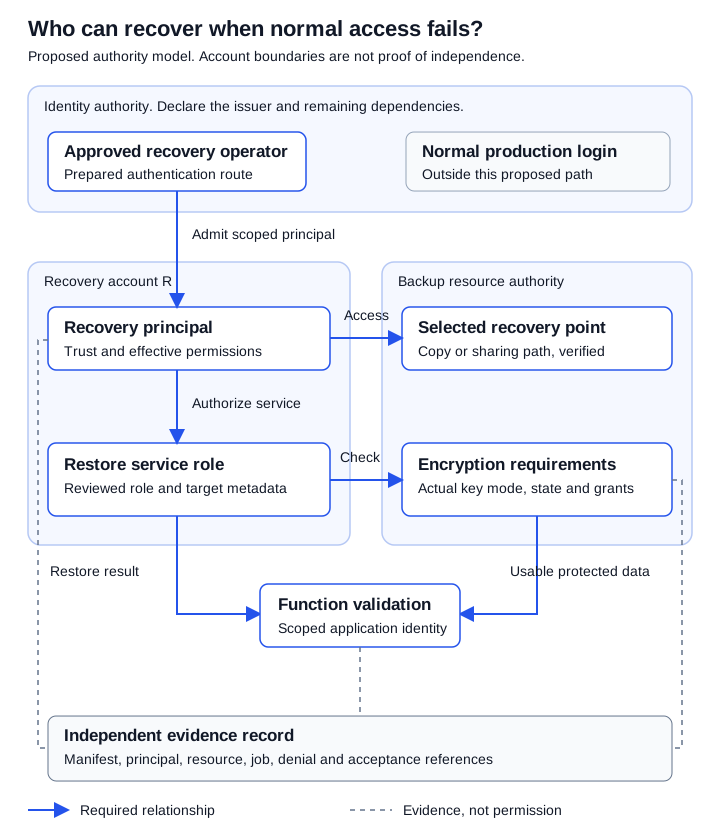
*Proposed authority context. Each solid arrow represents a required request or permission relationship. Dashed lines carry evidence. The diagram does not imply that all illustrated owners are separate people or that a vault share removes encryption dependencies. The following register provides the accessible details.*
| Boundary | Record before approving the design | Failure question |
|---|---|---|
| Operator identity | Issuer, device/authentication requirement, approver and alternate path | Can the named operator authenticate without the failed service? |
| Recovery principal | Trust conditions, account, allowed operations and session lifecycle | Can an unintended principal obtain or retain this authority? |
| Backup access | Recovery point, owner, copy/share mechanism and current grant | Does using it require a new action by the unavailable account? |
| Restore service | Assumed role, resource-type permissions and target configuration | Can the service perform the scoped restoration independently? |
| Encryption | Actual key mode, owners, required grants and key state | Can every required cryptographic operation still succeed? |
| Validation | Test identities, invariants, network isolation and acceptance owner | Does the restored function work without reopening unapproved effects? |
4. Compare alternatives against the same failure statement
Keeping ordinary access can be appropriate when the accepted failure is a workload outage and the central identity path remains trusted and available. It has a smaller operating burden and fewer emergency identities to maintain. Its limitation is explicit: it does not provide an independently usable path when its identity or administrative dependencies fail. Record that limitation instead of presenting the absence of emergency access as a hidden assumption.
A prepared emergency federation route can reduce reliance on IAM Identity Center while preserving the existing external IdP. AWS's emergency access guidance says that its direct-federation configuration works when IAM Identity Center is unavailable but the IAM data plane and external IdP remain available, and should be configured before disruption. The failover process describes enabling the IdP application and using roles with cross-account trust. This is a specific fallback, not evidence of independence from the IdP itself.
If the accepted failure includes the external IdP itself, direct federation through that same IdP does not solve the admission problem. Evaluate a separately prepared break-glass route instead. AWS's break-glass guidance recommends protected emergency roles/users, hardware MFA, use alerts and a connection to incident response. Record credential custody, authorized operators, reachable authenticators and tested withdrawal. This is not permission to paste a broad administrator policy into every account or disable controls during an ordinary exercise. A different login mechanism still needs the resource, service-role and key authority described below.
A separately controlled recovery account can address an unavailable or distrusted source authority, but only when the data and permission paths have been prepared for it. A new account created during the incident may still lack recovery-point access, a service role, encryption permission, compatible network configuration or current application artifacts. Its existence is not recovery readiness. Treat incident-time setup as a distinct, less-proven option with its own dependencies and expected delays.
An approval-mediated access mechanism can add a deliberate decision between possession of a recovery identity and access to retained data. That protects a different risk from ordinary federation availability. It also introduces approver, identity and service dependencies. Compare the security benefit and operating burden against the actual threat model. More account boundaries or more approvals are not automatically better when the team cannot maintain and rehearse them.
| Option | Strongest relevant use | Residual dependency to disclose | Acceptance evidence |
|---|---|---|---|
| Normal authorized administration | Workload failure with trusted administration intact | Normal identity and administrative systems | Scoped resource and restore-role tests |
| Prepared direct federation | Identity Center disruption with IdP still available | External IdP, IAM and target trust | Admission and denial through the prepared route |
| Independently prepared break-glass admission | Declared IdP failure within a bounded emergency-access design | Credential custody, MFA, IAM, authorized operators and scoped resource permissions | Observed admission without the failed IdP, use alert and verified withdrawal |
| Pre-established recovery copy/share | Source access unavailable at restoration time | Actual grant, keys, recovery identity and resource services | Restore under R without incident-time P administration |
| Approval-mediated recovery access | Suspected source compromise under a prepared approval design | Recovery approvers, identity, Region and service path | Request/decision/access observations and denied misuse |
5. Distinguish a backup copy from sharing an existing vault
A standard cross-account copy and a shared logically air-gapped vault are not interchangeable names for the same workflow. AWS's cross-account copy guidance describes destination copies and resource/encryption conditions. A copy must actually exist in the intended destination with usable configuration; a planned copy rule is not evidence that every protected resource has completed copying.
AWS's logically air-gapped vault guidance describes sharing through AWS RAM so a recipient account can restore supported recovery points. The vault supports AWS-owned or customer-managed encryption choices. A shared vault is not an independently duplicated destination recovery point, and logical air-gapping is not physical disconnection. Read the selected resource's support and encryption behavior before treating either option as usable.
The design decision is whether the intended recovery operation requires new source-side authority when the incident begins. A pre-established and verified share may remove that incident-time setup step. A recovery copy may provide a different ownership path. Neither establishes resistance to every future grant change, key change or compromise. Record who can alter the path and which protection the selected mechanism actually supplies.
Evaluate freshness and compatibility separately from authority. A recipient can have valid access to an unsuitable recovery point. A recent recovery point can contain the same unwanted data change as the source. Identify the selected version, acceptance criteria and reason it is considered trustworthy. The AWS Backup feature matrix is an input to resource selection, not proof that a particular copy or restore passed.
6. Treat approval-mediated recovery as another dependency chain
AWS Backup multi-party approval documentation describes prepared access to a logically air-gapped vault from a recovery account through an approval team. Its recommended setup includes a recovery organization and IAM Identity Center; the documented team resources are stored in US East (N. Virginia), with cross-Region dependencies where applicable. Do not infer that separate accounts or a different workload Region remove those dependencies.
For the review, inventory the requester's access, approval-team membership, authentication source, decision quorum or policy, shared team configuration, vault association and resulting restore access. Use exact current provider settings rather than inventing a generic two-person rule. Record which component must be available at decision time and how changes to team membership or association are controlled.
Consider the combination of failures rather than only each in isolation. A recovery organization using the same external identity dependency as the primary organization may still fail with that dependency. A team-resource Region can be another availability boundary. A separated approver can be unreachable during a genuine incident. Write those cases into the design's accepted limits instead of weakening the approval conditions when they become inconvenient.
Keep approval of access distinct from approval to resume business work. A recovery account may be allowed to obtain retained data for investigation while production processing remains paused. The manifest should specify which activity the approval permits and what the next owner must validate. That prevents a valid vault-access decision from being interpreted as permission to publish restored private records or reopen old workers.
7. Review organization policies without treating them as permissions
AWS Organizations documents that service control policies limit permissions rather than grant them, and that SCPs do not apply to the management account. An IAM role with a broad allow policy can still be constrained in a member account. Conversely, the management-account exception is not a reason to run ordinary recovery workloads there.
Record the organization, OU and account path for each recovery principal. Include relevant SCP and other applicable policy revisions, resource-policy conditions and explicit denies. A copy of the role's identity policy is incomplete evidence. The proposed review needs the effective request context and the observed authorization result for each required operation. Avoid simplifying all authorization into one spreadsheet intersection when service-specific evaluation can differ.
Separate setup permissions from incident permissions. A person who can create a share or change an organization policy before the incident may not need that privilege during a restore. A restore operator should not automatically gain permission to rewrite the wider organization policy whenever a test is denied. Preserve the denial, determine its intended meaning and ask the authorized policy owner for a scoped resolution.
Test the recovery design after routine organizational changes. Moving an account into another OU, changing a guardrail or replacing a shared deployment role can invalidate previous evidence. Attach the accepted policy context to the recovery manifest and review triggers. A test passed months ago under a different OU path is historical evidence, not current assurance of the new path.
8. Trace encryption authority through the actual resource path
When using a customer-managed key across accounts, AWS KMS guidance requires appropriate permission in both the key policy and the external account's IAM policy for supported cross-account operations. Service integrations can require additional permissions or grants. Do not transfer an example for one resource type to all backups or treat a visible key ARN as proof that the restore role can use it.
Create a key-dependency record for source material, copied recovery points, selected vault encryption and restored targets. Some resource paths use service-owned encryption behavior; others retain or introduce customer-managed key dependencies. Verify each selected path from current resource documentation and a bounded test. Record who can change policy, disable the key or affect the grant, and whether that owner is inside the declared failed or distrusted boundary.
Key state matters independently of policy. AWS's key-state reference describes state-dependent operation outcomes, and deletion guidance explains that pending deletion prevents cryptographic use and completed symmetric-key deletion makes remaining protected ciphertext unrecoverable. Extra IAM access cannot reconstruct deleted key material. A design that needs that key must disclose the dependency rather than promise an administrative workaround.
Do not test these failure modes by deleting or disabling production keys. Use static dependency review, harmless encrypted fixtures and approved test keys in an isolated scope. Deliberately destructive transitions need a separate operational decision and independent recovery control. The content proposes evidence questions; it does not authorize fault injection or imply that any such key-state experiment has already been performed.
9. Separate the operator from the service performing the restore
The operator submitting a restore request and the service executing resource operations are different principals. AWS's restore-by-resource guidance requires the appropriate restore role and resource-specific inputs. The service authorization reference identifies action dependencies and conditions, including role-passing requirements for relevant operations. Check the selected action rather than assuming every administrator can safely pass every role.
Specify the caller, permitted role ARN, service trust, restore role permissions and intended target. A narrowly scoped request can still be dangerous if it allows selecting an unrelated powerful role or restoring into an uncontrolled target. Conversely, the service role might lack a required resource permission even though the caller's request was accepted. Observe both stages and keep their error records separate.
Restore metadata is part of the authorization contract. Network placement, resource names, encryption configuration and resource-specific options can change the safety of the resulting workload. Compare the reviewed metadata to the submitted manifest and resulting resource. Do not regard provider defaults as approved business choices. A restored machine or database in the wrong network can violate the intended boundary while the job is technically complete.
Keep outbound business effects disabled in the test target. Restored schedules, queues, notifications or integration credentials can produce actions unrelated to the restoration objective. Use synthetic records and inert destinations. The service owner should verify the isolation before any application start. Recovery of old executable state is not permission to replay its side effects against current customers.
10. Keep observation and stop controls available
The recovery team needs a usable runbook, current resource inventory and evidence destination when normal access is unavailable. Review how operators reach those artifacts, who can update them and how their revisions are verified. A procedure stored only behind the impaired identity provider creates another access dependency. A downloaded copy without a freshness owner can preserve access while leading the operator to obsolete targets.
Assign an observer who can identify the current principal, job and target without relying on the same operator to summarize everything. The observer does not need broad production data access. Prefer non-sensitive resource identifiers, sanitized events and the exact manifest revision. If observation disappears, the proposed exercise stops before further consequential work; lack of visibility is not evidence that no effect occurred.
Plan a reversal route before changing the test environment. The ability to stop a synthetic workload or remove a temporary denial must not depend entirely on the access path being tested as unavailable. Keep that independent control under a different, approved exercise role. If the team cannot preserve both containment and reversal, run a narrower tabletop or harmless admission test first.
For incident operations, a missing acknowledgement creates uncertainty. Preserve the provider job reference or request identity and inspect its result through an authorized read path. Do not submit a new restoration simply to obtain a cleaner status. A second resource can increase cost, expand data exposure or confuse the later admission decision. Separate a confirmed failed submission from an accepted operation whose outcome has not yet been observed.
11. Use a recovery-authority worksheet
The following worksheet is a reusable review artifact, not an AWS configuration file. Fill it with references and expected results before the exercise. Blank fields remain unknown. Do not place tokens, passwords or customer payloads into it.
Recovery decision:
  Incident or exercise ID:
  Failure boundary and distrusted authorities:
  Customer function permitted after recovery:
  Manifest revision and accountable decision owner:

Identity and authorization:
  Operator authentication path and remaining dependencies:
  Recovery principal ARN and trust revision:
  Organization / OU / account policy context:
  Required operations and explicitly denied operations:
  Session issuance, refresh and withdrawal method:

Data and encryption:
  Resource type, Region and recovery point ID:
  Copy, pre-established share or approval-mediated path:
  Actions still required from unavailable source authority:
  Encryption mode and required keys / grants / owners:
  Restore role ARN and reviewed target metadata:

Evidence and disposition:
  Observer identity and independently accessible evidence location:
  Admission, resource, service-role and key test references:
  Restore job and resulting resource references:
  Function acceptance and negative-test references:
  Unknown effects, held functions and owner:
  Expiry / withdrawal observation and next review trigger:
For each required operation, include a permitted fixture and a rejected fixture. Name the expected enforcement point and why it should accept or deny. A transport failure should not be recorded as a policy denial; an empty result should not count as proof of decryption. The worksheet should allow another reviewer to distinguish setup defects from correct restriction and from unobserved behavior.
12. Rehearse the missing-authority path with synthetic fixtures
Suppose P contains fabricated order records and B holds a selected protected recovery point. R is prepared for isolated review. The exercise declares ordinary P operator login unavailable while relevant AWS resource services remain available. The objective is to retrieve the declared records in R and validate an agreed read function; new-order creation and payments remain disabled. These choices are illustrative and contain no claimed results.
First, establish the expected outcome with normal controls intact. Record the approved operator, actual principal, manifest, recovery point and target. Then make only the declared test access path unavailable using a reversible sandbox control. Do not begin by creating a new privilege during the failure; that would test administrative setup rather than the prepared recovery path. Preserve the independent stop role throughout.
Run one permitted recovery action and independent denials for an unapproved principal, unrelated recovery point, unrelated restore role and unapproved target. Check the intended stage of each denial. If restoration requires B to create a new share or P to change a key policy, record that source dependency as a failed assumption for this exercise. Do not silently repair it and count the original prepared design as successful.
After restoration, use the intended application identity to inspect the exact synthetic record set, schema and access restrictions. Check that forbidden writes and inert outbound destinations remain disabled. AWS's restore-testing validation guidance supports a separate validation workflow after job completion. The proposed acceptance criteria here remain the organization's responsibility; a sample health check is not a substitute for its business invariants.
13. Make the admission decision from separate evidence
The second visual asks what permits progression during an exercise. It is a decision sequence rather than another topology. Authentication success does not clear data-access, encryption or application requirements. Every missing observation holds the affected activity at its current boundary. A held state is useful only when an owner and next evidence requirement accompany it.
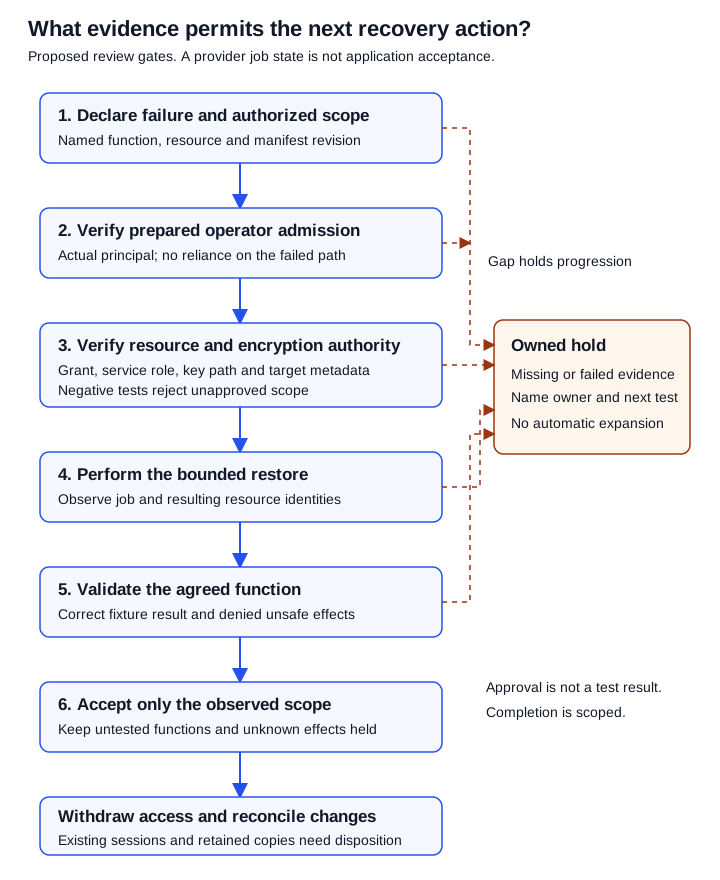
*Proposed review gates. “Hold” means pause the proposed action until its owner resolves the gap, not a provider error state. The sequence does not prescribe AWS service API ordering for every resource type.*
| Fixture | Proposed acceptance result | Required observation |
|---|---|---|
| Approved operator using prepared alternate admission | Obtain only the selected recovery principal | Actual principal, identity path and denied unrelated action |
| Operator relying on declared failed login | Remain unavailable through that path | Failure attributable to the intended fault |
| Unapproved principal requesting retained records | Refuse access | Correct policy/approval boundary and sanitized denial |
| Required key operation lacks authority | Hold restoration or subsequent validation | Exact operation, key state and relevant denial |
| Provider restore job completes but fixture read fails | Hold application acceptance | Resulting resource identity and failed function check |
| Application read passes but emergency session remains usable beyond closure | Keep authority closure open | Withdrawal/expiry observation for the actual session type |
Do not replace missing results with planned durations or expected success. The proposal defines what should be observed; the completed exercise record establishes what happened. A constrained success supports only its workload, principal, resource path and failure scope. Other resource types and combined failures remain separate coverage gaps.
14. Compare operating cost and residual exposure
An independent recovery path costs more than backup storage. Include maintained identities, approved authenticators, recovery-account baseline resources, key administration where applicable, evidence access, exercises, policy review and staff coverage. A separately operated organization adds ownership and configuration responsibilities. A path that is cheap to create but rarely rehearsed can impose more incident uncertainty than its setup estimate reveals.
Separate recurring readiness cost from incident consumption and implementation effort. Restored resources, transfers, retained duplicates, test workloads and cleanup can have different billing bases. Use dated Region/resource pricing and the organization's actual usage assumptions before estimating them. This paper provides no dollar figure, percentage saving or recovery-time forecast. Keep the model visible so finance and engineering compare the same accepted scope.
Balance authority separation with data exposure. Additional recovery identities, shares and restored copies can widen access if poorly maintained. Separate operators from approvers where the selected model requires it, review stale membership and control the destination's network/data permissions. Do not approve a persistent broad administrator merely because it makes a drill easier. The goal is usable scoped access when needed, with a tested closure path.
Choose an incremental introduction. Inventory one critical resource, establish its current authority path, identify one accepted failed dependency and rehearse one bounded alternative. Expand only after the team can maintain the register, negative tests, observation and withdrawal. A leadership decision can accept uncovered resources temporarily with a named consequence; it should not relabel that acceptance as full multi-account recovery assurance.
15. Withdraw emergency authority and reconcile what changed
Closing the incident requires more than disabling the alternate login application. New-session issuance, existing-session permissions, backup access, restored-resource exposure and already attempted operations are different closure items. Inventory each one against the manifest. Preserve the accepted result while retiring only the temporary authority that is no longer required. Recreating ordinary access does not establish that emergency access ended.
AWS's role-session revocation guidance describes a policy-based withdrawal mechanism with limits, including separate treatment for Identity Center permission-set sessions and non-revocable service-linked-role sessions. Apply the documented method for the actual credential type. Changing role trust alone must not be reported as evidence that every already issued session stopped working.
Use harmless test requests to observe the intended closure in the approved scope. Record an existing session and a newly requested session separately, without storing their credentials in the report. Keep propagation and timing uncertainty visible. If access must remain for a longer reconciliation activity, narrow its purpose, assign its owner and preserve its review condition instead of leaving the entire emergency path silently open.
Reconcile created resources, changed grants, admitted requests and uncertain outcomes. Decide retention and cleanup through the responsible data/security owners. A failed restore attempt may still have created billable or sensitive resources. A successful read may still leave an unapproved copy. Assign each item a disposition and evidence reference, then hand the remaining held customer functions to their application recovery owners.
16. Limitations and the next leadership decision
Review checklist: can the prepared authority survive this failure?
- Name the unavailable or distrusted authority and the assumptions that remain trusted. Confirm the alternate operator admission does not depend on the very service the exercise removes.
- Identify the exact recovery point, copy or sharing path, restore principal, service role, target and encryption dependencies. Record any action still needed from the failed source authority.
- Inspect the approval chain and approver availability separately from login availability. A distinct account or organization does not establish independent identity, key administration or regional services.
- Prepare an authorized synthetic permitted operation and meaningful denials. Keep expected outcomes separate from actual requests and observations; no administrative success clears the application gate.
- Validate the bounded restored function with prohibited writes and external effects isolated. Record its business invariants and held functions, not merely a completed restore-job state.
- Observe withdrawal for the actual session type, reconcile attempted operations and created copies, and retain owned exceptions. New-session denial alone cannot close every existing session or data-exposure path.
This framework does not guarantee recovery during every AWS control-plane outage, corporate identity failure or malicious incident. IAM, encryption, resource services, approver access and regional dependencies can remain common boundaries. Some AWS Backup resource paths have different copy, sharing, encryption and restore capabilities. Resolve the exact selected path through current documentation and controlled evidence; do not generalize a passing test to the whole account estate.
The distinct decision here is authority continuity. Regional recovery consistency remains the owner for recovered business state and writer admission. Workload identity transition remains the owner for retiring static execution credentials. Shared dependency blast radius remains the owner for capacity and state containment. A complete recovery program needs those complementary reviews without confusing their acceptance claims.
Take one completed worksheet to the security, platform and application owners. Decide which failed or distrusted authority the design must survive, which existing mechanism meets that scope, which grants must be prepared before failure and which residual risks the business accepts. Approve a bounded rehearsal with independent observation and reversal, then judge the observed result. The useful next output is an accepted authority contract with explicit gaps, not another architecture diagram labelled resilient.
For support defining that review, use Ampity's cloud reliability review, cloud security services or AWS consulting and migration scope. The framework and worksheet can be used independently; contacting Ampity is optional.
Related services
Cloud Reliability Assessment & Resilience Consulting
Cloud reliability assessment covering production architecture, disaster recovery and incident readiness. Identify failure modes and prioritize resilience work.
Cloud Security Architecture Consulting
Cloud security architecture consulting for AWS and GCP. Review IAM, network boundaries and compliance requirements, then implement agreed security controls.
AWS Consulting Services for Architecture, Cost & Migration
AWS consulting for architecture and Well-Architected reviews, cost optimisation, FinOps and migration. Plan changes around workload evidence and recovery needs.