Why Route 53 Can Still Answer from an Unhealthy Branch
Reconstruct one Route 53 record tree to distinguish disabled health inheritance, missing leaf checks, parent vetoes, load-balancer aggregation and documented...
Start with the record that made the decision
Route 53 can return an answer from an unhealthy branch without contradicting its documented health rules. A latency alias can prevent backing out when EvaluateTargetHealth is false. An unchecked leaf can remain considered healthy. A parent health check can veto healthy children. When every eligible alternative is unhealthy, a policy-specific fallback can still supply an answer. None of those outcomes establishes that an application recovered.
Diagnose one query name and record type against one dated configuration tree. Record the first health gate that explains the possible answer, then distinguish that expectation from an actual observation. A green check elsewhere, a successful fresh client request or a current console screenshot does not establish the decision made during an earlier incident.
This article covers configuration-level diagnosis in a public hosted zone, using supported same-zone record aliases, a documented latency-over-weighted A-record example and a separate valid failover pair. Examples and times are fictional, NOT EXECUTED. No AWS or DNS queries, routing changes or customer tests were performed. The result is a record-to-signal worksheet, not a failover drill or a claim of measured demand, availability or recovery speed. Vendor contracts were checked on October 7, 2026.
Identify the tree before applying a health rule
Keep the normalized name, type, routing policy and SetIdentifier with the hosted-zone identity. Two records with the same display name are not necessarily the same node. For each alias, retain AliasTarget.DNSName, AliasTarget.HostedZoneId, EvaluateTargetHealth and any own HealthCheckId. Retain the latency Region, weighted value or failover role only where that policy applies.
The ResourceRecordSet API distinguishes those fields. Alias records omit their own TTL and ResourceRecords; a weighted non-alias leaf has different fields. Do not diagnose an exported configuration by inventing fields absent from its applicable schema.
For aliases to other records, AliasTarget requires the current hosted zone and matching record type. A zone-apex alias cannot target a CNAME record. A cross-zone record reference is not the supported tree examined here. Stop at an applicability mismatch before discussing its expected fallback, and do not invent the error a real request would return.
One particularly important distinction: failover alias record sets require EvaluateTargetHealth: true. The false-flag example below uses latency aliases, not an invalid PRIMARY/SECONDARY pair. AWS's failover configuration guide also separates these routing policies. The word “failover” in an incident description does not identify the record's policy.
Trace the documented latency branch trap
Assume a fictional query for www.example.com. A selects the us-east-1 latency branch initially. Selection is stipulated to isolate the health decision, not inferred from the operator's location. Both latency aliases are in one fictional public hosted zone and target groups of weighted non-alias A records in that same zone. Each group has two leaves with equal nonzero weights of 50.
The selected east alias has target-health evaluation false and no own check. Both east leaf checks are stipulated failing. The Sydney alias has target-health evaluation true, no own check and two passing leaf checks. In AWS's complex configuration example, the false east flag keeps selection in that branch instead of backing out toward the healthy alternative. Do not assert which east IP wins this fictional weighted choice.
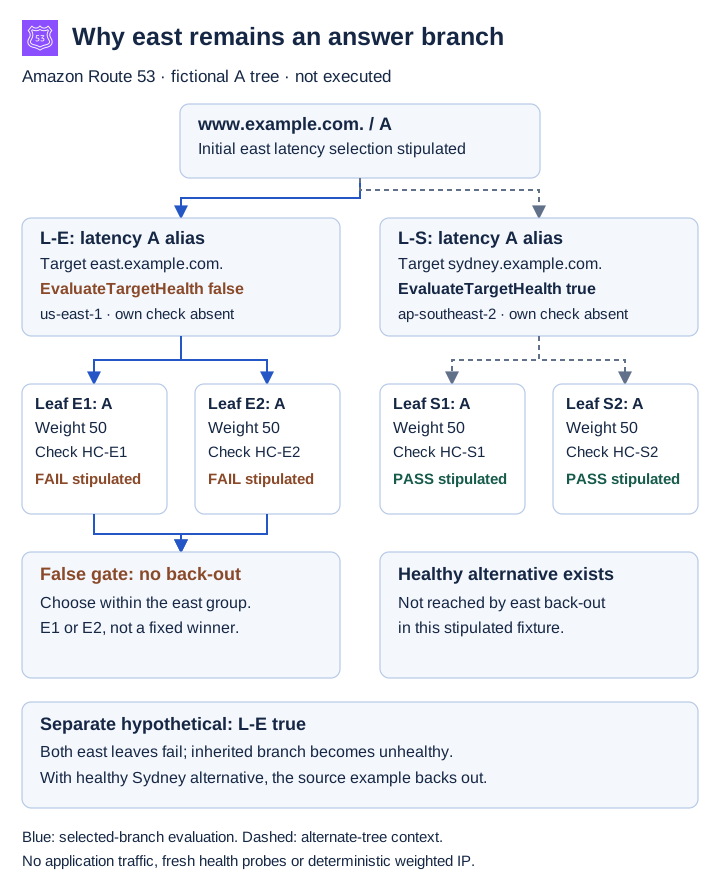
*Record-evaluation example, not a deployed topology or AWS result. The alternate branch is visible context, not a second selected answer. All four leaves have checks; an absent check is a different fixture. The main example contains no PRIMARY or SECONDARY policy node.*
Changing the east flag to true is a separate hypothetical comparison, not a recommended live fix. With all east leaves unhealthy and a healthy alternative, the documented example backs out. The actual system still needs its full configuration and signal evidence. A change proposal must consider the intended health contract and pass the team's separate authorization process.
Distinguish missing checks, parent vetoes and fallback
With inherited health enabled in the same latency tree, a weighted non-alias leaf with no check is considered healthy, not observed healthy. If its sibling fails, the unchecked leaf can explain why the branch remains usable for answer selection. A denied configuration read does not establish that the check is absent.
An alias can also have its own check. Where its own check and inherited target health are both configured, failover alias guidance requires both gates to pass. In a separate latency fixture with a healthy alternate branch, a failing parent check vetoes otherwise healthy leaves. Do not apply that ordinary exclusion statement to an all-unhealthy group without examining the fallback exception.
The grouping level matters. The record-selection reference documents fallback when no record in a queried group is healthy. But an alias inheriting health from an all-nonzero weighted group is itself unhealthy when no member is healthy. Directly querying the weighted group and evaluating the parent alias are not interchangeable observations. Health checks run periodically; a DNS query uses health status rather than launching a fresh endpoint probe.
Now consider a different valid fixture: status.example.com. A has exactly one PRIMARY alias and one SECONDARY alias, both target-health flags true. Each targets a distinct simple non-alias A record in the same zone, with a failing endpoint check. Both parent aliases also have their own failing checks, mapped to their corresponding endpoints. Both parents therefore have failing own and inherited health. Documented failover fallback returns the primary's applicable value when both primary and secondary are unhealthy. It is a fallback answer, not a healthy destination guarantee.
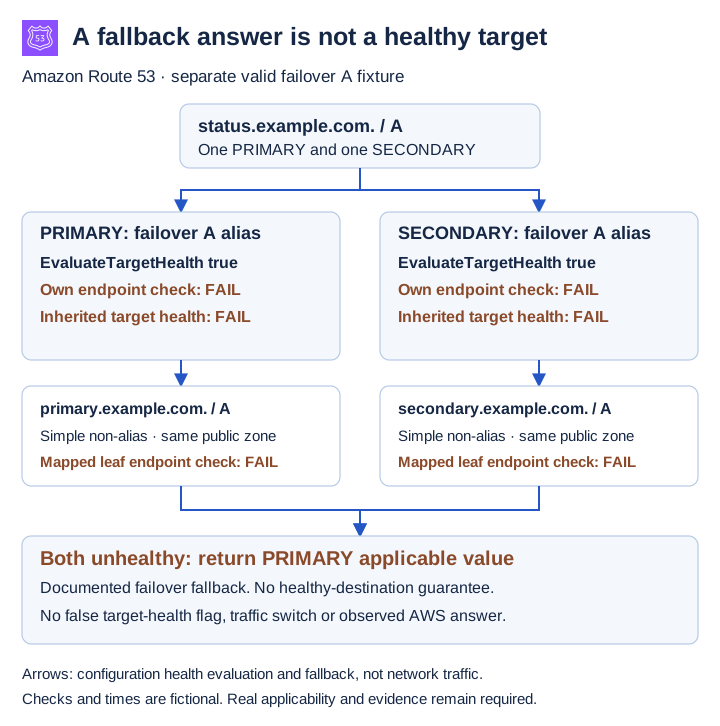
*Separate policy, separate fixture. Both true flags and explicit checks make the health assumptions visible. Red health observations do not imply an empty DNS response. This diagram is answer evaluation, not a traffic-transfer instruction.*
Do not turn these examples into a rule that every unhealthy record disappears. Also do not treat weight zero as equivalent to weight 50: AWS documents additional zero-weight selection behavior. The equal, nonzero fixture deliberately excludes it. Use the exact group's policy and inputs, or keep the expectation unresolved.
An ALB or NLB needs every associated target group
If an alias targets an Application Load Balancer or Network Load Balancer with target-health evaluation true, use the aggregate documented in AliasTarget. Every associated target group containing targets must have at least one healthy target. A group containing only unhealthy targets makes the aggregate unhealthy. An associated group with no registered targets is unhealthy too.
For a fictional two-group load balancer, a healthy target in web does not rescue an empty jobs group. A single healthy default group is insufficient evidence when the associated-group inventory is incomplete. Keep the exact load-balancer type, ARN, appropriate A/AAAA DNS target, canonical hosted-zone ID, group associations, target states and capture times together.
| Fictional associated groups | Target-health aggregate |
|---|---|
web: one healthy, one unhealthy; jobs: one healthy | Healthy under this stated aggregate rule |
web: one healthy; jobs: registered targets, all unhealthy | Unhealthy |
web: one healthy; jobs: no registered targets | Unhealthy |
web: one healthy; jobs: read denied or association unknown | UNKNOWN, not healthy and not proven empty |
These are classifications, not observed ELB outcomes. ELB's target checks are not Route 53 endpoint checks. AWS advises against creating Route 53 checks for the instances registered with an ELB load balancer. Do not interpret this aggregate as a complete model of ELB data-plane fail-open, per-AZ DNS or connection behavior. ARC zonal shift needs a separate operational rehearsal and recovery evidence; the alias classification here does not authorize it.
Keep family, endpoint and historical gaps visible
An A observation cannot establish the AAAA tree, its eligible target or the response from an IPv6 client. Alias support depends on the resource and its actual IP configuration. The common alias-values guide explains target-specific values and console listing behavior. A missing target in a list can reflect different accounts, missing listing access or an unsupported record type, not a nonexistent resource.
Map each check to its actual endpoint, protocol, port and applicable request configuration. Route 53 does not automatically check the IP value in the associated record. A passing check against another endpoint is not evidence for this leaf. The primary guidance warns against associating a domain-name check whose domain is the same as the record name being checked; do not create a self-referential check while collecting evidence.
Use two timelines: configuration captures and health/answer observations. A current false flag does not prove it was false at incident time. A target health report captured later cannot establish its earlier state without retained evidence. Keep observation time, timezone, source and uncertainty on every row. A resolver answer is not automatically an authoritative answer; the DNS caching article owns that separate boundary.
Reuse approved exports before requesting more access. The DNS owner supplies the dated record/check configuration, the load-balancer owner supplies associated-group evidence where needed, and the observer supplies the query record. These roles are proposed responsibilities, not people who reviewed this example. Permission denial means UNKNOWN and an owned next evidence request. Do not expand permissions or create checks as an incidental diagnostic step.
Complete one populated decision worksheet
The following packet is entirely fictional. Times are illustrative UTC labels, not retained AWS observations. Z-FIXTURE and check IDs are analyst labels, not runnable resource identifiers. Documentation-range addresses and example.com names identify no customer.
Packet: SW10-A; NOT EXECUTED; configuration-level assessment only
Query: www.example.com. / A
Zone: Z-FIXTURE; public; all record-to-record links stay in this zone
Configuration label: fixture-config at 2026-10-07 10:00 UTC
Signal label: fixture-signals at 2026-10-07 10:01 UTC
Selector premise: us-east-1 latency branch initially selected
Parent L-E: www.example.com. / A / latency / set east / Region us-east-1
L-E alias target: east.example.com. / Z-FIXTURE; EvaluateTargetHealth false
L-E own HealthCheckId: absent in stipulated fixture; not a denied read
Parent L-S: www.example.com. / A / latency / set sydney / Region ap-southeast-2
L-S alias target: sydney.example.com. / Z-FIXTURE; EvaluateTargetHealth true
L-S own HealthCheckId: absent in stipulated fixture
Leaf E1: east.example.com. / A / weighted / set e1 / weight 50 / TTL 60
E1 answer: 192.0.2.11; HealthCheckId HC-E1; stipulated FAIL
E1 check endpoint: 192.0.2.11 / HTTP / port 80 / path /health
Leaf E2: east.example.com. / A / weighted / set e2 / weight 50 / TTL 60
E2 answer: 192.0.2.12; HealthCheckId HC-E2; stipulated FAIL
E2 check endpoint: 192.0.2.12 / HTTP / port 80 / path /health
Leaf S1: sydney.example.com. / A / weighted / set s1 / weight 50 / TTL 60
S1 answer: 198.51.100.11; HealthCheckId HC-S1; stipulated PASS
S1 check endpoint: 198.51.100.11 / HTTP / port 80 / path /health
Leaf S2: sydney.example.com. / A / weighted / set s2 / weight 50 / TTL 60
S2 answer: 198.51.100.12; HealthCheckId HC-S2; stipulated PASS
S2 check endpoint: 198.51.100.12 / HTTP / port 80 / path /health
First relevant gate: L-E EvaluateTargetHealth false
Source rule: complex-configs, false target-health latency branch example
Expected decision: remain in east branch; weighted choice is unspecified
Possible answer set for this premise: 192.0.2.11 or 192.0.2.12
Actual answer / status / authoritative or recursive vantage: UNKNOWN
AAAA configuration and observation: UNKNOWN; not assessed from A
Incident-time configuration and signals: UNKNOWN; fixture is not history
Mismatch: none observed because no actual query was executed
Competing explanation for a real incident: cache or historical configuration gap
Next evidence owner: DNS owner, then observer for correctly labeled answer
Next evidence: dated real record tree, mapped checks and same-window observation
Change proposal: none authorized; no flag or health check was changed
The packet localizes a documented explanation without declaring an incident root cause. For a real case, replace stipulated signal fields with evidence references and retain any missing history as UNKNOWN. Do not copy public teaching endpoints into a production check. A populated record should make another operator able to challenge the exact premise, not simply agree that DNS looked wrong.
Use a separate node row for every record and a separate observation row for each family and vantage. This blank record is a proposed reader artifact, not an execution command or change request:
Packet / analyst role / assessment time / evidence classification:
Query name / type / response status / answer / timestamp / uncertainty:
Observation source / authoritative or recursive vantage / evidence reference:
Node key: zone / normalized name / type / policy / SetIdentifier:
Parent node / target class / target DNSName / target HostedZoneId:
Selector inputs: Region, weight or failover role, as applicable:
EvaluateTargetHealth / own HealthCheckId / absent versus denied versus unknown:
Check endpoint / protocol / port / path / configuration evidence time:
Leaf or associated-group signal / state / capture time / evidence reference:
Configuration at incident time / signal coverage at that time / gaps:
Applicability rule / own gate / inherited gate / expected eligibility:
Group fallback rule / possible answer set / unsupported deterministic claims:
Observed versus expected difference / first relevant gate / alternatives:
Family not examined / permission gaps / evidence owner / required next readback:
Change proposal, if any / separate approver / accepted diagnostic limitations:
Stop at the boundary the evidence supports
The DNS failover overview distinguishes simple groups from complex trees. It does not override the specific fallback or target contract. Do not generalize this A-record trace into private-zone reachability, multivalue aliases, Traffic Flow-managed changes, a CNAME chain, calculated/alarm checks or every routing policy.
CloudFront does not permit target-health evaluation true. For API Gateway, S3 and interface endpoint aliases, current API guidance describes no operational benefit from that flag and recommends application-focused health checks for failover. Those boundaries are reasons to recheck applicability, not permission to attach the latency example to a different resource.
Your next action is to complete one node row for the observed name/type and identify its first relevant gate or missing evidence. If answer eligibility explains the result, submit a separate owned change proposal only if the intended contract needs correction. If authoritative answers match the contract but clients do not recover, hand the evidence to the DNS rehearsal owner. If data authority or destination readiness is unresolved, use the topology and recovery playbook. A reliability review can help scope that handoff. An answer-selection diagnosis never authorizes writer promotion, traffic mutation or replay of uncertain business effects.
Related resources
DNS Failover Is Not Instant Client Recovery
Test endpoint changes across authoritative DNS, recursive caches, runtime resolution and connection reuse. Measure client recovery instead of assuming TTL is an SLA.
Rehearse DNS Failover and Client Recovery
Measure DNS failover through resolver caches, connection reuse and an accepted business operation. Keep authoritative propagation, client recovery and safe reversal as separate evidence in a bounded rehearsal.
Multi-Region vs Multi-AZ: A Practical Guide
Choose multi-AZ or multi-region from user objectives, failure scenarios, data rules, and tested failover, then define safe recovery and failback.