Why RDS Proxy Is Not Reducing Connections as Expected
Distinguish session pinning, long transactions, backend limits and churn before changing an RDS Proxy workload. Includes engine-aware evidence and a proposed...
If RDS Proxy has nearly as many backend connections as client connections, session pinning is one explanation, not a diagnosis. A busy transaction, idle backend inventory, a connection ceiling or repeated connection setup can produce a different problem. Compare the deployed connection path, session operations and matching metrics before changing the application.
Pinning is also a correctness mechanism. Removing the operation that triggers it can change the state a later query expects. A smaller connection graph is not an acceptable result if the application now reads the wrong schema or shares state incorrectly.
This article is for application and database owners investigating an existing Amazon RDS Proxy workload. It supplies a diagnostic record and a proposed isolated test, not a production change command. No AWS account, proxy or application was tested for this article. Vendor behavior was checked against current primary sources on 7 October 2026.
1. Identify which connection lifecycle is failing
Separate the client session between the application and proxy from the backend connection between the proxy and database. AWS's proxy concepts describe transaction-level reuse: a backend can return to the pool when safe after a transaction. With pinning, a client remains associated with a backend until its session ends.
An application pool releasing a client to its own idle list does not necessarily end that client session. Nor does a transaction commit necessarily make a pinned backend available to another session. Review the driver's actual checkout, reset and close behavior. The useful observation is the lifecycle boundary reached, not the method name a wrapper calls.
Before interpreting a chart, record account, Region, proxy identity, endpoint, target group and target. Record engine family, exact database version, driver and framework versions, wire protocol, authentication path and relevant proxy settings. Distinguish RDS from Aurora and writer from reader endpoints. This article's fixture uses RDS for PostgreSQL through a writer proxy endpoint; it does not establish identical behavior for another engine or deployment.
Verify that the observed application actually uses that endpoint. A direct database connection bypasses proxy metrics. A diagnostic result from a newly launched worker may not explain older processes holding different pool settings. Use the existing fleet connection-budget article to inventory those owners; this article addresses the separate proxy reuse boundary.
2. Treat pinning triggers as engine-specific evidence
AWS's pinning reference lists different triggers and tracked settings by engine. Do not apply a MySQL exception to PostgreSQL or classify every prepared statement identically.
| Observed operation | Diagnostic consequence |
|---|---|
PostgreSQL SQL SET, temporary objects or SQL PREPARE | Check the documented PostgreSQL pinning condition and its workload use |
| MySQL/MariaDB session-variable changes | Some values are tracked; others pin. Inspect the exact operation, scope and engine |
| Statement text larger than 16 KB | AWS lists this as a pinning condition across engine families |
PostgreSQL protocol-level prepared statements need particular care. AWS added multiplexing for Extended Query Protocol, distinguishing tracked protocol messages from SQL-level PREPARE, DISCARD, DEALLOCATE and EXECUTE, which still pin. Do not disable parameterized queries or abandon safe query binding because an old article says all prepared statements pin. Inspect what the deployed client sends, with credentials and parameter values removed.
A reset operation can also be the trigger. AWS's workload considerations specifically warn that PostgreSQL pool reset using DISCARD ALL can pin the client connection on release. A reset intended to help pooling can therefore reduce proxy reuse. Removing it without understanding the state it clears is not a safe fix.
Ask the application owner to explain what state each suspect operation establishes, who relies on it and when it must be cleared. If that contract is unknown, the right output is a missing correctness requirement, not an instruction to force multiplexing.
3. Read a small, compatible metric set
Use AWS's metric reference. This comparison uses one-minute periods, ProxyName and the recommended statistics:
| Metric | Statistic | What it measures |
|---|---|---|
ClientConnections | Sum | Current clients, including setup |
DatabaseConnections | Sum | Current backends, including setup |
DatabaseConnectionsCurrentlySessionPinned | Sum | Session-pinned backends |
DatabaseConnectionsCurrentlyInTransaction | Sum | Backends in transactions |
DatabaseConnectionsCurrentlyBorrowed | Sum | Borrowed backends |
MaxDatabaseConnectionsAllowed | Sum | Allowed backend maximum |
DatabaseConnectionsBorrowLatency | Average | Borrow time in microseconds |
Dimension compatibility matters. Pinned-backend metrics support proxy/target/target-role sets, not ProxyName, EndpointName; borrow latency supports proxy or endpoint sets. Compare aligned scopes, not an endpoint numerator against a whole-proxy denominator. AWS publishes across underlying proxy instances, so use its aggregation guidance. PostgreSQL Extended Protocol traffic is excluded from the documented query-request and query-latency metrics; absence there is not absence of traffic.
Keep timestamp, period, statistic, dimensions and units beside exported series. A current-count gauge is not a count of unique business operations. Do not add a day's pinned samples and call the total pinned sessions. A ratio built from compatible samples is an observation aid, not a universal success threshold.
Compare offered application work, deadline completions, local acquisition waiting and transaction duration separately. A flat proxy count can coexist with a growing queue. An average borrow time can hide brief delays. The packet needs the application's outcomes to explain whether the symptom matters.
4. Keep competing explanations alive
Use the observed pattern to choose the next question, not to authorize a setting change:
| Pattern in aligned evidence | Next question |
|---|---|
| Pinned backends persist between transactions | Which client/session operation establishes affinity, and is that state required? |
| Transaction occupancy rises with borrow waiting | Are transactions longer or more concurrent, including time waiting on another service? |
| Backends approach their allowed maximum | What limit and direct-consumer allowance applied during this window? |
| Connections repeatedly close and reopen | Which application/proxy lifecycle or setup failure explains the churn? |
| Database metadata exceeds proxy counts | Which direct or internal consumers are outside this proxy scope? |
AWS's configuration guidance distinguishes MaxConnectionsPercent, idle backend retention and idle client timeout. Its database metadata can include consumers outside proxy counts. A pool can also remain below its allowed maximum. None of those states establishes session pinning by itself.
Capture the settings that applied at incident time, not just today's readback. Keep any changed database connection limit, deployment or timeout in the timeline. A larger backend ceiling may reduce waiting while leaving affinity unchanged. A shorter client idle timeout can create reconnect churn or interrupt an expected pause. This article proposes no universal percentage or timeout.
If the incident includes failover or uncertain committed writes, use the connection-recovery article. Pinning diagnosis cannot determine whether an interrupted business operation completed.
5. Compare transaction reuse with session affinity
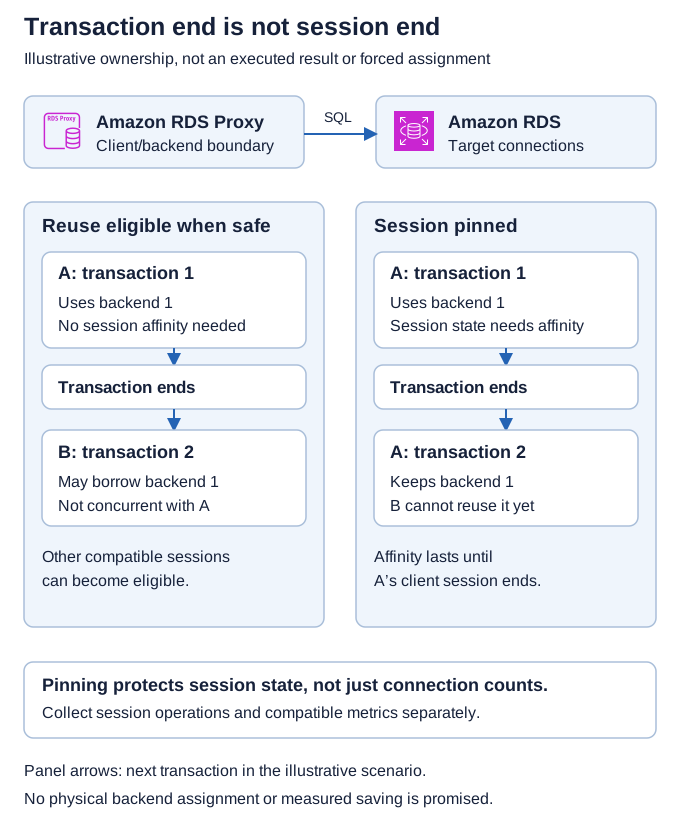
Ownership comparison, not a network topology or executed result. Blue arrows show the next transaction in each scenario, not concurrent access to one backend. Reuse is eligible only when safe; backend selection is not guaranteed. Metrics and session-operation evidence must be collected separately.
The comparison explains why a quiet pinned session can matter even when no transaction is active. The engineering decision is whether the required state can be represented safely without that affinity. If not, account for the resulting backend occupancy rather than labelling every pinned connection a defect.
6. Propose a two-client test with a correctness control
Use an approved isolated RDS for PostgreSQL target and proxy with synthetic data only. Keep the deployed engine, protocol and pool behavior representative. Assign an application owner, database operator, finite duration and maximum spend. This is a proposed test specification, not a completed reproduction or a guarantee of visible metric movement with two clients.
Create two client sessions, A and B, with the same reviewed database role and compatible defaults. In the baseline, each performs a bounded transaction returning a known synthetic value, then ends the transaction while keeping its session open. Inspect initialization and reset behavior first; if the baseline already sends another pinning operation, that confound must be recorded or isolated before attributing a difference to the candidate. Do not require the proxy to assign the same backend to both; verify successful results and record observed occupancy.
For the suspect case, have A set a harmless session-level marker such as a reviewed application_name value using SQL SET, then perform two separated transactions that read its own marker. B reads its expected default marker separately. The test owner verifies that the selected marker and permissions are appropriate for that engine/version. No customer identifier belongs in it.
The expected contract is that A's required state survives its transaction boundary and B does not inherit it. Record session-pinned and transaction gauges, client lifecycle events and exact result values. Keep A's session open for the agreed bounded observation interval, then close that isolated client through its normal driver path. Do not terminate production sessions to create a metric drop.
| Test control | Required evidence |
|---|---|
| No suspect operation | Known results, observed session/transaction lifecycle and baseline metrics |
| A performs the reviewed session operation | A retains intended state; B remains isolated; any pinning observation is recorded |
| Only the candidate operation changes | Equivalent offered work and no unreviewed reset, protocol or pool changes |
| A's test session ends | Driver close readback and subsequent observations, without promising immediate sample changes |
CloudWatch aggregation and background connections can hide a small fixture's effect. If the service metric cannot distinguish the test, report that instrumentation limit rather than inventing a zero or increasing load without approval. A rise in pinning aligned with the operation supports the hypothesis; a conflicting result requires checking other triggers and scope.
7. Change only after identifying the state contract
A candidate might remove an unnecessary session operation or change the way common initialization is supplied. That is a separate implementation decision with compatibility tests. Preserve the prior application configuration and expected result set before testing it. Check error, cancellation and client-return paths as well as a successful query.
Do not turn off pinning merely to lower a gauge. The RDS Proxy limitations state that PostgreSQL does not support session pinning filters. Other engine-specific filter choices still need proof that session state cannot leak or change required behavior. This diagnosis does not supply a filter change.
Optional proxy/debug or SQL logging is also a change. Obtain privacy, retention and cost approval before collecting query text. Use sanitized operation names where possible; do not capture credentials, customer SQL parameters or session tokens in a shared packet. AWS's metric reference describes proxy troubleshooting logs as human-oriented with a changeable format, so avoid treating a log-string parser as a stable API.
Stop the candidate test for incorrect results, state leakage, increased deadline failures, retry amplification, resource mismatch or exceeded budget. Reversal restores the reviewed configuration, not committed writes or external effects. Re-run the same correctness controls after reversal if state handling changed.
8. Finish with a bounded explanation
Retain this compact record with the application and database owners:
Account / Region / proxy / endpoint / target:
Engine/version / driver/version / protocol / auth path:
Incident window / offered work / deadline completion:
Metric names / dimensions / statistic / period / units:
Session operation / expected state / lifecycle boundary:
Competing explanation / missing evidence:
Synthetic test scope / budget / result (or NOT EXECUTED):
Candidate / correctness controls / stop and reversal limits:
Decision owner / next observation:
The next action is to select one affected application path and compare its session lifecycle with a compatible pinned-backend series. If pinning is supported by the evidence, explain the state that requires it before proposing a change. If it is not, follow the transaction, ceiling or churn evidence instead. The proposed test has not been executed, and this article does not claim an achieved connection reduction or savings outcome.
Related resources
Local Connection Pools Can Exceed the Database Fleet Budget
Count database connections across processes, replicas and deployment overlap. Separate application pools, proxy backends and query capacity before scaling.
Why Connection Pools Matter During Database Failover
Review RDS failover beyond database availability: stale pooled sessions, interrupted transactions, bounded reconnection and evidence of application recovery.