Why an Empty CloudTrail Event History Cannot Rule Out an S3 GetObject
Separate management-only Event history, historical S3 data-event coverage, denied evidence reads and completed empty searches before claiming an object was not read.
An empty CloudTrail Event history does not rule out an S3 GetObject. Event history shows management events; an object read is a data event. First find an already-approved source that could have collected the requested data activity, then establish its historical coverage and complete the search. If that evidence is missing, report the gap rather than “no access.” See AWS's Event history limits and S3 event classification.
This article helps platform and security operators interpret one general-purpose S3 bucket's GetObject evidence. It is not a logging setup guide, a policy-denial diagnosis or an instruction to query sensitive production records. All packets below are fictional and unexecuted. No AWS account, API, object or customer incident was tested. Sources were checked October 7, 2026.
1. Write the object question, not just the username
“Did someone read the report?” is not yet a reproducible search. Identify the bucket owner, requester account or role when known, ordinary bucket access path, object key and version if relevant, requested action and time interval. Use UTC with the original timestamp source. A local application timestamp and CloudTrail's event timestamp are different observations; retain their uncertainty instead of assuming exact equality.
Record the Region where the request was made and the Region/account context of the selected evidence. A central log archive account is a storage location, not necessarily the account whose activity is being investigated. The record schema defines eventTime, awsRegion, userIdentity, eventName, requestID and eventID. Preserve applicable fields and gaps, not a single display name copied from a console column.
Define the claim's extent before looking for a zero. Is it one named request, one principal's activity or every read of a version during a period? A conclusion about one attempt cannot answer the other two questions. If object identity, access path or time is uncertain, keep the question provisional and ask its owner to resolve the ambiguity.
2. Reject the management-history surface for this data-event question
Event history covers the last 90 days of management events in one account and Region. It is separate from trails and event data stores. Its console search permits one attribute filter plus a time range, not an organization-wide multi-field audit. Increasing the time range or repeating a GetObject search cannot add data events to that surface. These are documented Event history boundaries, not an inference from an empty screenshot.
S3 configuration changes and object activity are different evidence classes. A bucket-policy change may explain why access became possible, but it does not establish whether a particular object read happened. Likewise, seeing recent bucket events is not a positive collection check for GetObject.
For this ordinary S3 path, AWS identifies GetObject under data events for AWS::S3::Object. Directory buckets and access points have separately documented resource types and behavior; they are outside this article's worksheet. Do not turn the shorthand “S3 event” into a universal selector. See S3's supported event/resource types.
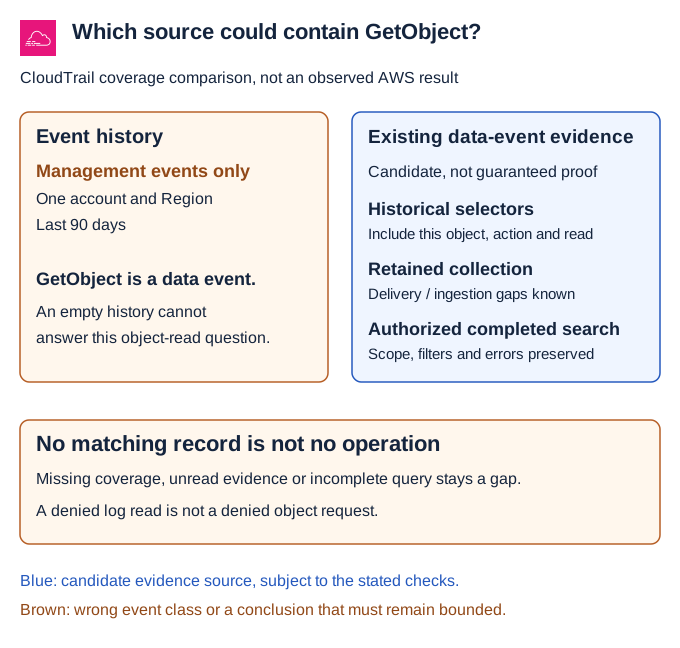
Coverage comparison, not a traffic diagram or observed AWS result. A candidate source still needs historical collection and query evidence. Neither an empty result nor a denied evidence read establishes that no object operation occurred.
Open the full-size coverage comparison
3. Find existing collection and preserve its historical scope
Identify a retained trail-log export or an existing event data store whose configuration could include the action. Use the authorized organization's evidence path rather than creating another collector. Trails and event data stores do not log data events by default, and collecting them incurs additional charges. AWS describes resource/action filtering in its data-event logging guide.
Examine the actual selectors, including read versus write, resource type, object prefix or ARN conditions, action filters and exclusions. A selector limited to writes is not coverage for reads. A selector for one prefix is not coverage for the entire bucket. A multi-Region trail label alone cannot overcome a selector that excludes the object.
GetEventSelectors describes a trail's configured selectors. It is not the corresponding inspection operation for an event data store, and a current readback does not tell you which settings applied last week. Obtain the appropriate existing configuration and change evidence for the selected collector. If configuration history is unavailable, mark historical coverage UNKNOWN rather than substituting today's screenshot.
Enabling data-event collection now does not reconstruct an uncollected request. Importing or inspecting already-retained records is a different task and needs evidence that those records exist. Assign prospective logging improvement separately, with an owner for selection, retention, access and costs. Do not modify selectors merely to make this diagnostic worksheet look complete.
4. Distinguish collected, delivered, retained and readable
A matching selector is necessary evidence, not a receipt that every relevant record reached the selected query source. Preserve collection start/stop and configuration changes, delivery/ingestion gaps, available retained partitions and the inspected period. A recent record is a useful spot check but not proof of continuous historical coverage.
For trails, GetTrailStatus exposes current logging state, recent delivery times and delivery errors. Those are dated diagnostic signals, not an exhaustive historical-health certificate. Event data stores need their own applicable ingestion/retention evidence. Never copy trail-status assumptions onto a different source type.
Now separate two denials. An investigator denied access to a log object, query service or encryption key has an unsuccessful evidence read. A retained GetObject event reporting AccessDenied concerns the object request. Neither is a successful read of the report. Preserve which action was denied and the request/error reference; do not let a tool turn an exception into an empty result.
Cross-account coverage also needs qualification. AWS's S3 integration guide notes access-denied cases where entries are redacted or omitted. Do not promise a complete denied-attempt ledger merely because caller and owner logging were configured. A missing record cannot establish permission was granted or an attempt never happened.
5. Finish the authorized search before interpreting matches
Use the admitted source and scope, preserving the exact filter/query text or approved export selection. Keep resource/account/Region restrictions, action, timestamp field, interval endpoints and identity matching visible. A role-session display name alone may not represent all activity by the identity the review intends to cover.
Capture query completion, all relevant pages or partitions, errors, capture time and the selected source revision. If a query is still running, a page is unconsumed or a retained partition cannot be read, report INCOMPLETE or UNKNOWN. Do not merge that branch into a zero-match total. Querying an existing store can still consume resources or incur charges; remain within approved access and budget.
For a returned event, distinguish the recorded API action from the application's useful outcome. GetObject evidence does not prove the application decoded the file, displayed it to a person or stored every byte. The CloudTrail record schema documents optional error fields and says read-only APIs have null responseElements; null is not a failed-operation test. Inspect the applicable error and request context, and correlate with approved application evidence when the claim requires it.
6. Work a fictional evidence packet
Suppose a service owner asks about reports/monthly.csv in a general-purpose bucket, for October 6 from 10:00 to 10:15 UTC. Account aliases Atlas (bucket owner) and Birch (requester) replace identifiers. All rows are stipulated interpretations, not AWS responses. No collection, query, permission check or object read was executed.
| Packet | Stipulated evidence | Supported disposition |
|---|---|---|
| A: wrong surface | Atlas Event history returns zero GetObject matches | Wrong event class. It cannot answer this data-event question. |
| B: wrong scope | A data-event export covers another Region or a different object prefix | Scope mismatch. Resolve the intended source and filter before interpreting counts. |
| C: excluded read | Historical selector record includes writes only throughout the interval | Selected collector did not cover this action. No inference about whether a read occurred. |
| D: denied evidence | Investigator's retained-log read fails authorization | Evidence inaccessible. Preserve the failure and ask the evidence owner; not zero events. |
| E: completed empty | Admitted historical scope, retained interval and completed authorized query; no matching records | No matching record in this bounded inspected source. Not proof of no operation. |
| F: denied object attempt | Matching retained event identifies the request and reports AccessDenied | Evidence of that denied attempt, not a successful read or proof about every attempt. |
| G: local cancellation | For one named job, retained client fixture says cancellation occurred before request dispatch | Supports no dispatch by that specific fixture attempt, subject to its evidence quality. Does not rule out other requests. |
Packet G illustrates why evidence for “did not occur” must come from the defined operation boundary, not a log-table zero. It is an invented client fixture, not an AWS guarantee that all pre-dispatch failures are observable. In real use, retries, multiple workers or another caller can invalidate an attempt-level negative if the owner silently broadens it to the whole interval.
If packet E includes an unexamined cross-account denied-attempt limitation, preserve it alongside the bounded result. Accepting a search packet means its reported scope is reproducible, not that the audit source is exhaustive. A reviewer should be able to name the excluded account, prefix or unread interval without guessing.
7. Copy a blank evidence record
Keep the original evidence in approved restricted storage. Bucket names, keys, identity/session information and request records can disclose sensitive operations. Share aliases and references where sufficient; never paste credentials or full customer objects into this record.
Record ID / question owner / checked date:
Claim: one attempt, principal activity or all reads in a period:
Bucket owner / requester account and principal / access path:
Bucket / key / version when relevant / expected action:
Request Region / source account and Region / timestamp source:
UTC interval / endpoint semantics / clock uncertainty:
Source kind / trail or store identity / approved export reference:
Historical selector revision / resource and action inclusion:
Read/write selection / exclusions / coverage UNKNOWN intervals:
Collection start-stop / delivery-ingestion / retained partitions:
Observer authority / evidence-read failure and error reference:
Exact query or filter / completion / pages-partitions / capture:
Matched event IDs / request IDs / error fields / correlation:
Result: wrong surface, gap, inaccessible, incomplete or bounded matches:
Supported statement / explicit non-claims / source limitations:
Missing evidence / accountable owner / next authorized read:
Prospective collection change: separate approval, not executed here:
Leave unknown fields unknown. Do not populate them with packet E's fictional acceptance assumptions. The useful handoff might be “selector history missing, logging owner to provide the revision for 10:00–10:15 UTC,” not a new dashboard.
8. Close the question without expanding authority
Stop when scope, historical configuration, retained availability or read authority cannot be established within the approved investigation. Route the exact missing input to its owner. Do not grant yourself log/key access, start a new query beyond budget, turn on data events or issue a real GetObject as an incidental validation test.
For a local interpretation rehearsal, ask another reviewer to classify packets A–G and explain why D differs from F and why E differs from G. These are proposed educational checks, not AWS execution tests. Operational verification would need separate authority and resulting-state evidence.
Start with the screenshot's event class and one resource/time question. Produce either a reproducible bounded search statement or an owned evidence gap. The security hardening playbook owns later control implementation and verification; the observability investigation article owns application signal design. Neither should be commissioned as a substitute for first checking whether the inspected CloudTrail surface could contain the requested event.