IAM Roles Anywhere: Certificate Withdrawal and Session Evidence
Review IAM Roles Anywhere withdrawal with imported CRL, trust-anchor and profile evidence. Separate new session rejection, old access and helper exposure.
Primary sources checked
Decide which withdrawal claim the evidence can support
A certificate authority's revocation decision does not, by itself, establish that IAM Roles Anywhere rejects another credential request. The service documents certificate revocation through imported certificate revocation lists (CRLs), without callbacks to certificate distribution points or OCSP endpoints. Separately, credentials already issued need their own resource-authorization review. Keep those decisions apart when closing a withdrawal ticket. See the Roles Anywhere trust model.
This guide produces a bounded withdrawal record for one certificate-authenticated workload: the certificate and issuing CA, associated trust anchor, selected profile and role, relevant imported CRL, newly attempted session issuance, an already-issued session and one harmless resource observation. It also records where a helper exposes credentials locally. The result can be a supported new-issuance restriction, an unresolved older-session question or a rejection of the proposed closure claim.
The scenario is synthetic. No AWS account was inspected, certificate imported, credential requested, helper started or resource operation executed while preparing this guide. The matrices describe proposed evidence relationships and stipulated outcomes, not measured AWS timing or a completed security exercise. They contain no real identifiers or credential material.
Generic workload-identity migration, SDK provider precedence and organization-wide credential retirement remain with their existing owners. This guide is for the Roles Anywhere-specific gap between a CA decision, the service's revocation/configuration state and use of temporary credentials. Cross-account role chains, multiple issuing hierarchies, certificate issuance design and active forensic collection require additional scope.
Identify the issuance path before changing it
A valid certificate is only part of the request path. Record the exact account and Region, certificate issuer and serial, trust-anchor ARN, profile ARN, target role ARN and the process that uses them. Use restricted aliases in a broadly shared review; keep exact identifiers in the approved evidence store. A common name alone is not a unique certificate reference.
CreateSession returns temporary credentials after certificate authentication and wraps an STS AssumeRole operation. Its request identifies the trust anchor, profile and role. Its documented expiration calculation uses the profile and requested duration, with the role maximum as a separate validity constraint. Preserve the actual returned expiration safely when an authorized test is performed, rather than substituting the certificate's expiry or a default duration.
A public certificate identifier can help correlate records, but do not collect its private key, the response's secret access key or session token. Even a credential response captured for debugging creates another sensitive copy. The reviewer needs an issued-session alias, sanitized principal reference, issue/expiration observations and the approved evidence location, not a secret pasted into the change ticket.
Also inventory alternate paths without changing them. The same machine might use a different profile, another trust anchor or a non-Roles-Anywhere credential source. A rejection on the selected path says nothing about those alternatives. If they matter to the intended closure, give each an owner and its own packet instead of silently extending one test's conclusion.
Join the CA decision to the imported CRL revision
Record the CA's revocation decision as one event and the service import as another. The PKI owner should identify the issuer, affected serial, revocation reason, signed CRL revision and publication time under their approved process. An operator should then establish which CRL is associated with the reviewed trust anchor and whether the expected revision actually reached Roles Anywhere.
The ImportCrl reference documents a PEM CRL, its trust-anchor association and enabled state. The presence of a file on the CA's server or a certificate's distribution-point URL is not an import receipt. Import success is also not proof that the intended serial appears in that revision or that the enabled state is the expected one.
Use authorized readback and a controlled comparison. GetCrl returns the association, data, enabled state and update information. Retain a digest or protected reference to the reviewed material, plus evidence of the relevant issuer/serial match. Do not attach every certificate in the estate to explain one withdrawal.
A later CA decision may require a later service update. UpdateCrl can replace CRL data; its request does not contain an enabled-state field. Do not infer an enable transition from a successful data update. Record each control's actual readback rather than one status called “revocation complete.”
This guide does not establish a universal import propagation time, behavior for every stale/expired CRL, or coverage of a multi-level hierarchy. If the chosen CRL's applicability or freshness semantics are unclear, keep new-issuance closure unresolved and obtain the necessary service-specific review. Do not resolve uncertainty by assuming either fail-open or fail-closed behavior.
Review enabled trust anchors and profiles as distinct controls
The trust anchor and profile can be used to stop new issuance through a selected configuration, with different impact. DisableTrustAnchor documents that credential requests specifying a disabled anchor are unauthorized. DisableProfile documents that requests using a disabled profile fail.
An anchor may support more than the affected certificate; a profile may serve more than this process. Before a planned change, identify other consumers and decide whether the selected control has an acceptable blast radius. During suspected compromise, the incident owner may choose prompt broader containment, but it still needs a named decision and evidence of what was affected.
Represent configuration as independently recorded revisions: anchor-a revision A2, profile-p revision P3 and crl-c revision C4. A revision label in this guide is a review alias, not a vendor-provided version field. Pair the alias with dated source readback and a digest of the relevant reviewed configuration where appropriate. Do not claim the API provides an immutable configuration snapshot merely because your record has a revision column.
If a rejected request used another anchor or profile, it cannot establish the expected restriction on this one. Likewise, disabling the reviewed profile does not prove that the same certificate cannot reach a different authorized profile. Keep the conclusion attached to the exact path under test, with untested alternate-path questions visible.
Separate an older session from another CreateSession attempt
A session created before the withdrawal change may already be held by the application, another process or a copied local file. Stop assuming that its next resource request repeats certificate validation. It is a different observation from making another CreateSession call with the certificate.
IAM's temporary-permission disabling guidance explains request-time permission evaluation, policy propagation and resource-based grant considerations. An older session's allowed or denied operation must be interpreted with its actual role, policy context, target and observation time. A certificate-list change is not a complete substitute for that analysis.
Where incident response requires denying previously issued role sessions, use the authorized IAM owner's review of the role-session revocation mechanism. Its issue-time deny can affect other sessions of the role and does not replace preventing fresh issuance. This guide deliberately provides no copy-and-apply deny-all policy or role-deletion recipe.
A failed harmless read does not automatically prove the desired containment. It may reflect a missing object, transport failure, expired credentials or an unrelated resource denial. A successful read proves that the observed session still had that operation's authority at that time. Neither result establishes every resource action or reverses effects from requests already completed.
Record helper mode, selected client and local exposure
The helper command changes the local credential surface. The current credential-helper guide describes credential-process output to its caller, update-mode writes to a credential file and serve-mode local credential delivery. It warns that processes able to reach the local serve endpoint can retrieve credentials, and that readers of the update file may use its contents.
Therefore, “bound to localhost” is not proof of per-process authorization. Record the actual network namespace, reachable local principals and service supervision arrangement. For file delivery, record the approved path, ownership, access controls and backup/log handling without opening or printing credential values. For an external process, protect both the program and the configuration that selects it.
Do not repeat the helper page's comparison table as a universal refresh contract. Its opening SDK refresh explanation and credential-process table row use different framing. The SDK process-provider guide explains that the caller can rerun a configured process before returned temporary credentials expire; actual support and lifecycle depend on the client.
No helper binary, command arguments, SDK version or live refresh was inspected here. Actual refresh behavior remains unknown. A real packet must pin the executable version and digest, invocation mode and flags, application/client version, selected credential path, observation window and safely observed outcome. Stopping a helper may stop local vending or renewal on that path while leaving already-held credentials usable. It does not establish that every consuming process has discarded them.

Hypothetical withdrawal evidence. Case B stipulates a selected new-session rejection alongside an older session's allowed read. Helper shutdown is a separate scenario, not proof of credential erasure. Arrows join evidence rather than depict deployed traffic. No AWS execution is shown.
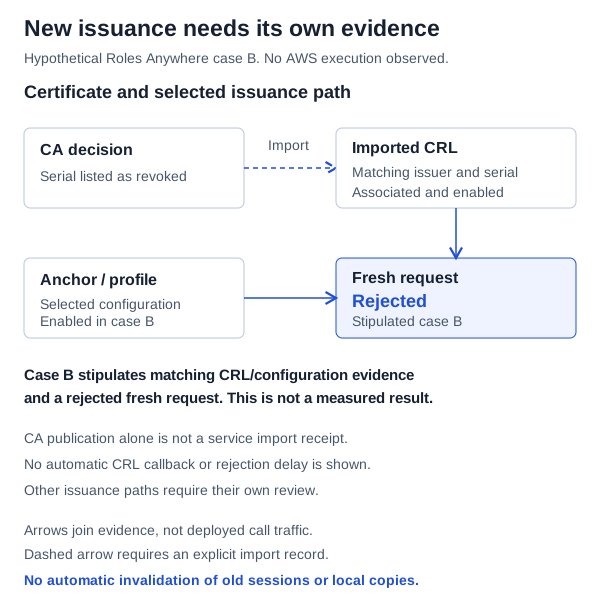
Withdrawal evidence, panel 1 of 2. Case B stipulates a rejected fresh request. CA publication alone does not establish the service's imported state or its admission result. Arrows join evidence, not deployed traffic.
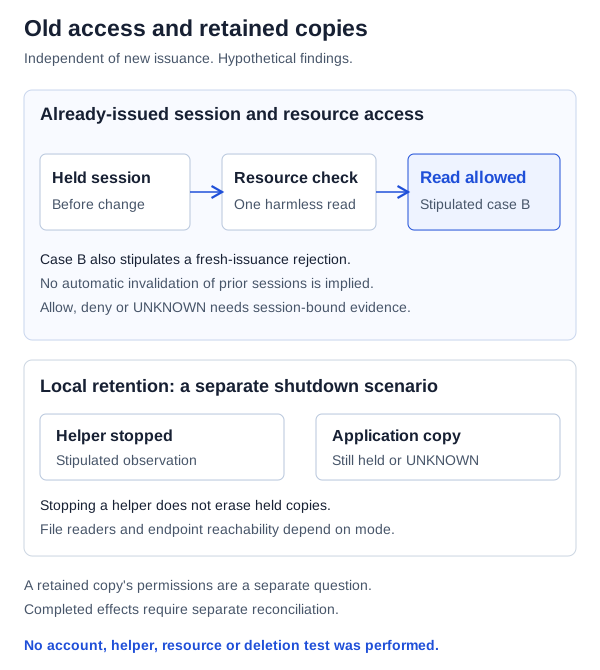
Withdrawal evidence, panel 2 of 2. Older-session access and local credential retention need separate findings. No automatic invalidation, erasure or reversal of completed effects follows from the issuance rejection.
Prepare an authorized observation with a known harmless target
Assign four responsibilities: a PKI owner for the CA decision and CRL content, a Roles Anywhere administrator for service configuration, an IAM/resource owner for existing-session authorization and an application/host owner for helper and process evidence. One person may hold several responsibilities, but the permission questions remain separate.
Grant the observer only the approved reads needed for the selected resources. GetCrl requires its documented read permission. ImportCrl and UpdateCrl name separate mutation permissions; disabling an anchor or profile is another change, not a diagnostic read. The observer should not acquire broad role-policy editing rights just to fill a worksheet.
Use an isolated role/path and a test resource for rehearsal where practical. Establish the known baseline: a selected session can perform the authorized harmless operation and a fresh, correctly constructed issuance request is understood. A broken baseline can make every later failure look like successful withdrawal. Do not use a destructive operation, a customer data read or a local metadata-endpoint fetch to demonstrate exposure.
For an approved environment observation, arrange secure execution that retains required session material only inside the controlled runtime. Collect sanitized request IDs, principal/session aliases, issue/expiration metadata and outcome categories. Distinguish the process using the older session from a process silently acquiring a new one. If that binding cannot be established safely, mark the older-session result unknown.
Work a synthetic withdrawal matrix
The fictional workload batch-a uses certificate cert-a, issuer ca-a, anchor-a, profile-p and role-r in one account/Region. An older session session-old was issued before revision R1. It is stipulated to permit one harmless read of test-object-q before the changes. All labels identify invented records; there are no credentials, real ARNs or clock values to execute.
Rows below are independent scenarios branching from that baseline, not a sequence an operator should apply to production. “Reject expected” is a proposed acceptance expectation under the stated correct configuration. It is not an observed result. No row establishes a universal rejection delay.
| Case | CA and imported-list evidence | Anchor/profile evidence | New CreateSession conclusion |
|---|---|---|---|
| A | CA marks cert-a revoked; no matching service import established | A1/P1 enabled | Revocation rejection not established |
| B | C2 contains cert-a under ca-a; association and enabled readback accepted | A1/P1 enabled | Reject expected for this certificate/path |
| C | CA decision exists; imported content or enabled state is unknown | A1/P1 enabled | Hold, do not infer rejection |
| D | CRL association is anchor-other, not anchor-a | A1/P1 enabled | Hold, wrong-path evidence |
| E | CRL state unchanged | A2 records anchor-a disabled | Reject expected through anchor-a |
| F | CRL state unchanged | P2 records profile-p disabled | Reject expected through profile-p |
| G | B's issuance restriction retained | Same reviewed revisions | Fresh issuance remains a separate check |
- A
- CA and imported-list evidence: CA marks cert-a revoked; no matching service import established
- Anchor/profile evidence: A1/P1 enabled
- New CreateSession conclusion: Revocation rejection not established
- B
- CA and imported-list evidence: C2 contains cert-a under ca-a; association and enabled readback accepted
- Anchor/profile evidence: A1/P1 enabled
- New CreateSession conclusion: Reject expected for this certificate/path
- C
- CA and imported-list evidence: CA decision exists; imported content or enabled state is unknown
- Anchor/profile evidence: A1/P1 enabled
- New CreateSession conclusion: Hold, do not infer rejection
- D
- CA and imported-list evidence: CRL association is anchor-other, not anchor-a
- Anchor/profile evidence: A1/P1 enabled
- New CreateSession conclusion: Hold, wrong-path evidence
- E
- CA and imported-list evidence: CRL state unchanged
- Anchor/profile evidence: A2 records anchor-a disabled
- New CreateSession conclusion: Reject expected through anchor-a
- F
- CA and imported-list evidence: CRL state unchanged
- Anchor/profile evidence: P2 records profile-p disabled
- New CreateSession conclusion: Reject expected through profile-p
- G
- CA and imported-list evidence: B's issuance restriction retained
- Anchor/profile evidence: Same reviewed revisions
- New CreateSession conclusion: Fresh issuance remains a separate check
The second matrix joins each case to the older-session and host questions. “Allowed stipulated” is a deliberately hypothetical counterexample showing why an issuance finding cannot close resource access. It is not a claim that every old session will remain allowed.
| Case | session-old and harmless resource evidence | Helper/local exposure evidence | Defensible disposition |
|---|---|---|---|
| A | Read allowed stipulated, before recorded expiration | Process retains a session | CA decision alone does not establish withdrawal |
| B | Old read allowed stipulated; fresh-issuance rejection also stipulated | Existing copy remains in the application | New issuance restricted in this scenario; old access not closed |
| C | No bound session-old observation | Helper mode/version unknown | Hold both unobserved boundaries |
| D | Read attempt fails with a transport error; authorization outcome unknown | Another process has an unreviewed file path | Resource restriction is inconclusive; investigate separately |
| E | Older-session use not tested | Serve reachability not inspected | Anchor restriction is not proof of complete access stop |
| F | Read allowed stipulated | Update file still accessible to a permitted reader | Profile restriction leaves a separate session/exposure issue |
| G | A separately reviewed IAM/resource restriction denies the correct test read | Helper stopped, but retained copies unresolved | Only the selected resource denial is supported; copies/effects remain open |
- A
- session-old and harmless resource evidence: Read allowed stipulated, before recorded expiration
- Helper/local exposure evidence: Process retains a session
- Defensible disposition: CA decision alone does not establish withdrawal
- B
- session-old and harmless resource evidence: Old read allowed stipulated; fresh-issuance rejection also stipulated
- Helper/local exposure evidence: Existing copy remains in the application
- Defensible disposition: New issuance restricted in this scenario; old access not closed
- C
- session-old and harmless resource evidence: No bound session-old observation
- Helper/local exposure evidence: Helper mode/version unknown
- Defensible disposition: Hold both unobserved boundaries
- D
- session-old and harmless resource evidence: Read attempt fails with a transport error; authorization outcome unknown
- Helper/local exposure evidence: Another process has an unreviewed file path
- Defensible disposition: Resource restriction is inconclusive; investigate separately
- E
- session-old and harmless resource evidence: Older-session use not tested
- Helper/local exposure evidence: Serve reachability not inspected
- Defensible disposition: Anchor restriction is not proof of complete access stop
- F
- session-old and harmless resource evidence: Read allowed stipulated
- Helper/local exposure evidence: Update file still accessible to a permitted reader
- Defensible disposition: Profile restriction leaves a separate session/exposure issue
- G
- session-old and harmless resource evidence: A separately reviewed IAM/resource restriction denies the correct test read
- Helper/local exposure evidence: Helper stopped, but retained copies unresolved
- Defensible disposition: Only the selected resource denial is supported; copies/effects remain open
For B, the reviewer can accept a narrow issuance finding only after the real CRL and rejection evidence are authenticated. They must leave older access open in the same record. For G, an administrator should not equate stopping the helper with a remote-session invalidation. The two stipulated observations deliberately answer different questions.
Change one field as an offline reasoning exercise. Replace C2's anchor association with anchor-other and the intended CRL finding must hold. Remove the binding between session-old and the read and its result becomes unknown. Replace an authorization denial with a network timeout and the resource restriction becomes inconclusive. These are reasoning counterexamples, not an executable simulator or a reproduced AWS test.
Keep a reusable withdrawal record with separate findings
Use this worksheet in a restricted change or incident record. Give unknown fields an owner rather than filling them with “not applicable” for convenience. The evidence reference should let another authorized reviewer retrieve the source without exposing its secret-bearing contents.
| Field group | Record to complete |
|---|---|
| Scope and authority | Workload, account/Region, planned withdrawal or incident, decision owner and approved observation/change boundaries |
| Certificate/CA | Issuer plus serial/fingerprint reference, CA decision, signed-list revision and permitted content handling |
| Imported CRL | CRL identifier, trust-anchor association, content comparison/digest, enabled readback, collection time and unresolved freshness question |
| Anchor/profile/role | Exact restricted references, independent enabled readbacks, policy/configuration revisions, other affected consumers and alternate paths |
| New issuance | Same certificate/path binding, request time/ID, result/reason, configuration readback interval and unrelated-failure exclusions |
| Older session | Safely retained alias, issuance/expiration evidence, exact process/client binding, selected harmless resource action and actual result/reason |
| Helper and host | Binary digest/version, mode/flags, supervisor, file or endpoint boundary, local-reader/reachability review and unknown copies |
| Effective IAM/resource handling | Authorized policy owner, relevant grants/denies, propagation observation and role-wide impact review |
| Completed effects | Operations already attempted, destination readback, unknown effects and named reconciliation/compensation owner |
| Disposition and next action | Separate issuance, session, exposure and effects findings, their evidence limits and first unresolved item |
- Scope and authority
- Record to complete: Workload, account/Region, planned withdrawal or incident, decision owner and approved observation/change boundaries
- Certificate/CA
- Record to complete: Issuer plus serial/fingerprint reference, CA decision, signed-list revision and permitted content handling
- Imported CRL
- Record to complete: CRL identifier, trust-anchor association, content comparison/digest, enabled readback, collection time and unresolved freshness question
- Anchor/profile/role
- Record to complete: Exact restricted references, independent enabled readbacks, policy/configuration revisions, other affected consumers and alternate paths
- New issuance
- Record to complete: Same certificate/path binding, request time/ID, result/reason, configuration readback interval and unrelated-failure exclusions
- Older session
- Record to complete: Safely retained alias, issuance/expiration evidence, exact process/client binding, selected harmless resource action and actual result/reason
- Helper and host
- Record to complete: Binary digest/version, mode/flags, supervisor, file or endpoint boundary, local-reader/reachability review and unknown copies
- Effective IAM/resource handling
- Record to complete: Authorized policy owner, relevant grants/denies, propagation observation and role-wide impact review
- Completed effects
- Record to complete: Operations already attempted, destination readback, unknown effects and named reconciliation/compensation owner
- Disposition and next action
- Record to complete: Separate issuance, session, exposure and effects findings, their evidence limits and first unresolved item
Do not collapse the four findings into one unqualified “revoked” checkbox. A support ticket may close its PKI task while an IAM containment task remains open, but the parent incident must show that remaining work. Conversely, a properly evidenced narrow conclusion is useful even when organization-wide credential inventory is outside this review.
Choose containment and recovery without silently reopening trust
A matching CRL can target certificate-based issuance while preserving other legitimate paths, subject to the actual CA hierarchy and association. Disabling a profile or anchor can be operationally simpler but affect a wider set of consumers. Restricting an older session's resource permissions addresses a different boundary and may affect other sessions of the same role. Select the combination from the incident's risk and workload dependencies.
For planned retirement, agree the replacement identity and consumer readiness before changing the old path. For suspected compromise, prompt containment can take priority over an orderly observation period. Do not delay a needed restriction merely to complete this guide's matrix. Preserve permitted evidence and record which checks were skipped for safety.
Define stop conditions before any rehearsal: wrong account/Region, mismatched certificate/issuer, ambiguous CRL association, unexpected production target, secret-bearing output, an uncontrolled helper endpoint, broader-than-authorized consumer impact or inability to attribute a resource result. Stop the observation, protect captured material and escalate to the relevant owner. Do not broaden trust or substitute a static credential to force a passing probe.
Recovery is not simply reversing the last API call. Re-enabling an anchor/profile or replacing a CRL with an earlier list may restore a compromised certificate's issuance path. Removing an incident deny may restore authority to retained sessions. A mistaken configuration change needs a separately approved recovery revision, with its impact and acceptance evidence; suspected key compromise may require a new credential identity and host investigation instead.
A denied request cannot undo an earlier upload, secret read or external effect. The service owner must reconcile those consequences separately. Keep outcomes unknown where source data or logs cannot establish them. This guide cannot prove that no credential copy escaped, that every future request is denied or that completed effects were authorized.
Close the first unknown before expanding the conclusion
Bring one completed worksheet to the PKI, IAM and application owners. If the CA revoked a certificate but no service import is established, resolve the matching imported-list state. If fresh issuance is restricted but the older session remains usable, retain that result and request the authorized session/resource review. If helper exposure is unknown, inspect its configuration and host boundary without fetching or displaying its credentials.
For the broader choice between runtime identity, federation and a bounded exception, return to the workload-identity transition decision pack. Use the trust-policy article for generic admission restrictions and the CI retirement record for legacy consumer coverage. The EKS credential-source guide owns its pinned SDK/Pod diagnosis; its observed provider order must not be copied into an unspecified Roles Anywhere client.
Primary references
Checked on 17 October 2026. These are service and API references, not evidence that the synthetic cases occurred.
- Roles Anywhere trust model.
- Roles Anywhere CreateSession.
- ImportCrl, UpdateCrl and GetCrl.
- DisableTrustAnchor and DisableProfile.
- Credential helper and SDK process credential provider.
- Disabling temporary-credential permissions and revoking role sessions.
Related services
Cloud Security Architecture Consulting
Cloud security architecture consulting for AWS and GCP. Review IAM, network boundaries and compliance requirements, then implement agreed security controls.
Cloud Reliability Assessment & Resilience Consulting
Cloud reliability assessment covering production architecture, disaster recovery and incident readiness. Identify failure modes and prioritize resilience work.