Verify Bedrock Guardrails Before Releasing an Answer
Trace the Bedrock request, selected content, assessment and answer destinations. Use a route worksheet and bypass cases to review an application-owned release boundary.
Primary sources checked
Verify the path, not only the configured policy
A guardrail configured in the AWS console is not evidence that your application used it before releasing an answer. Trace the deployed request, selected input content, returned assessment and every destination that can receive generated output. Then test a route that deliberately omits or changes the attachment. A useful release check must detect that bypass, not only demonstrate a blocked prompt in a playground.
This guide is for the engineer who owns an existing answer endpoint and the operator who can stop its release. Its output is a reviewed route record and a proposed integration-test matrix. No AWS requests, account changes, deployments or policy evaluations were executed to prepare this guide. The worked support-assistant case is fictional, and its expected outcomes are test requirements, not measured guardrail detection results.
The scope is application-owned text answers. It does not certify a model, authorize a tool, prove legal compliance or assess every kind of multimodal output. The existing LLM guardrails playbook owns the broader validation, approval and recovery framework. Here the narrower question is whether the exact Bedrock safeguard the team relies on reaches the answer's actual release path.
Start with the answer destination, not the policy screen
Select one consequential answer class. Identify its user, permitted sources, sensitive fields and safe alternative when a required check is unavailable. List all ways that answer can leave your service: live response, history, export, notification, review queue and background completion callback. Include intermediate destinations that expose generated content to a reader, such as browser events or diagnostic dashboards accessible outside the incident team.
Follow each destination upstream to its writer. An API handler may use one inference client while a retry worker uses another. A history record may be written before the UI applies its check. An export may reconstruct the answer from a raw stream rather than the accepted message. These are different answer-release routes even when the product gives them the same name.
Give each route an owner and record the code revision that implements it. The evidence must explain which function decides release and which functions can write around it. Do not accept a diagram labelled “Guardrails enabled” as a substitute for that inspection. Equally, do not claim a bypass exists merely because there are two clients. The route record should distinguish observed calls, inferred relationships and paths that remain uninspected.
The first gate is completeness of this inventory, not a detector score. If no one can identify the notification writer, keep notification delivery outside the approved answer feature until someone inspects it. Closing the live endpoint does not stop a queued callback that still owns a delivery credential.
Pin a supported route and the version it actually uses
Bedrock exposes different endpoint surfaces and API contracts. The current endpoint comparison lists Guardrails on Runtime, not Mantle. Runtime Responses requests are synchronous, whereas background inference belongs to the Mantle surface. An endpoint name alone still does not establish support for a particular model/API combination. Consult the current endpoint and model documentation together. Bedrock endpoints.
For the fictional worked case, the candidate route is Runtime ConverseStream through https://bedrock-runtime.us-east-1.amazonaws.com, using us.anthropic.claude-haiku-4-5-20251001-v1:0. The current Haiku card lists Runtime Converse and streaming support and the US profile. This is a documentation-based candidate, not verified account entitlement. The source Region does not establish single-Region processing, so placement approval is a separate prerequisite. Haiku 4.5 model card.
Record the actual guardrail identifier, version, request configuration and the code that supplies them. The fictional record calls the intended policy revision “support-answer revision 7”; that label is not an AWS guardrail ID and cannot be pasted into a request. A real team replaces it with the identifier and numbered version returned by its own approved configuration process. AWS documents creating a version separately from editing the working draft. Create a guardrail version.
Use a deployed numbered version when the release needs reproducible policy identity. This is an application governance choice, not a claim that AWS forbids DRAFT. Compare the client request with the intended release record and, where available, the returned assessment identity. A version mismatch should hold the answer under the proposed contract even if the text looks harmless. Otherwise a configuration rollback or environment override can silently move the feature onto a different policy.
Check exceptions separately. A developer test route, a direct-provider fallback and a background summarizer do not inherit this attachment. Either define and test their independent required controls or exclude them from the approved answer class. The endpoint table cannot prove that a separate assessment call was made by your worker.
Map the assessed content instead of assuming the whole request is guarded
The Converse guide documents guardrailConfig, guardrail identifier/version, selected guardContent and response handling. It also identifies tool results, tool definitions and generated tool arguments as fields not evaluated by the configured Converse guardrail. Keep tool authorization and argument validation outside this answer-content assurance. Guardrails with Converse.
Build a field map from the exact serialized request. Name the user question, retrieved passage, conversation history, system instruction and any attachment-derived text separately. Record which policy needs which field, which fields the request selects, and which remain outside the assessment claim. Input coverage and output coverage are different observations. A successful output check does not retroactively establish that an earlier input was assessed.
The current Converse documentation has an important interpretation problem: its general selected-block warning says unwrapped content is skipped, while a later example describes a word filter evaluating unwrapped context alongside selected contextual-grounding blocks. Do not resolve that inconsistency by claiming universal exclusion or universal coverage. Record the policy-specific ambiguity and seek clarification or test the exact configuration under approved conditions before relying on the disputed behavior.
The guide's proposed conservative design explicitly submits every text field that the chosen check must assess, using the supported interface for that check. It excludes retrieved material only when another owned control and the task's risk decision justify that exclusion. Deliberate selection must be visible in the record. Selecting only the newest question because it lowers assessment cost changes the coverage claim; it is not merely an SDK optimization.
Use synthetic markers to inspect this boundary. Place an approved test marker in the question, then in a retrieved passage, then in history, without changing the release rule. Compare request serialization and native assessments. Detection is not guaranteed just because a marker appears in selected text. You need separate evidence that the field was submitted and that the configured policy handled the labelled case acceptably.
Do not confuse guardrail streaming mode with background inference
ConverseStream's configuration accepts sync or async for streamProcessingMode. Those values describe assessment relative to streaming chunks, not a durable background job or an application release policy. Preserve the API's actual value rather than copying the differently spelled configuration from an InvokeModel example. GuardrailStreamConfiguration.
AWS's streaming guide explains that synchronous processing scans buffered chunks before returning them, while asynchronous processing may return chunks before assessment completes and block subsequent chunks after detection. It also warns that asynchronous mode does not support sensitive-information masking. Neither mode by itself proves whole-answer semantic correctness. Streaming response behavior.
In the worked case, the application buffers generated answer text on the server and shows fixed progress only. Its candidate configuration uses sync, but release still waits for the application's completion, assessment and task checks. A returned scanned chunk may be incomplete, belong to a stopped attempt or contain a claim that violates the task's evidence rule. The partial-answer disclosure article owns the choice of release unit; the Bedrock stream-boundary article owns the native completion observations.
If the team wants asynchronous delivery for a low-consequence answer class, commission that as a different contract. Name the fragments that can reach readers before assessment, who accepts that residual exposure and how interrupted messages appear in history. Do not advertise masking on that path without supported evidence. Switching to faster delivery because an assessment is slow must not silently change the approved sensitive-answer feature.
For a genuine background route, inspect the completion fetcher and notification writer. A final assessment applied after inference can be an application design option, but it needs its own supported request, data handling, timeout and release controls. ApplyGuardrail is a separate operation with declared INPUT or OUTPUT source, assessment details and intervention outcomes. HTTP 200 is not synonymous with permission to publish the original candidate. ApplyGuardrail API.
Worked scenario: one support answer and its bypass
The fictional assistant answers a permitted customer question from one approved refund-policy passage. It may explain the policy and draft a response for review. It cannot issue a refund, send a customer email or change a ticket. Those actions remain unavailable independently of the model and the content filter.
The supplied policy says a refund requires an authorized operations review. The test question asks whether the refund has already been approved. The source contains no approval receipt. The accepted task response must preserve the pending review and must not invent approval. A content guardrail may not detect this business distinction, so a domain acceptance check is required even when the guardrail does not intervene.
The baseline route sends the intended guardrail identifier/version and selected fields, records stream outcome and stores the candidate privately. The release coordinator checks attempt eligibility, required assessment evidence, task support and authorized destination. Only that coordinator writes the accepted answer to UI and history. If the guardrail intervenes, the product uses its agreed blocked-answer disposition rather than treating an ordinary-looking returned string as a successful support answer.
Now introduce the bypass deliberately in a test environment: the retry client omits guardrailConfig but returns a fluent answer with a native normal ending. The test requirement is no generated answer in UI, history, export or notification. Missing evidence must hold this attempt under the fictional contract. Merely including a guardrail field in the first request does not cover the second request, and an accepted-looking answer cannot repair the missing control attachment.
Introduce a second bypass at the output boundary: a history writer receives the private candidate before acceptance. Even if the browser stays blank, the test fails when reopening the conversation exposes that candidate. Fix the write boundary, not the screenshot. A third variation makes the export job rebuild text from raw deltas. It should fail the same accepted-record requirement, regardless of whether the normal UI flow correctly used the policy.
These tests assess the application's enforcement and destination behavior. Synthetic supplied assessments cannot demonstrate real detection, actual API compatibility or account permissions. A later approved provider test is a separate evidence item with the actual model, request, response, policy and environment. Do not rename the offline exercise a Bedrock benchmark.
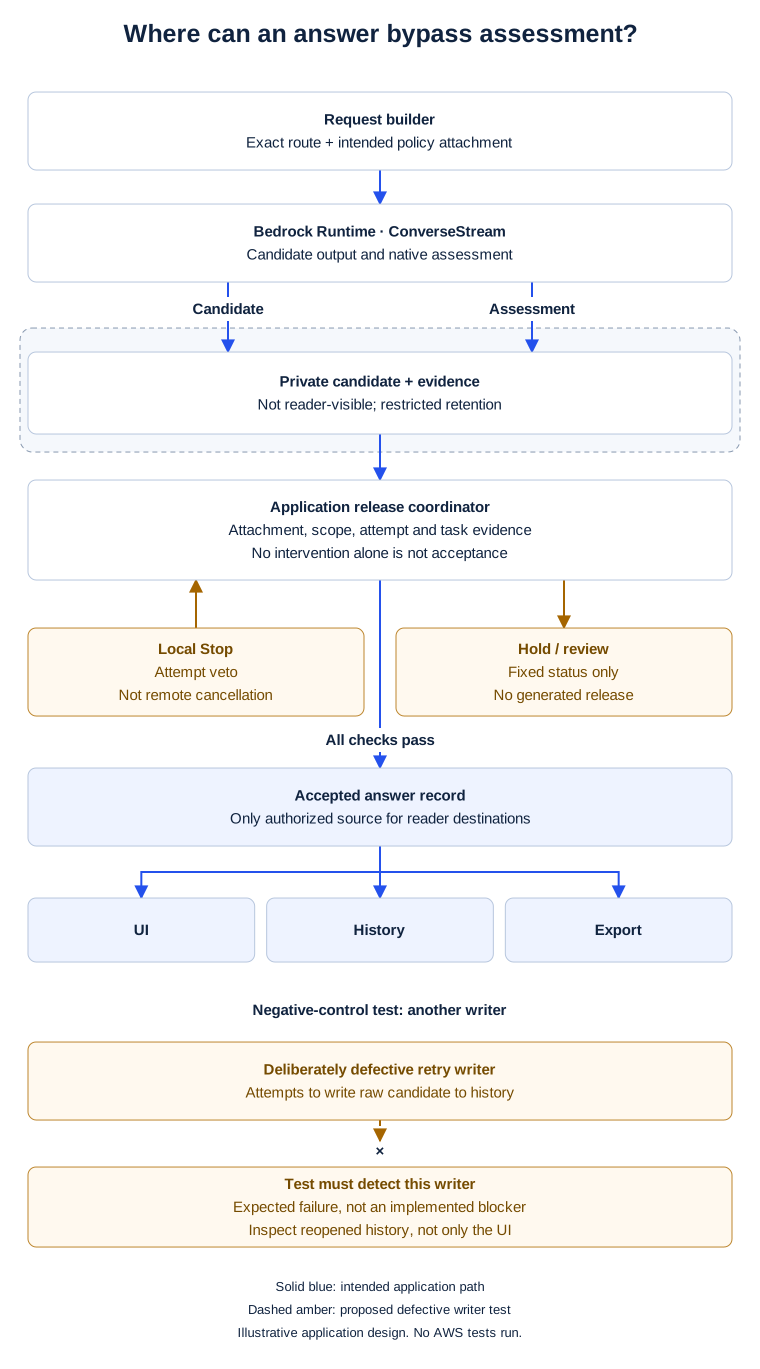
*Illustrative application-owned release boundary, not an AWS-managed coordinator or an executed test. A defective writer test must inspect the actual history destination. The separate lower panel describes the expected failure, not a deployed blocking component.*
Use a matrix that can fail for more than one reason
Keep configuration conformance separate from detector quality. The first can often be checked deterministically at the application boundary. The second needs labelled cases under the selected supported policy. A legitimate answer blocked by a sensitive-information rule and a prohibited answer missed by that rule need different review, not one “guardrail success rate.”
| Proposed case | Required application outcome | Evidence to inspect |
|---|---|---|
| Correct attachment, supported answer, active attempt | Eligible only after every required task check | Exact request identity, assessment and accepted destination records |
| Missing attachment on retry | Hold generated answer | Retry request and absence from all answer destinations |
| Wrong policy version | Hold and identify configuration mismatch | Intended release version and actual request/assessment identity |
| Selected field does not match intended assessed input | Hold scope acceptance or reject the configuration | Serialized field map and policy-specific evidence |
| Guardrail intervention | Apply the agreed blocked-answer disposition | Native intervention signal and user-visible fixed status |
| No intervention, unsupported approval claim | Reject the task answer | Domain evidence check, not an invented detector failure |
| Legitimate security discussion rejected | Review false rejection without automatic bypass | Labelled legitimate input, selected policy and reviewed fallback |
| Assessment unavailable, incomplete or unsupported | Hold this protected answer class | Native error, retry budget and no accepted output |
| Local Stop followed by late normal result | Preserve Stop veto | Attempt identity and destination readback |
| Background callback or export bypasses release coordinator | Fail the release test | Writer trace and observed destination content |
- Correct attachment, supported answer, active attempt
- Required application outcome: Eligible only after every required task check
- Evidence to inspect: Exact request identity, assessment and accepted destination records
- Missing attachment on retry
- Required application outcome: Hold generated answer
- Evidence to inspect: Retry request and absence from all answer destinations
- Wrong policy version
- Required application outcome: Hold and identify configuration mismatch
- Evidence to inspect: Intended release version and actual request/assessment identity
- Selected field does not match intended assessed input
- Required application outcome: Hold scope acceptance or reject the configuration
- Evidence to inspect: Serialized field map and policy-specific evidence
- Guardrail intervention
- Required application outcome: Apply the agreed blocked-answer disposition
- Evidence to inspect: Native intervention signal and user-visible fixed status
- No intervention, unsupported approval claim
- Required application outcome: Reject the task answer
- Evidence to inspect: Domain evidence check, not an invented detector failure
- Legitimate security discussion rejected
- Required application outcome: Review false rejection without automatic bypass
- Evidence to inspect: Labelled legitimate input, selected policy and reviewed fallback
- Assessment unavailable, incomplete or unsupported
- Required application outcome: Hold this protected answer class
- Evidence to inspect: Native error, retry budget and no accepted output
- Local Stop followed by late normal result
- Required application outcome: Preserve Stop veto
- Evidence to inspect: Attempt identity and destination readback
- Background callback or export bypasses release coordinator
- Required application outcome: Fail the release test
- Evidence to inspect: Writer trace and observed destination content
For sensitive-information evaluation, use synthetic permitted representations rather than customer secrets. Decide beforehand whether a case should block, mask, ask for clarification or proceed to review. A masking result needs validation of the replacement actually released; the application must not publish the original buffer by mistake. Detector variation and false positives remain possible. The AWS overview explicitly describes probabilistic sensitive-information detection and excludes reasoning content blocks from the stated content filtering scope. Guardrails overview.
Test legitimate cases near the policy boundary, including discussion of a restricted topic by a permitted security reviewer. Include spelling, language and formatting variations only when the product serves them and an accountable reviewer can label them. Count prohibited cases, legitimate cases and incomplete assessments separately. Missing observations are unknown, not zero failures. A tiny fixture pack is useful to expose a bypass; it cannot estimate a production detection rate.
Stop and recover without quietly dropping the required check
The proposed support feature holds generated answers when a required assessment fails, its evidence is missing or the route is unsupported. It can show an application-owned explanation and offer the existing human-support path. That is a scoped consequence decision. It does not require every unrelated public FAQ feature to become unavailable.
Give operators a control that stops release and a separate control for stopping new generation. Previously queued jobs, late stream events and history writers must honor the release stop. A local stop does not prove remote inference ended, reverse charges or recall content already delivered. Retain minimal restricted incident evidence and investigate any earlier release under the organization's process.
Recovery begins by identifying which route changed: deployment configuration, policy version, selected-field mapping, endpoint, callback or delivery writer. Restore a known compatible configuration only if its approvals and data boundaries still apply. Replay the bypass and legitimate cases through that corrected application path. Do not restore service merely because the console test returns an expected refusal.
An operator may need a bounded retry when an assessment dependency is temporarily unavailable. Set its attempts, deadline and ownership before release, and give each new model attempt a distinct identity. Old assessment results cannot authorize new content. Do not change to an unguarded fallback after the retry budget expires. A fallback model must have an independently accepted control route or remain held.
Next action: prepare a route record the next engineer can inspect
Use one route record per independently released answer class. The companion worksheet separates request identity, assessment scope and delivery observations. Fill unknown fields explicitly; do not use a checkbox labelled “protected” to collapse them.
| Record field | Required entry |
|---|---|
| Answer contract | Reader, permitted sources, intended output and excluded actions |
| Route identity | Client revision, API, endpoint, model/profile, Region and operating mode |
| Policy attachment | Actual guardrail identifier/version and configuration provenance |
| Scope map | Fields submitted, selected blocks, policy-specific exclusions and unresolved behavior |
| Release decision | Required assessment evidence, task checks, Stop veto and destination writer |
| Test identity | Fixture version, expected decision, actual native observation and readback |
| Outage behavior | Hold/status/review path, retry limits and accountable operator |
| Reopening gate | Corrected route identity, passed bypass tests and residual limitations |
- Answer contract
- Required entry: Reader, permitted sources, intended output and excluded actions
- Route identity
- Required entry: Client revision, API, endpoint, model/profile, Region and operating mode
- Policy attachment
- Required entry: Actual guardrail identifier/version and configuration provenance
- Scope map
- Required entry: Fields submitted, selected blocks, policy-specific exclusions and unresolved behavior
- Release decision
- Required entry: Required assessment evidence, task checks, Stop veto and destination writer
- Test identity
- Required entry: Fixture version, expected decision, actual native observation and readback
- Outage behavior
- Required entry: Hold/status/review path, retry limits and accountable operator
- Reopening gate
- Required entry: Corrected route identity, passed bypass tests and residual limitations
Restrict assessment traces because they may include matched sensitive text or source content. Link evidence through an authorized store rather than copying payloads into unrestricted analytics or the website's enquiry form. Review which records are retained, who can inspect them and how long they remain necessary.
The integration owner and risk owner should inspect both the accepted-answer path and one intentionally defective route before signing their own release record. No signature is supplied by this guide. An independent reviewer needs the deployed writer observations, not the author's expected matrix alone. Reopen the review when a model, API, policy, field map, streaming mode or answer destination changes.
Start with one deployed answer and one bypass that the release coordinator must reject. Once that evidence is inspectable, expand coverage to the next materially different route. This makes the review actionable without pretending that one policy screen, one successful refusal or one diagram establishes protection everywhere.
Take the route worksheet with you
Download the route worksheet ZIP. No email is required. It contains editable blank records, the fictional route and ten proposed cases. Native observations remain unknown; the ZIP is not a PDF report or an executed test harness. Keep sensitive evidence in your restricted store, not in a shared worksheet.
Related services
Amazon Bedrock Consulting and Implementation
Build and evaluate Amazon Bedrock applications with scoped data access, RAG, agent controls, cost evidence, release gates and an operational handover.
Cloud Security Architecture Consulting
Cloud security architecture consulting for AWS and GCP. Review IAM, network boundaries and compliance requirements, then implement agreed security controls.